Kasprowy Wierch Cable Car: The Complete Guide
How do you get to Kasprowy Wierch by cable car?
The PKL cable car leaves from Kuźnice (1,000 m) and takes about 20 minutes with a cabin change at Myślenickie Turnie, arriving at the summit station (1,959 m, the ridge itself reaches 1,987 m). Tickets are dated and timed, sold online up to two hours ahead, and sell out on fine days — never plan to just show up.
What the ride to Kasprowy Wierch actually involves
Of everything in the Tatra National Park, the cable car to Kasprowy Wierch is the one piece of high-mountain Poland that does not require hiking boots, a full day, or a fit body. It lifts you from the valley floor at Kuźnice, just above Zakopane, straight onto a genuine 1,987 m alpine ridge in about twenty minutes.
That is also exactly why it needs planning rather than turning up: the system that runs it, PKL (Polskie Koleje Linowe), sells a fixed number of dated, timed seats per day, and on a clear morning in July or during the February school holidays, those seats are gone before most visitors have finished breakfast. This guide covers how the ride works end to end — getting to the base station, the two-cabin journey, ticket booking, prices for 2026, when the line shuts down, and what to do once you are standing at the top.
Getting to Kuźnice, the base station
Kuźnice sits at about 1,000 m, roughly two kilometres south of central Zakopane, and it is closed to private cars. There are three practical ways in: walk from town, which takes 30 to 40 minutes along a pleasant road past the ski jump; take one of the frequent minibuses that run from the bus station area and Kościuszki street; or drive to the Rondo Kuźnickie car park and walk the last stretch. There is no way to drive, taxi, or bus directly up to the cable car doors. Arrive with time to spare before your booked slot — the base station has a ticket check, a security screening for avalanche transceivers in winter, and can have its own queue even once you already hold a ticket.
From Kuźnice you can also see the other route up the same mountain: the long summer and winter hiking trail via Myślenickie Turnie and Boczań, which the cable car simply flies over in a few minutes. Most visitors ride up and either ride straight back down or continue on foot from the top; walking up and riding down, or the reverse, are both allowed and both common.
The ride: 20 minutes, one change of cabin
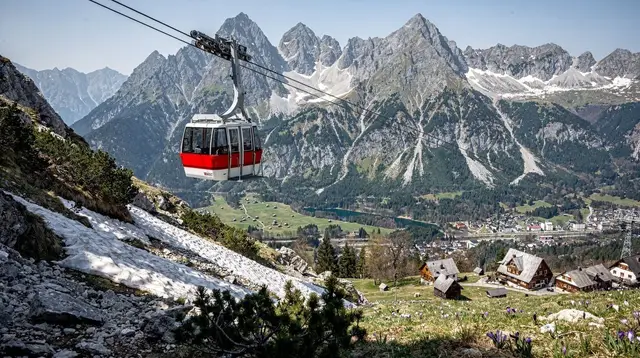
The Kasprowy Wierch line is built in two sections rather than one continuous run. The lower section climbs from Kuźnice to the intermediate station at Myślenickie Turnie, where passengers step out of one cabin and into another for the upper section, which continues to the summit station at 1,959 m. The change adds a few minutes of walking and waiting inside the station rather than a separate ticket or queue, and the whole journey — both sections and the change combined — takes about 20 minutes under normal conditions.
The view through the change is worth watching for: the lower section rises through spruce forest and past the Kalatówki meadow, while the upper section leaves the treeline behind almost immediately, crossing bare scree and snow patches that can persist into July. On a clear day the cabin windows give a preview of the ridge walk toward Giewont long before you reach the top.
Best time to ride: morning light against afternoon crowds
The cable car runs on a fairly predictable daily rhythm, and it pays to work with it rather than against it. Cloud tends to build over the ridge through the morning and early afternoon, especially between May and September, so the clearest views from 1,987 m usually belong to whoever rides the first or second departure of the day. By early-to-mid afternoon on a fine summer day the summit station itself gets genuinely crowded, since holders of morning and midday slots are still up there taking photos of the panorama while afternoon-slot visitors arrive to join them, and the walk to the summit marker can briefly turn into a queue rather than a stroll.
Weekends, Polish public holidays, and any day during the winter school holidays add a second layer of crowding at the base station itself: expect a line at the ticket check and security screening even with a confirmed booking, since everyone with a slot in the same half-hour window arrives at roughly the same time. Arriving 15 to 20 minutes before your departure window, rather than exactly on time, absorbs that wait without risking a missed cabin. Weekday mornings outside the main summer and winter peaks are consistently the quietest option, with short or no queues at either end.
Cabin capacity: bigger cabins in winter, smaller in summer
The upper-section cabins are not the same size year-round. In winter they carry around 60 passengers, reflecting both the heavier ski-season demand and different loading conditions; in summer, when the cabin design and balance shift, capacity drops to around 32 passengers. This seasonal difference is worth knowing because it changes how fast a given day’s ticket allocation fills up — a summer day with smaller cabins reaches its sold-out point sooner than the same crowd would in winter.
Tickets: dated, timed, and often gone by midday
This is the detail that trips up more visitors than anything else about Kasprowy Wierch. Tickets are not simply “a ticket for today” — each one is sold for a specific date and a specific departure window, and PKL’s online system typically opens sales up to two hours before the slot itself, alongside advance sales for later dates. On a fine summer weekend, a sunny stretch during the winter school holidays, or any day the halny wind has just stopped blowing, the day’s slots can be fully booked by mid-morning. There is no reliable way to simply arrive at Kuźnice and expect to ride within the hour.
The practical response is to book online a day or more ahead whenever the cable car is a fixed point of your itinerary rather than a “if we get there” extra. If you are combining the ride with other things to do around a bundled cable car ticket that also handles the return transfer from Zakopane, that kind of package removes the booking pressure entirely, since the ticket and the transport slot are set in advance together.
Ticket prices, 2026
| Season | Ticket type | Approximate price (return) |
|---|---|---|
| High season (summer, winter peak) | Standard, online | 99–165 PLN |
| Low season | Standard, online | around 129 PLN |
| Any season | Express / faster departure, where offered | above standard price |
| Under 7 | Free (subject to national park entry rules) | — |
Prices move with demand and are set by PKL rather than by any fixed calendar, so treat these as a planning range rather than a quote. A one-way ticket is usually available for a lower price than the return, useful if you plan to walk down via Hala Gąsienicowa rather than ride both ways. Note that the cable car ticket is separate from the Tatra National Park entry ticket, which you still need if you walk any of the surrounding trails.
When the cable car does not run
Two things stop the Kasprowy Wierch line, and neither is rare enough to ignore when planning a tight schedule. The first is scheduled maintenance: the line typically closes for a stretch in late October and early November, and again for part of spring, both outside the main tourist seasons but worth checking if your trip falls near either window. The second is wind. The upper section runs along an exposed ridge, and cable cars of this kind have hard technical limits on the wind speeds they can operate in safely.
A day that looks calm and clear in Zakopane town can still be too windy 1,000 metres higher, and PKL will suspend the upper section, the lower section, or both without much notice. If Kasprowy Wierch is the single reason for your visit to the Tatras, build in a spare day or a backup plan such as the Gubałówka funicular, which sits lower and tolerates more wind.
At the top: 1,959 m station, 1,987 m summit
Stepping out of the summit station puts you at 1,959 m, already well above the treeline and usually well above any cloud sitting in the valleys below. The true summit of Kasprowy Wierch, at 1,987 m, is a short and easy walk from the station — a few minutes on a wide gravel path, no scrambling involved — past the meteorological and astronomical observatory that has operated on the summit since the 1930s. From there, on a clear day, the view runs along the entire main ridge of the High Tatras to the east and across to the gentler Western Tatras, with Slovakia’s own peaks, including the Slovak Tatras around Štrbské Pleso, visible to the south.
This is also, for many visitors, the easiest point in the whole park to grasp why the Tatra National Park rules exist: the terrain above 1,900 m is genuinely alpine, with thin soil, slow-growing plants, and weather that changes fast. Stay on the marked paths even for the short walk to the summit marker.
What can disappoint at the top
Not every booked ticket buys a view. Because the summit station sits almost a kilometre above Zakopane, cloud can sit on the ridge on a day that looks completely clear from Krupówki, and there is no refund for a summit spent inside fog rather than looking at a panorama. The station building itself is functional rather than scenic: a ticket hall, a small buffet serving hot drinks, soup, and simple snacks, and indoor seating that works better as a windbreak than as a proper meal stop. On a packed midsummer day, both the buffet and the viewing terraces fill up quickly, and the short gravel path to the actual summit marker can feel more like a shuffling queue than a mountain walk.
The route itself asks little of the body — flat station floors, a paved approach at Kuźnice, and a gentle gravel path from the summit station to the highest point — but it is not step-free throughout, and the base station’s queuing area and ticket barriers involve some standing and shuffling that can be hard going for visitors with limited mobility. Travellers riding up specifically for the view should budget for the real chance of arriving to cloud rather than sunshine, and treat a clear panorama as a bonus rather than a guarantee.
From the summit: two ways onward
Riding back down is the default, and for a half-day visit it is the sensible choice. But the summit station is also a junction for two very different onward routes, both for hikers only — neither is a walk you should start without checking the forecast and your own fitness first.
Toward Kopa Kondracka and Giewont. A marked ridge trail heads east from the summit, crossing Kopa Kondracka and continuing toward Giewont, Zakopane’s chained “Sleeping Knight” summit. This is a long, exposed, full-day undertaking for experienced hikers, not a stroll to fit around a return cable car ticket, and it should never be attempted with a storm building — Giewont’s ridge has a documented history of lightning strikes.
Down to Hala Gąsienicowa. The gentler option descends northeast from the summit area into the Hala Gąsienicowa basin, home to the Murowaniec mountain hut and a network of easier trails back toward Kuźnice or out via Palenica Białczańska. This route suits hikers who want to combine the cable car ride up with a proper walk down rather than a second round trip in the cabin.
Either way, a Tatra National Park entry ticket is required the moment you leave the summit station on foot, separately from the cable car fare.
Kasprowy Wierch in winter: the only high-mountain skiing in the Tatras
From roughly December to April, Kasprowy Wierch switches role from viewpoint to Poland’s only true high-mountain ski area, with about 973 m of vertical drop and marked off-piste routes for strong skiers, on top of everything described above for the standard sightseeing ride. Skiers and boarders use the same cable car, which is one more reason winter tickets can sell out fast on a bluebird powder day — see the dedicated Kasprowy Wierch skiing guide for lift details, and how it compares to Zakopane’s other ski areas if you are choosing between them.
Practical tips
- Book for a specific morning slot if you can. Cloud tends to build over the ridge as the day goes on, especially in summer, so an early departure gives better odds of a clear panorama at the top.
- Dress for altitude, not for Zakopane. Temperatures at 1,987 m run noticeably colder and windier than the valley floor in any season, and snow patches can linger into summer near the summit station.
- Carry your park ticket if you plan to walk anywhere from the top. The cable car ticket covers the ride only; stepping onto any trail, even the short summit path, falls under the same entry ticket rules as the rest of Tatra National Park.
- Have a fallback for wind days. If the forecast shows strong wind, consider swapping the day’s plan toward Gubałówka or a valley walk, and moving Kasprowy Wierch to a calmer day later in your trip.
- Combine it rather than treat it as standalone. Many visitors pair the cable car with the ski jump and Gubałówka in one outing via a combined day covering the ski jump, Kasprowy Wierch and the Gubałówka funicular, which spreads the cost of transfers and avoids planning three separate visits to three separate ticket systems.
None of this replaces checking PKL’s own live status page before you set out — wind closures and sold-out slots change hour by hour, and no guide can promise you a ride that a gust of wind can cancel in minutes. For a one- or two-day Zakopane itinerary, treat Kasprowy Wierch as the single fixed morning appointment you build the rest of the day around, not as something to slot in whenever there happens to be time.
Kasprowy Wierch cable car: frequently asked questions
Is there food or shelter at the summit station?
There is a small buffet inside the summit building selling hot drinks, soup, and simple snacks, plus indoor seating that doubles as shelter from wind and cold. It is not a full restaurant and fills up fast on busy days, so treat it as a warm-up stop rather than a meal plan — eat properly in Kuźnice or back in Zakopane instead.
Why is the summit sometimes in cloud when Zakopane looks clear?
The summit station sits nearly a kilometre higher than the town, and cloud often forms or lingers on the exposed ridge on days that look perfectly clear from Krupówki below. There is no way to guarantee a view from the valley floor, so checking a mountain-specific forecast before booking a slot is the closest thing to a guarantee, and a clear panorama is worth treating as a bonus rather than an assumption.
Cable car tickets
Verified deep-linked GetYourGuide tours. Book through these links and we earn a small commission at no cost to you.
GetYourGuide does not provide a product photo for this activity — the image shows the meeting point, photographed by us.