Most people arrive in Zakopane expecting a small alpine city, something to wander for two or three days the way you would wander Kraków or Ljubljana. It is not that. Zakopane, at 830 to about 1,000 m, is a town of roughly 27,000 residents that sits between the Podhale plain and the wall of the Tatras, and its entire built-up centre can be summed up honestly: one pedestrian street, a cluster of wooden villas, two small museums, a cemetery, a ski jump, and the two stations where cable cars and funiculars leave for the mountains.
That is not a criticism. It is the point. Zakopane earns its “winter capital of Poland” nickname from what surrounds it, not from an urban core built for browsing. This page covers what the town itself, on its own, actually offers — and is honest about where that runs out.
A gateway town, not a city to explore for days
Treat Zakopane the way you would treat a trailhead village with a good dinner scene, not a destination city. The town has no old town square, no district beyond Krupówki and its immediate side streets, and no skyline beyond wooden gables and the Tatras behind them. What it does have is real: the best-preserved concentration of Zakopane-style wooden architecture anywhere, a genuinely lively evening street, and the two access points, Gubałówka and Kuźnice, that get you into the mountains without a car.
Budget your visit accordingly. A first Zakopane trip usually runs three to five days, and only a fraction of that time is spent in the town itself — an evening on arrival, perhaps a rained-out morning, and a last stroll before heading back to Kraków. The rest goes to Morskie Oko, Kasprowy Wierch, and the valleys. If a guide or itinerary promises “two days exploring charming Zakopane,” treat that as an overstatement: the town walk itself is a half-day at most.
Krupówki, the one street that is the town
Krupówki is Zakopane’s spine: about 1.1 km of pedestrianised street running from the old church at the southern end up toward the base of the Gubałówka funicular. Walking it end to end takes 15 to 20 minutes without stopping, but almost nobody walks it without stopping — oscypek stalls grilling smoked sheep cheese to order, souvenir shops selling parzenica-embroidered goods and kierpce moccasins, horse-drawn carriages for hire, and in the evening, restaurants with live highlander bands and a bonfire out front.
This is where most visitors form their opinion of the town, for better or worse: it can feel like a genuine mountain evening out, or like a fully touristed strip, depending on the season and the hour. Arriving before the evening crowds, or coming back after 9pm when the day-trip buses have left, changes the experience considerably — a point covered in more detail in the half-day Krupówki walk guide. Whatever the mood, this single street carries almost all of the town’s shops, restaurants and street life; everything else in Zakopane sits just off it or a short walk away.
The Zakopane style, wooden villas and the Tatra Museum
The one thing Zakopane offers that nowhere else in Poland does at this scale is the Zakopane style of architecture: steep-roofed wooden villas with carved eaves, folk motifs and log construction, created by the painter and architect Stanisław Witkiewicz in the 1890s out of local Goral highlander carpentry. It began with Villa Koliba, built 1892-1894, now the Museum of the Zakopane Style and the clearest single stop for understanding the look that shaped the whole town. A short walk away, Villa Atma was home to the composer Karol Szymanowski from 1930 to 1935 and now holds a museum devoted to him.
The Tatra Museum, founded in 1888, is the town’s oldest cultural institution and covers the natural history and Goral culture of the region in one building on Krupówki itself — a sensible stop if time only allows one museum. For a fuller sense of the Zakopane style and why it still defines the town’s look more than a century later, the dedicated guide covers the villas worth seeking out beyond the two best-known ones, including the Jaszczurówka chapel built 1904-1907.
None of this requires more than a morning. The museums are small by international standards, and the villas are best appreciated from the street rather than as a checklist of interiors to enter one by one.
Pęksowy Brzyzek and the old wooden church
At the southern end of Krupówki stands Zakopane’s old wooden parish church, with the Pęksowy Brzyzek cemetery beside it — the resting place of many of the town’s defining figures, including Witkiewicz himself and members of the TOPR mountain rescue service, marked with wooden and metal grave crosses carved in local folk style. It is a quiet counterpoint to Krupówki’s noise, a 10-minute walk from the busiest part of the street, and worth the detour even for visitors who otherwise skip churches and cemeteries on holiday: the ironwork and woodwork on the graves are, in miniature, the same craft tradition that built the villas.
This is not on the UNESCO list of wooden churches of southern Małopolska — that honour belongs to churches such as the one at Dębno, near Nowy Targ — but it is the town’s own piece of that same building tradition, and the most atmospheric quarter-hour Zakopane offers away from the shops.
Wielka Krokiew, the ski jump you visit but do not use
Wielka Krokiew, the large ski jump on the southwestern edge of town, opened on 22 March 1925 and has hosted major competitions ever since, including an FIS World Cup meet every January — the 2026 edition runs 10-11 January. Visitors climb to the top of the profile for the view back over the town and out toward Gubałówka; a small number of installations, including a summer zip line, add to the visit in the warmer months.
Be clear about what this is: a working competition venue, not a public activity. The full guide to Wielka Krokiew covers opening hours and what to expect on a competition weekend, when the town fills up and hotel prices rise. It pairs well with a visit to Gubałówka, since the ski jump sits between the town centre and the funicular’s base station.
Two ways up from Zakopane: Gubałówka funicular and Kuźnice cable-car base
Zakopane town has two departure points into the hills above it, and they serve different purposes. The Gubałówka funicular, at the top end of Krupówki, takes 3 to 4 minutes to climb 300 m to 1,126 m, where a ridge-top panorama of the entire Tatra chain opens up, along with souvenir stalls and, in summer, a toboggan run. It is a low-effort, high-payoff outing that fits easily into an afternoon and needs no hiking gear. For the fuller picture of what the top station and the ridge walk toward Butorowy Wierch offer, see the Gubałówka guide.
Kuźnice is a different kind of departure point entirely: the base station for the cable car to Kasprowy Wierch at 1,987 m, the only genuinely high-mountain lift access in the Polish Tatras. Kuźnice is closed to private cars, so getting there means a 30 to 40-minute walk from the centre, a minibus, or parking at Rondo Kuźnickie. From the top station, ridge routes continue toward Kopa Kondracka and Giewont, well beyond what counts as a town visit — the Kasprowy Wierch cable car guide covers ticket timing, since slots are dated and sell out on clear days.
| Departure point | From centre | Climbs to | Trip up | What’s at the top |
|---|---|---|---|---|
| Gubałówka funicular | Top of Krupówki, in town | 1,126 m | 3-4 minutes | Panorama, stalls, ridge walk, summer toboggan |
| Kuźnice cable-car base | 30-40 min walk, or minibus | 1,987 m (Kasprowy Wierch) | About 20 min with a change | High-mountain ridge routes, off-piste skiing in winter |
For visitors who want a taste of height without committing to a hiking day, the rope park above Gubałówka is a straightforward add-on to the funicular trip:
a rope park session on the ridge above Gubałówka, which turns the funicular ride into a half-day out rather than a quick there-and-back. A combined outing that pairs both the ski jump and the funicular in one booking is also worth considering: a guided visit covering the Wielka Krokiew ski jump and the Gubałówka funicular together.
What Zakopane is not
Set expectations before arriving, because the mismatch is the single most common disappointment reported by first-time visitors. Zakopane is not a city with museums and neighbourhoods to fill several days; it is not on the sea and has no beach, boat trip or island; it is not a high-alpine resort with lift-served skiing spreading across the whole area — only Kasprowy Wierch reaches serious altitude, the other local hills such as Nosal and Szymoszkowa are small and gentle; and it is not cheap during the Christmas-New Year and February school-holiday weeks, when prices in town match Western Europe.
It is also not the place to improvise a summer morning at Morskie Oko or on the Kasprowy cable car without checking tickets first, since both require advance booking in season, a point covered in the ticket-booking guide.
What the town is, honestly, is a well-placed, characterful base: good wooden architecture, a lively main street, easy access to two very different lift systems, and a short drive or minibus ride from everything else covered on this site.
Getting to Zakopane and getting around once you’re here
There is no airport in Zakopane. Most visitors fly into Kraków (KRK) and travel on by bus or car; the full comparison of bus, train and car from Kraków covers timing and cost, but as a baseline, buses run all day and take roughly 2 to 2.5 hours over about 110 km, while driving the single road, the Zakopianka, can double in time on Friday evenings, Sunday afternoons and snowy weekends — details worth reading before driving yourself.
Inside town, walking covers everything on Krupówki and the church quarter. For the trailheads beyond — Kuźnice, Kiry for the Kościeliska valley, Palenica Białczańska for Morskie Oko — private minibuses leave regularly from the bus station area and Kościuszki street, and no rental car is needed for a normal stay. A day trip that packages the funicular into a wider look at the town and thermal baths is a reasonable way to see several fixed points in one outing:
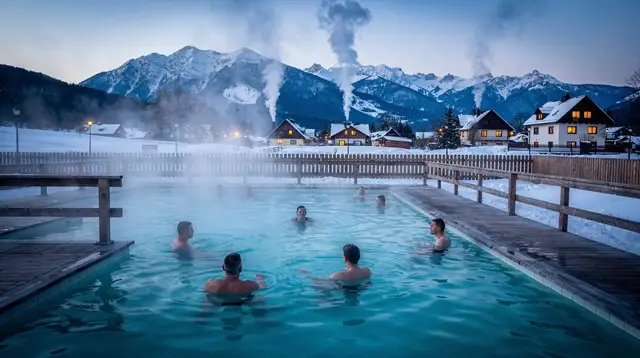
a day trip combining Zakopane’s thermal baths with the cable car covers ground that would otherwise take separate half-days.
For winter or shoulder-season visitors who want to get out of the town centre onto snow-covered tracks without a full mountain hike, guided motorised options run from the edge of town:
a buggy, quad or snowmobile tour through the valleys around Zakopane, or, combined with warm water afterward, a snowmobile and sleigh ride finishing at the thermal pools.
A realistic half-day in town
For visitors squeezing the town in around mountain days, this is roughly what a compact, unhurried visit looks like:
| Time | Stop | Note |
|---|---|---|
| Morning | Tatra Museum or Villa Koliba | Pick one; both are small |
| Late morning | Pęksowy Brzyzek and the old church | 10-minute walk from Krupówki |
| Midday | Walk the length of Krupówki | 1.1 km, browse the stalls |
| Afternoon | Gubałówka funicular | 3-4 minutes up, panorama at the top |
| Early evening | Wielka Krokiew | Short detour on the way back |
| Evening | Dinner on or near Krupówki | Look for live highlander music |
That sequence covers essentially everything the town offers in isolation, with room to spare for a coffee break. It is deliberately not a two-day plan, because a two-day plan for the town alone does not exist without padding it with more mountain excursions instead.
Where to eat, where to stay, how long to stay
Zakopane’s food identity is Podhale food: oscypek, the smoked sheep cheese made only from May to September under PDO rules, grilled and served with cranberry sauce; kwaśnica, a sour cabbage soup with smoked meat; and moskole, potato flatbreads, alongside pierogi and grilled trout.
Krupówki has the highest density of restaurants, and also the highest density of tourist-priced ones — the where-to-eat guide and the broader list of common Zakopane mistakes are worth a look before choosing where to sit down, and the oscypek guide explains how to tell the real, seasonal cheese from the year-round cow’s-milk gołka sold as a substitute in winter.
For accommodation, staying directly in town near Krupówki maximises evening atmosphere and walkability but sits furthest from some trailheads; options in Kościelisko or Poronin trade a short commute for quiet. The where-to-stay comparison breaks this down by trailhead access, and the budget guide covers what a day in town versus a day in the mountains actually costs in złoty.
Most first-time visitors settle on three to five nights total, structured around one arrival evening in town, several mountain days, and a final relaxed morning before heading back to Kraków — a rhythm laid out fully in the weekend and multi-day itineraries.
If an evening of live Goral music, a bonfire and grilled food is part of the plan, it is worth booking rather than hoping to wander into a good one — the highlander evening guide explains how these feasts are typically organised and where the more genuine ones happen versus the largest tourist-bus venues.
Questions about visiting Zakopane town itself
Is Zakopane worth visiting for more than a day, on its own?
Not really, on its own. The town itself, Krupówki, the wooden villas and the museums, fills half a day to a full day. What justifies staying longer is the Tatras around it, not the town, so plan the extra days as mountain days, not as more time on Krupówki.
Is Zakopane a city or a village?
Neither, exactly: it is a small town of about 27,000 residents with one main pedestrian street. It carries the informal title of winter capital of Poland, but there is no old town, no urban centre to wander for days, and no district beyond Krupówki and its side streets that a visitor needs to see.
What is the Zakopane style of architecture?
It is a wooden building style created by Stanisław Witkiewicz in the 1890s out of local Goral carpentry, with steep roofs, carved timber and folk motifs. Villa Koliba, built 1892-1894, was the first house and is now the Museum of the Zakopane Style; Villa Atma, home of the composer Karol Szymanowski from 1930 to 1935, is another example.
Can you ski or jump on the Wielka Krokiew ski jump?
No. Wielka Krokiew, opened on 22 March 1925, is a competition ski jump that hosts the FIS World Cup every January, with capacity for about 40,000 spectators. Visitors walk up to view the profile and the town from the top; it is not open for public use.
How long does it take to walk the whole of Krupówki?
Krupówki is about 1.1 km end to end, a 15 to 20-minute walk without stopping. Most visitors take much longer because of the shops, oscypek stalls and street musicians, so budget an hour or two if you plan to actually browse.
What is the fastest way up from Zakopane town into the high Tatras?
The Gubałówka funicular, at the top of Krupówki, is the quickest, 3 to 4 minutes for a panoramic viewpoint at 1,126 m, but it does not reach the high mountains. For the high Tatras, the Kuźnice cable car base, reached by a 30-40 minute walk or a minibus from the centre, is the starting point for Kasprowy Wierch.
Does Zakopane have a lake or sea nearby, inside the town?
No. Zakopane is inland, with no beach and no boat trips from the town itself. The nearest lake worth mentioning, Morskie Oko, is a separate destination in the national park, reached from a car park about 25 km away, not a feature of the town.
Is one evening in Zakopane enough to get a sense of the town?
For the town alone, yes: an evening on Krupówki, dinner with live highlander music, and a short walk to the old church and Pęksowy Brzyzek covers the essentials. Add a morning at the Tatra Museum or a villa if architecture interests you, but a single evening plus a morning is realistic.