Krupówki and Zakopane Town: A Half-Day Walking Route
How do you see the centre of Zakopane in half a day?
Walk the length of Krupówki, step a few minutes off it to see the wooden villas of the Zakopane style and the old church with the Pęksowy Brzyzek cemetery, then ride the funicular up to Gubałówka for the panorama of the whole Tatra chain. The whole loop fits comfortably into a morning or an afternoon, since the town itself is a single pedestrian street of about 1.1 km plus a handful of nearby lanes.
What a Half-Day in the Centre Actually Covers
Zakopane is not a city you need days to cross. It is one pedestrian street, a scatter of wooden lanes around it, and the mountains standing behind everything. The town sits at roughly 830 to 1,000 m, and its entire walkable centre — Krupówki plus the quiet streets either side of it — can be covered on foot in the time it takes to have a long lunch elsewhere. That is not a criticism of the place; it is simply what “town” means here, and it is the reason a half-day is the right unit to plan around, not a full day.
This route strings together the parts of central Zakopane that reward walking rather than driving or taking a minibus: Krupówki itself, the wooden villas that gave the town its architectural name, the old church and its cemetery, and then a short ride up to Gubałówka for the view that explains why everyone came here in the first place. None of it needs a car, a guide, or a fixed schedule — it needs an order, which is what this page sets out.
Where to Start: The Foot of Krupówki
Krupówki runs roughly from the area near the old church at its southern end up to the base station of the Gubałówka funicular at its northern end, a length of about 1.1 km. Starting at the southern end and finishing at the funicular gives the walk a natural shape: town first, altitude second. Doing it the other way works too, but ending on the panorama rather than starting with it tends to feel like the better order, since everything below stays in view from above once you have already seen it at street level.
Before setting off, it helps to know what this street is and is not. It is the public square Zakopane never built as one: pedestrian, lined with wooden-fronted shops, grill stalls and cafés, busy from late morning into the evening in every season. It is not where the historic architecture concentrates — for that, the side streets a few minutes off it matter more, and this route visits them before Krupówki rather than instead of it.
Walking Krupówki Itself
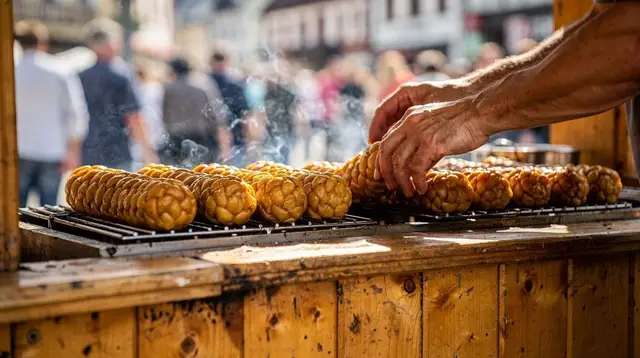
The street itself is best treated as a corridor to move along rather than a destination to linger in for hours. The grilled oscypek stands are the single most photographed thing on Krupówki, and rightly so — genuine oscypek is a seasonal, PDO-protected sheep cheese made only from May to September, and a stand grilling it with cranberry sauce is worth stopping for once. For more on telling the real thing from the winter substitute, the guide to oscypek covers what changes outside the season.
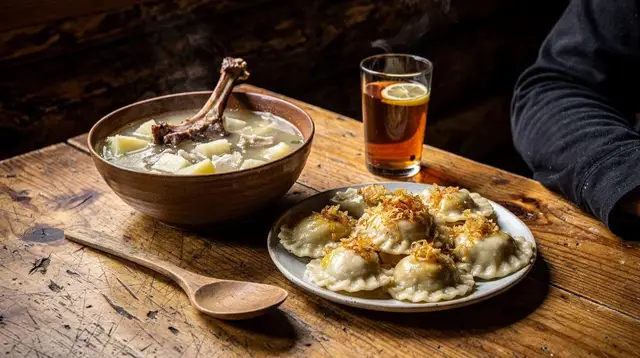
Beyond the food stalls, Krupówki carries souvenir shops, highlander wool and leather goods, amber jewellery of variable quality, and a run of bars and restaurants whose terraces fill up whenever the weather allows. It is unapologetically touristy, and readers who want the unvarnished opinion on whether that matters can find it in the companion piece Krupówki: love it or avoid it. For eating well rather than eating at the first stall reached, the guide to avoiding tourist traps and the primer on Podhale cuisine — kwaśnica, pierogi, grilled trout — are worth reading before, not during, the walk.
Side streets branch off Krupówki at intervals, most of them quieter within thirty seconds of leaving the main strip. This is where the walk earns the “town” part of its name rather than staying a shopping street the whole way through.
Off the Street: The Wooden Villas of the Zakopane Style
A few minutes’ walk from Krupówki, on the streets that climb gently toward the church, stand the wooden villas that define what is known as the Zakopane style — a building language created in the 1890s by Stanisław Witkiewicz out of local Goral carpentry, with steep shingled roofs, carved gables and covered porches. These villas are not a museum exhibit behind glass; most are still private houses or small guesthouses, seen from the street rather than entered, which is exactly why this stretch of the walk works well on any schedule and in any weather.
The full background on the style, its origins and its best-known houses is in the dedicated guide to Zakopane-style architecture, and the longer story of how this architecture came to define an entire town is told in the architecture that saved a town. For this half-day, it is enough to slow down for ten or fifteen minutes on these lanes, look at the roofs and porches rather than the shopfronts, and notice how different the pace feels one street back from Krupówki.
The Old Church and Pęksowy Brzyzek Cemetery
Continuing toward the southern end of the route, the old wooden church and the adjoining Pęksowy Brzyzek cemetery form the quietest stop on this walk. The cemetery gate is itself a piece of Zakopane-style carving, and the graves inside — many marked with carved wooden crosses rather than stone — belong to generations of Podhale highlanders, guides, and figures from the town’s cultural history. It is a small site, walked in ten to fifteen minutes, and it asks for a different register than the street outside: no stalls, no shopping, just wood, stone and names.
This is also the point on the route closest to the villas of Villa Koliba and Villa Atma, both discussed in the architecture guide above, and to the Tatra Museum, which sits nearby and is worth folding in if the walk so far has gone faster than expected — more on that below.
Back to Krupówki, Then Up to Gubałówka
From the church and cemetery, the route rejoins Krupówki and follows it north to its far end, where the base station of the Gubałówka funicular stands. This is the second half of the half-day: from street level in a wooden mountain town to a ridge with the whole Tatra chain laid out in front of it.
The funicular ride itself is short — three to four minutes, climbing about 300 m — and a return ticket runs roughly 37 to 49 PLN as of 2026. It is not a long journey, but it is the single biggest change of register on this entire walk: five minutes earlier you were on a shopping street, and now you are looking south across the full width of the range, from Giewont’s distinctive outline to the higher peaks further along the ridge. The base station area does build a queue on clear, busy afternoons, so going earlier in the day — late morning rather than after lunch — keeps the wait reasonable without needing to plan around a strict time.
Full detail on the funicular, what the ride and the top station involve, and how it compares with the alternative cable car up Kasprowy Wierch is covered in the dedicated Gubałówka funicular guide and the Gubałówka destination page.
What You See and Do at the Top
Gubałówka’s summit ridge is built for exactly this kind of half-day visit: a viewing terrace facing the Tatras, a run of souvenir stalls distinct from those on Krupówki below, a summer toboggan run, and — in season — stands selling grilled oscypek again, this time with the mountains as a backdrop instead of a shop window. None of it needs more than an hour, and the walk along the ridge toward Butorowy Wierch is there for anyone who wants to extend the stop by another twenty or thirty minutes rather than turn straight back to the funicular.
For a guided version of this same panorama stop that folds in a tasting, the excursion behind a Gubałówka outing that pairs the ridge with an oscypek tasting and a skywalk platform covers the same ground with a structured stop built in, which suits travellers who would rather not work out queue timing themselves.
If Time Allows: The Tatra Museum
If the walk through town and up to Gubałówka has taken less than expected, the Tatra Museum — founded in 1888, close to the old church end of the route — is the natural addition. It gives context on the natural history and highlander culture of the Podhale that the villas and the cemetery only gesture at from outside. It is not built into the core route above because it needs its own hour and because opening days vary, but readers with a loose half-day rather than a tight one should treat it as the first thing to add back in, not an afterthought. The Tatra Museum, Atma and Hasior guide covers what each of the museum’s sites actually holds.
Doing This Walk With a Guide Instead
Everything above works perfectly well self-guided — none of it needs specialist knowledge, and the route is short enough that getting slightly lost costs a few minutes, not an afternoon. That said, two situations make a guided version worth considering: wanting the history and the highlander context explained on the spot rather than read afterward, and wanting a single fixed plan on a first visit rather than working one out.
For that, a private guided walk through Zakopane’s old town covers the same streets and villas with someone explaining what is being looked at, and a private town tour of Zakopane is built around the same compact centre this page describes, adjusted to whatever pace the group wants. Neither changes the shape of the route — they simply hand over the planning and the storytelling.
Travellers whose interest runs toward local history beyond the Zakopane style specifically may also want the Jewish history walking tour angle covered by a private walking tour focused on Zakopane’s Jewish history, which touches streets close to this same centre from a different angle.
Where This Half-Day Fits in a Longer Stay
On a single full day in Zakopane, this walk suits the morning, leaving the afternoon for something in the mountains proper — the one-day Kraków itinerary builds around exactly that trade-off. On a longer stay, it slots more naturally into a weekend itinerary as the lower-effort half-day between two more demanding mountain days, since nothing on this route requires hiking boots or an early start.
For newcomers still deciding how many days the destination as a whole deserves, the guide on how many days in Zakopane sets this town walk against everything else on offer, including the things to do in Zakopane overview and the broader walking tours category.
Culturally, this half-day only samples the Podhale — for readers who want the fuller picture of highlander dress, dialect and music glimpsed on Krupówki’s stalls, the Gorale culture guide and highlander evening fire and music pick up where this walk leaves off, usually in the evening rather than the same afternoon.
Frequently Asked Questions About Walking Krupówki and Central Zakopane
How long does it actually take to walk Krupówki end to end?
Krupówki is about 1.1 km. Walked without stopping it takes 15 to 20 minutes, but nobody walks it without stopping: with the stalls, the mountain-view side streets and a coffee break, allow at least an hour just for the street itself.
Do I need to book the Gubałówka funicular in advance?
Tickets are sold at the base station in town and there is no need to book online for a normal visit, but the queue lengthens on fine-weather afternoons and around midday in high season. Going earlier in the day is the simplest way to keep the wait reasonable.
Is this walk suitable for a rainy or low-cloud day?
Krupówki, the villas and the cemetery all work in poor weather since they are close together and mostly under trees or arcades. Gubałówka’s panorama depends entirely on visibility, so on a day of low cloud it is worth checking the peaks from town before riding up, or saving the funicular for a clearer moment.
Can small children or a pushchair manage this route?
Krupówki is flat, paved and pedestrian, and the funicular cabin takes pushchairs without any awkwardness. The only uneven ground on this particular walk is the short stretch of gently sloping lanes around the old church, which stays manageable.
Is the Tatra Museum worth adding to this half-day?
If the walk has gone quickly and an hour is left, yes: it sits close to the route and gives context on the Tatras and the Zakopane style seen minutes earlier on the villas. If time is already tight, it is better kept for a separate visit than rushed.
Where does this half-day fit if I only have one full day in Zakopane?
On a single day, this town walk usually takes the morning or the end of the afternoon, leaving the other half for something in the mountains proper, such as the Kasprowy Wierch cable car or a valley walk from Kuźnice.
Is Krupówki worth it, or is it just a tourist strip?
It is unmistakably touristy, with souvenir stalls and grilled oscypek stands the whole length, but it is also the town’s actual public space, backed by genuine Zakopane-style architecture just a street away, so the honest answer is both at once rather than either.
Zakopane walking tours
Verified deep-linked GetYourGuide tours. Book through these links and we earn a small commission at no cost to you.
GetYourGuide does not provide a product photo for this activity — the image shows the meeting point, photographed by us.