Podhale Cuisine Beyond Oscypek: Kwaśnica, Pierogi and Mountain Food
What food is Podhale known for besides oscypek?
Podhale's everyday cooking is built for a mountain climate: kwaśnica (sour cabbage soup with smoked meat), żurek (fermented rye soup), moskole (flat potato griddle cakes), pierogi, and grilled trout from local rivers. Sheep's cheeses bundz and bryndza sit alongside oscypek, and hot tea with raspberry syrup is the everyday drink alongside vodka and Polish beer.
A cuisine built for altitude, not for folklore
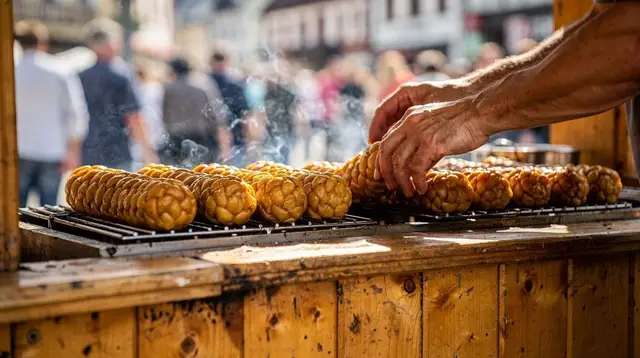
Most visitors arrive knowing one word: oscypek, the smoked sheep’s cheese sold grilled on every stall along Krupówki. It deserves the attention — there’s a full guide to oscypek on this site — but it is one dish in a much wider table, and treating it as the whole story misses the point of Podhale cooking.
This is food shaped by a specific set of conditions: a town sitting at 830 to about 1,000 m, winters that run long and hard, and a farming economy built on sheep, cabbage, potato and rye rather than the wheat and produce of the lowlands. None of that is an accident, and none of it is theatre for tourists. It is what people who work outdoors in the cold have always cooked, in Zakopane and in the villages around it, long before anyone sold it as a “highlander feast.”
The dishes below are the everyday backbone of a Podhale meal, in restaurants, mountain huts (schroniska), and home kitchens alike: two sour soups that visitors regularly confuse, a flat potato cake, pierogi, grilled trout, two sheep’s cheeses that are not oscypek, and what people actually drink with all of it.
Kwaśnica: the soup that defines the table
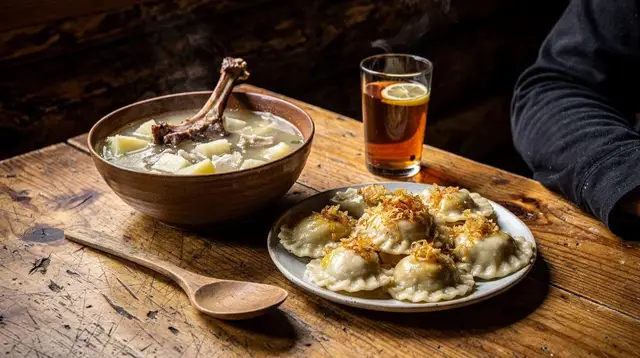
Kwaśnica is the dish most closely tied to Podhale identity, and it is built on one ingredient: fermented, soured cabbage (kapusta kiszona), simmered for hours with smoked pork ribs or bacon, potato, and usually caraway seed or bay leaf. The result is sharp, smoky, and substantial — closer to a stew than a clear soup, and served scalding hot with dark bread.
It is a winter dish by design, but you will find it year-round, because sauerkraut keeps without refrigeration and smoked meat was always a way of carrying a pig’s protein through a mountain winter. Order it in a restaurant on Krupówki, in a mountain hut after a day on the trail, or at a highlander evening feast and it will taste broadly the same: this is not a dish that varies much by kitchen, because the point was never novelty.
Żurek: the other sour soup, and how to tell them apart
Żurek gets confused with kwaśnica constantly, understandably — both are sour, both usually carry smoked meat, both are Polish soups eaten across the country and not unique to the mountains the way kwaśnica effectively is. The difference is the base. Żurek is built on fermented rye flour (a starter called zakwas), not cabbage, and it is typically finished with a boiled egg, sliced sausage, and sometimes marjoram. In tourist restaurants it is often served in a hollowed bread bowl, which is a presentation trick, not a Podhale tradition — the soup itself long predates it and is eaten across Poland, not only here.
If a menu offers both, ordering one of each with a friend is the easiest way to understand the difference: kwaśnica is cabbage and smoke, żurek is rye and tang.
Moskole: flat potato cakes off a dry griddle
Moskole are a Podhale specialty that rarely travels outside the region: grated or mashed potato formed into flat, thick cakes and cooked on a hot dry plate rather than fried in oil, which gives them a dense, slightly chewy texture closer to a griddle bread than a hash brown. They are usually split while warm and filled — butter and sugar, a savoury spread, or a smear of sheep’s cheese are all common.
You will see them sold from stalls in Zakopane and at markets in the villages, including the Thursday market in Nowy Targ, and they are a good example of Podhale cooking’s central logic: potato, a crop that actually grows at this altitude, turned into something that keeps you warm and full without much else added to it.
Pierogi in the mountains
Pierogi are not exclusive to Podhale — they are eaten across Poland — but they are a fixture here too, and the fillings lean toward what the region actually produces: potato and cheese (ruskie), sauerkraut and mushroom, or minced meat, alongside sweet versions filled with seasonal fruit. In a mountain restaurant they often turn up pan-fried with onion or bacon rather than simply boiled, which suits the colder, heartier register of the whole regional table.
They are also one of the more reliable dishes for a visitor unsure of what else to order — recognisable, filling, and available almost everywhere from Zakopane down to the villages of Bukowina Tatrzańska and Białka Tatrzańska.
Bundz and bryndza: the sheep’s cheeses next to oscypek
Oscypek gets the attention because it is smoked, shaped, and sold grilled as street food, but it is only the end point of a longer chain of sheep’s milk cheeses, and two of the others are worth knowing. Bundz is the fresh cheese: soft, mild, barely set, made from the same sheep’s milk as oscypek but eaten within days rather than smoked and aged. Bryndza is bundz that has been salted and left to mature into something spreadable and considerably sharper — closer to a strong feta than to oscypek’s firm, smoky bite.
Both show up on bread, in soups, or as a side to potatoes, and both are seasonal in the same way oscypek is: the milk exists because the sheep are out on high pasture, which in this region means roughly May to September, so the freshest versions of all three cheeses belong to summer, not to a winter visit.
Grilled trout: the other protein of a mountain river
Where oscypek is the food of the high pastures, trout is the food of the valleys. Mountain streams feeding into the Dunajec and the rivers around the Pieniny support both wild and farmed trout, and grilled whole trout — simply seasoned, sometimes with herbs, served with potato — is a standard main course wherever a restaurant sits near water. It turns up regularly around Szczawnica and the Dunajec gorge, where a raft trip or a walk along the river makes a grilled trout lunch the obvious stop afterward, and it is a useful contrast on a menu otherwise dominated by smoked pork and sheep’s cheese.
Where the food changes: mountain huts on the trail
A schronisko (mountain hut) serves food differently from a restaurant in town, and it helps to know this before arriving at somewhere like the hut below Giewont expecting a full menu. Everything a hut kitchen serves has to be carried up — by cable car where one runs nearby, otherwise on someone’s back or by horse — so the offering stays deliberately narrow: a pot of kwaśnica or barszcz kept hot through the day, bigos, a plate of pierogi, bread with lard or cheese, and cake, rather than an à la carte list.
Portions are generous and prices sit a little above town, which is fair given how far the ingredients travelled. Card payment is not guaranteed at every hut, so it is worth carrying more cash into the mountains than a day in Zakopane usually requires. This is also where kwaśnica earns its reputation rather than its novelty: after hours on a trail toward Dolina Pięciu Stawów Polskich or up to the ridge, a bowl of hot, sour, smoky soup does exactly the job it was built for long before anyone ordered it as a tourist meal.
What to drink: raspberry tea, vodka, and Polish beer
The everyday non-alcoholic drink of the region is unusual enough to be worth naming specifically: hot black tea with raspberry syrup (herbata z sokiem malinowym), sweet, red, and served in a glass rather than a cup. It is not a tourist invention — it is what gets ordered with a meal, at a market stall, or after coming down from a cold trail, and it pairs naturally with the smoke and salt of the food.
Alcohol follows the same logic of warmth and strength: Polish vodka, clear or flavoured (including versions infused with herbs or honey), and Polish beer are both standard, and both appear heavily at a highlander evening with live górale music around a fire. Tasting the range of Polish beer specifically, rather than picking one at random, is easier with a guided session — a private Polish beer tasting in Zakopane covers a spread of styles with some explanation of what makes them different.
Where each dish actually turns up
| Dish | What it is | When you’ll see it |
|---|---|---|
| Kwaśnica | Sour cabbage soup, smoked pork | Year-round, especially winter and mountain huts |
| Żurek | Fermented rye soup, egg, sausage | Year-round, across Poland, not Podhale-only |
| Moskole | Flat potato griddle cakes | Market stalls, street food, year-round |
| Pierogi | Filled dumplings, boiled or pan-fried | Year-round, almost every restaurant |
| Grilled trout | Whole river fish, simply seasoned | Near rivers: Szczawnica, Dunajec valley |
| Bundz / bryndza | Fresh / salted sheep’s cheese | Best in season, roughly May to September |
| Oscypek | Smoked, shaped sheep’s cheese | PDO season only: May to September |
What can disappoint: salt, sameness, and few vegetarian options
A few things catch visitors off guard, and it’s worth saying plainly. The food is salty and fatty by design — smoked meat, aged cheese, and long-simmered stock — which is exactly right after a day outdoors and less pleasant after a day spent mostly walking Krupówki. Vegetarian options exist (pierogi ruskie, mushroom and cabbage fillings, bryndza on bread) but a genuinely vegetarian evening feast is hard to build without asking in advance, since the everyday repertoire assumes smoked pork as a base note even in soups that don’t look meat-forward on a menu description.
And because the core dishes don’t vary much between kitchens, by design, a week of eating only kwaśnica, pierogi, and grilled oscypek starts to feel repetitive rather than adventurous — the fix is mixing in żurek, moskole, and a trout dinner near the water, rather than defaulting to the same two or three plates every night.
Tasting it without guesswork
The honest way to work through this list on a short trip is either to order deliberately — kwaśnica or żurek at lunch, pierogi and a trout dinner near the water, moskole as a market snack — or to let someone else sequence it for you. A private food tasting tour through Zakopane’s Polish traditions moves through several of these dishes in one outing, which is a faster way to taste the range than picking one restaurant and hoping the menu covers it.
For visitors who want food folded into a broader walk through town rather than a standalone tasting, a private walking tour of Zakopane can be built around stops for food along the way.
What to avoid: menus aimed squarely at coach groups on Krupówki tend to flatten all of this into interchangeable “highlander” plates at inflated prices — the guide to eating well in Zakopane covers how to spot the difference. And because this is working food rather than fine dining, it is also inexpensive relative to Western Europe; the budget guide has the wider picture on what a meal actually costs in złoty.
If a day trip from Kraków is all the time you have, building in one proper sit-down meal — rather than a grilled oscypek from a stall — is the difference between tasting Podhale food and only tasting its most photogenic cheese. For a longer stay, a two-day weekend itinerary or an evening built around a highlander feast gives this food the time it actually needs, since almost none of it is meant to be eaten in a hurry — it is built to be sat down to, in the cold, after being outside.
Podhale food FAQ: kwaśnica, pierogi and the rest
What is kwaśnica made of?
Kwaśnica is a soup built on sauerkraut (fermented cabbage) simmered with smoked pork or bacon, usually with potato and caraway or bay leaf. The sourness and the smoke are the point: it is a winter dish meant to warm and to keep.
Is żurek the same as kwaśnica?
No. Żurek is based on fermented rye flour (zakwas), not cabbage, and is often served with boiled egg and sausage, sometimes in a bread bowl. Kwaśnica is sourer and more cabbage-forward. Both are sour soups with smoked meat, which is why visitors mix them up.
What are moskole?
Moskole are flat potato griddle cakes from the Podhale region, cooked on a dry hot plate rather than fried in oil. They are usually split and filled with butter, sheep’s cheese, or a savoury spread, and sold warm at market stalls and mountain huts.
What is the difference between bundz and bryndza?
Both are sheep’s milk cheeses made from the same base as oscypek, but unsmoked. Bundz is the fresh, mild, barely set version, eaten within days of being made. Bryndza is bundz that has been salted and left to mature into a spreadable, sharper cheese.
Is trout really local to the Tatras?
Yes. Mountain streams around the Podhale and Pieniny support wild and farmed trout, and grilled trout is a common main course near the rivers, particularly around Szczawnica and the Dunajec valley, alongside the more famous grilled oscypek.
What do people drink with a Podhale meal?
Tea with raspberry syrup (herbata z sokiem malinowym) is the everyday non-alcoholic choice, hot and sweet. Polish beer and flavoured or clear vodka are standard alongside a highlander meal, especially at an evening feast with live music.
Is Podhale food very heavy?
Yes, deliberately so. Smoked meat, cabbage, potato, rye, and sheep’s cheese are calorie-dense, slow-digesting foods suited to a climate with long, cold winters and physical days outdoors — not a diet built around lightness.
What do mountain huts (schroniska) serve?
A hut kitchen works from a short, fixed list rather than a full menu, because every ingredient has to be carried up: expect kwaśnica or barszcz, bigos, pierogi, bread with cheese or lard, and cake, at prices a little higher than in town. Not every hut takes cards, so bring cash.
Is there vegetarian food in Podhale cuisine?
Some: pierogi ruskie, mushroom or cabbage fillings, and bryndza on bread are genuinely meat-free. But the everyday repertoire assumes smoked pork as a base note, including in some soups that don’t read as meat dishes, so a vegetarian evening feast usually needs asking in advance rather than assuming the menu covers it.
Food tasting tours
Verified deep-linked GetYourGuide tours. Book through these links and we earn a small commission at no cost to you.
GetYourGuide does not provide a product photo for this activity — the image shows the meeting point, photographed by us.