Rafting the Dunajec Gorge: The Complete Guide
How does rafting the Dunajec gorge work?
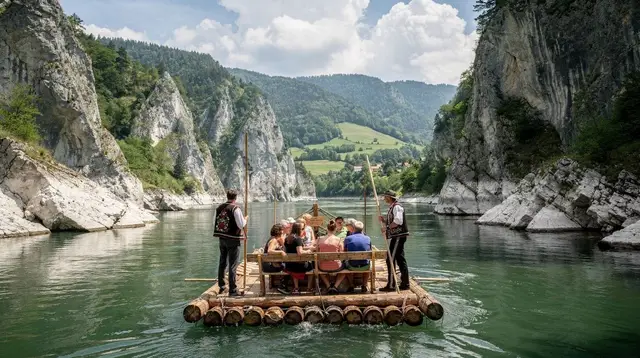
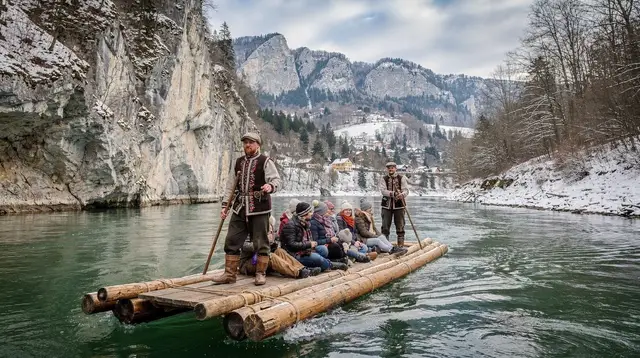
Traditional wooden rafts carry 10 to 12 passengers and are steered by two raftsmen using long poles, a craft that traces back to a raftsmen's guild founded in 1832. The route runs about 18 kilometres from Sromowce Niżne or Kąty to Szczawnica, taking roughly 2.5 hours through limestone gorges up to 300 metres high, with the river marking the Polish-Slovak border for 17 kilometres of that stretch. Rafting runs from 1 April to 31 October, with July and August the busiest weeks.
How the wooden rafts work
The rafts that carry visitors through the Dunajec gorge are not a modern tourist invention. They are flat wooden platforms, several long log sections called dubas lashed together side by side, a design that Podhale and Pieniny raftsmen have used on this stretch of river since long before rafting became a day trip. The raftsmen’s guild that still runs the tradition today was formally founded in 1832, which makes this one of the oldest continuously operating tourist activities in Poland.
A raft carries 10 to 12 passengers, seated in a row along its length, with two raftsmen working it: one at the front, one at the back. Neither uses a paddle in the way a kayaker would. Instead they push long wooden poles against the riverbed and the banks, reading the current to steer the raft through the narrower sections of the gorge, slowing it on the bends and letting it drift on the open stretches. It is a skill passed down within raftsmen families around Sromowce and the Pieniny villages, and part of what the trip sells is watching it done well rather than doing any of the work yourself. Passengers sit, look at the gorge walls, and are carried rather than paddle.
The route: Sromowce to Szczawnica
The float starts at one of two piers at the upstream end, Sromowce Niżne or Kąty, both on the edge of the Pieniny, and ends downstream at Szczawnica. Which of the two starting piers a particular raft departs from does not change the trip: both feed the same channel and the same stretch of gorge, so the scenery, the distance and the pace are identical whichever pier is used.
The whole float covers about 18 kilometres and takes roughly 2.5 hours, moving at the pace the current and the raftsmen’s poles set rather than on a fixed schedule of stops. For a guided wooden-raft cruise on the river, the appeal is entirely in that slow, low, close-to-the-water passage through the gorge: no engine noise, no schedule pressure, just the raft, the current and the limestone rising on both sides.
The scenic core of the trip is the gorge itself, where the limestone walls close in and rise to about 300 metres above the water. For roughly 17 kilometres of this stretch, the river is not only scenic, it is the international border: the Polish bank faces the Slovak bank directly across the water, part of the wider Slovak Tatras borderland that sits within easy reach of a Schengen crossing with no checks at the water’s edge. Rafters see both countries from the same seat without ever needing a passport for the float itself.
Where this sits in the Pieniny
The Dunajec gorge is the centrepiece of the Pieniny, a smaller and gentler range than the High Tatras, better known for river scenery and castle ruins than for high peaks. The Sromowce piers sit close to two landmarks that most visitors pair with the raft trip on the same day: Niedzica castle, a Polish-Hungarian border fortress built in the 1320s, and Lake Czorsztyn, the reservoir it now overlooks, with the ruins of Czorsztyn castle on the opposite shore. A guide to both castles covers what there is to see at each.
At the other end of the float, Szczawnica is a small spa town with its own draw beyond being the raft’s landing point, and the nearby summit of Trzy Korony (982 m) gives a viewing platform above a 500-metre drop over the gorge, reached by a walk that is a natural extension of a day built around the river. The hike up Trzy Korony and through the Homole gorge is the walking counterpart to the float below it. For a short, guided version of the same corner of the Pieniny on foot, a Dunajec kayaking outing with transfer from Szczawnica covers similar ground on the water instead.
When to raft: season and crowds
Rafting on the Dunajec runs from 1 April to 31 October, and only within that window, since water levels and weather outside it are not reliable enough for the guild to operate. Within the season, July and August are by far the busiest months: the piers at Sromowce Niżne, Kąty and the landing at Szczawnica all see their longest queues, and the gorge itself is at its most crowded with rafts following close behind one another.
Spring and early autumn cover the same route and the same limestone scenery with noticeably fewer people, though water levels and the exact rhythm of departures shift with the season. A closer look at how the season plays out month by month, and which weeks to avoid, is in the dedicated guide to the best season for Dunajec rafting.
Because the float is entirely weather and river dependent, it pairs naturally with flexible day planning rather than a fixed itinerary slot. The full guide to planning a Dunajec and Pieniny day trip lays out how to fit the raft, the castles and Szczawnica into one day, and the Pieniny and Dunajec 2-day itinerary spreads the same region over two, with time left for the walk up Trzy Korony as well as the float.
Raft, pontoon or kayak: the three ways down the gorge
The traditional wooden raft is not the only way to cover this stretch of the Dunajec. Two other options run the same water:
| Option | What it involves | Effort |
|---|---|---|
| Traditional wooden raft | Seated, steered entirely by two raftsmen with poles | None — passengers sit and watch |
| Pontoon (rubber raft) | Inflatable raft, typically a shared group, more active steering | Light to moderate |
| Kayak | Individual or tandem kayak, self-paddled along the same stretch | Moderate, some paddling skill useful |
All three follow the same section of river through the gorge between the Sromowce piers and Szczawnica, so the scenery on offer is the same regardless of which one is chosen; the difference is entirely in how much of the work the passenger does.
A pontoon rafting trip on the Dunajec from Zakopane suits travellers who want a more active version of the same float without paddling it entirely themselves, while independent kayakers who want to cover the gorge under their own power, with a stop at Niedzica castle and a thermal bath worked into the same day, are better served by a Dunajec kayaking day from Kraków that combines the castle and thermal baths.
Travellers based in Zakopane who want the traditional raft itself, with transport included, are the audience for a traditional Dunajec rafting excursion departing from Zakopane.
Getting there and getting back
Neither Sromowce Niżne, Kąty nor Szczawnica sit directly on the way between Zakopane and Kraków, so most visitors either join an organised trip that handles the transfer both ways, or drive themselves and arrange to be collected at the opposite end from where they parked, since the raft does not return to its starting pier. A trip that starts and ends in Szczawnica itself, without a long transfer either way, is the most compact version: a Dunajec rafting outing based in Szczawnica covers the float without building a longer day around it.
For anyone planning around Kraków rather than Zakopane, the gorge is also sold as a standalone or combined day trip from the city; the guide to a Kraków day trip that takes in the Dunajec and the wider things to do around the Dunajec gorge both lay out how the logistics work from that side. From Zakopane, minibuses and organised transport cover the route to Sromowce and back; the category page for Dunajec rafting options lists the full range of ways to book it.
What this trip is not
The raft float is not whitewater: the Dunajec here is a broad, calm river running through a gorge, not a series of rapids, and the traditional wooden raft in particular is a slow, seated passage rather than an adventure sport. It is also not a swimming stop or a picnic float — rafts keep moving along the route from the Sromowce piers to Szczawnica rather than stopping partway. And it is not run outside its season: outside 1 April to 31 October, the piers are closed and no amount of planning changes that, so any winter or early-spring visit to the Pieniny should treat the gorge as scenery to view from the bank rather than a trip to book.
Currency is worth flagging too, since the Pieniny sit close to the Slovak border: on the Polish side, including at Sromowce and Szczawnica, prices and any cash needed are in the Polish złoty, not euros — the euro only applies once a visitor actually crosses onto the Slovak side of the wider Tatra and Pieniny region.
Frequently asked questions about Dunajec river rafting
What are the traditional Dunajec rafts made of, and how many people do they carry?
The rafts are flat wooden platforms, built by lashing together several long log sections called dubas. Each raft carries 10 to 12 passengers and is steered by two raftsmen who stand at the front and back and push against the riverbed with long wooden poles rather than paddle.
Where does the Dunajec rafting route start and end?
The traditional route starts at the piers of Sromowce Niżne or Kąty, on the edge of the Pieniny, and finishes downstream at Szczawnica. Both starting piers feed the same stretch of river, so the trip length and scenery are the same whichever one a raft departs from.
How long does the raft trip take, and how far is it?
The float covers about 18 kilometres and takes roughly 2.5 hours, moving at the gentle pace set by the current and the raftsmen’s poles rather than by any engine. The gorge itself, where the limestone walls close in and rise up to about 300 metres, is the scenic heart of the descent.
Is the Dunajec really the border between Poland and Slovakia?
Yes, for part of the route. The river forms the Polish-Slovak border for about 17 kilometres of the gorge section, so for a stretch of the float the Polish bank of the Pieniny faces the Slovak bank directly across the water, with no crossing formalities needed from the raft itself.
When is the rafting season, and when is it busiest?
Rafts run from 1 April to 31 October, weather and water level permitting. July and August are the peak months, when piers and car parks at Sromowce Niżne, Kąty and Szczawnica see the heaviest queues; spring and early autumn are calmer with the same route and scenery.
What is the difference between the wooden raft, the pontoon, and kayaking?
The traditional wooden raft is the slow, guided, seated option steered entirely by the raftsmen. Rubber pontoon rafting and kayaking cover the same stretch of river but ask for more physical involvement from passengers, and both run alongside the wooden rafts on the same stretch of the Dunajec rather than on a separate river section.
Can I combine Dunajec rafting with Niedzica castle or Szczawnica?
Yes, geographically it fits naturally. Niedzica castle and Lake Czorsztyn sit close to the Sromowce piers, and Szczawnica, where the float ends, is a spa town with its own attractions, so the raft trip is commonly paired with one or both on the same day out in the Pieniny.
Do I need cash, and is it in złoty or euros?
On the Polish side of the Pieniny, including at the Sromowce and Szczawnica piers, the currency is the Polish złoty, since Poland is not in the eurozone. Cards are widely accepted in town, but small stalls and parking near the piers can prefer cash in złoty.
Dunajec rafting trips
Verified deep-linked GetYourGuide tours. Book through these links and we earn a small commission at no cost to you.
GetYourGuide does not provide a product photo for this activity — the image shows the meeting point, photographed by us.