Two castles, one lake, and a mountain viewpoint above a gorge: that is the whole of Niedzica and Czorsztyn in one sentence, and it is worth being precise about it before anything else, because the names get mixed up more often than most in the Pieniny. This is not the Chochołowska valley in the Tatras, despite the similar sound, and it is not something you bolt onto a Dunajec rafting afternoon on the way back to Zakopane. It is its own half-day, best planned on its own terms. Anyone wanting the two castles compared side by side, room by room, can go straight to the dedicated Niedzica and Czorsztyn castles guide.
Two castles facing each other across a reservoir
Lake Czorsztyn is a reservoir, not a natural lake. It was created by a dam on the Dunajec river and completed in 1995, and it now covers about 11 square kilometres of what used to be farmland and villages. The dam project had been discussed since before the Second World War and took decades to finish; when the water finally rose, it left two medieval castles standing on opposite shores, looking at each other across open water for the first time in their history — they had always faced each other across a valley, not a lake.
On the southern shore, Niedzica Castle is the better preserved of the two and the one worth the entry ticket. On the northern shore, the ruins of Czorsztyn Castle are free to walk around and give the better photograph looking back. Between and around them, paths, a small beach, boat rental and lakeside cafés make the shoreline itself a pleasant, easy walk — flat, shaded in places, with benches and views that change every few hundred metres.
Niedzica Castle: a 14th-century border fortress
Niedzica Castle was built between 1320 and 1326 by a Hungarian noble family, on a rocky spur above what was then the Dunajec valley. For most of its history it stood exactly where a border fortress should: on the frontier between the Kingdom of Poland and the Kingdom of Hungary, a line that shifted over the centuries but ran through this stretch of the Pieniny for hundreds of years. The castle changed hands, was extended in the Gothic and then Renaissance styles, and survived — unlike Czorsztyn across the water — largely intact.
Inside, the rooms hold a regional museum: furnished interiors, weapons, a torture chamber that draws the school groups, and a local legend about a supposed Inca treasure hidden in the castle by an 18th-century owner with South American connections, which is repeated on every tour but has no serious evidence behind it — treat it as folklore, not history. The courtyard and the walls give the clearest view down onto the lake and across to Czorsztyn, and that view, more than the museum rooms, is why most visitors come.
Niedzica village itself, at the foot of the castle, is small: a handful of guesthouses, restaurants serving Podhale food, and the departure point for boat trips on the lake in summer. It sits close enough to the Slovak border that a short detour across into Slovakia is possible from here too, though most day visitors stay on the Polish side and treat Niedzica as a stop, not a base. Drivers coming from Zakopane often pass through Nowy Targ on the way, and those travelling on a Thursday or Saturday morning can build in a stop at the Podhale market town’s weekly market before continuing on to the castle.
Czorsztyn: the ruin on the far shore
Czorsztyn Castle predates Niedzica and was, for a long time, the more important of the two — a royal Polish stronghold guarding the same valley from the opposite side. It fell into ruin after a fire in the 17th century and was never rebuilt, which is exactly why it now looks the way a ruined castle is supposed to look: broken walls, a tower you can climb for a view, grass growing where floors used to be, no roof between you and the sky.
That ruin is the reason photographers often prefer the Czorsztyn side: the walk up is short, the entry fee is smaller than Niedzica’s, and the ruined silhouette against the lake and the Pieniny ridgeline behind it is the postcard image most people are chasing when they say they want to see “the castle on the lake.” From the Czorsztyn tower, Niedzica Castle across the water is the clean, intact counterpoint — which is the whole point of visiting both.
A small visitor centre near Czorsztyn covers the story of the dam and the villages that were relocated or flooded when the reservoir filled, which is worth five minutes if you want the reservoir’s history rather than just its view.
Trzy Korony: the viewpoint above the gorge
Trzy Korony (“Three Crowns”), at 982 m, is the highest point of the Pieniny range and a separate outing from the castles — close by, but not the same stop. Its viewing platform sits above a roughly 500-metre drop straight down to the Dunajec gorge, and on a clear day the panorama takes in the whole of the Pieniny ridge, the river below, and the Tatras on the horizon to the south.
The standard approach is from Szczawnica, not from Niedzica: the marked trail climbs from the town through beech forest, and the round trip takes most walkers three to four hours at an easy pace, longer with children or photo stops. There is no shortcut from the lake shore — Trzy Korony and the castles are two separate legs of a Pieniny day, not two views from the same car park. Walkers who want the easier version of a Pieniny cliff-top view without the full climb sometimes choose the Homole gorge walk near Jaworki instead, which starts from the same general area but stays lower and flatter.
Not the Chochołowska valley — a name that confuses first-time visitors
It is worth saying plainly: Niedzica and Czorsztyn have nothing to do with the Chochołowska valley. The names are unrelated in meaning, but they sound similar enough in a guidebook skim that first-time visitors sometimes plan a day assuming they are close together. They are not. The Chochołowska valley is a Tatra National Park valley west of Zakopane, entered from Siwa Polana, famous for its April crocus bloom and its long, flat walking track under the high peaks.
Niedzica and Czorsztyn are in the Pieniny, a separate and lower range east of Zakopane, built around a lake and two castles, with no crocuses and no national park entry ticket required for the lakeside walk. If a plan has both on the same day without a very early start and a lot of driving, one of the two names has been read wrong — check the map, not the sound of the word.
Not the same afternoon as Dunajec rafting
The second mix-up is timing, not geography, and it is common enough to flag directly. Niedzica and Czorsztyn sit in the Pieniny, and so does the Dunajec gorge rafting route — but they are not the same stop, and a single afternoon does not comfortably hold both plus the drive back to Zakopane.
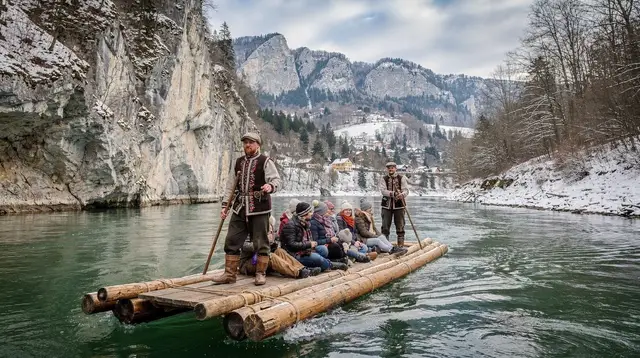
The traditional wooden-raft trip runs from Sromowce Niżne or Kąty down to Szczawnica, about 18 km and 2.5 hours on the water alone, before any time spent getting to the launch point, queuing, or getting back to a car or bus afterwards. Add a visit to Niedzica Castle, the walk to Czorsztyn’s ruins, and the drive between the lake and the rafting launch point, and a single afternoon runs out fast — especially with the standard Zakopane-Kraków-area traffic on the Zakopianka factored into the return.
The workable version is two separate half-days, or two full days back to back, possibly with the Trzy Korony walk added to whichever day has more daylight left. Several tour operators sell combined Pieniny days that include both a castle stop and a rafting or kayaking leg — that works because the operator has already solved the sequencing and transport, which is harder to improvise with a rental car and a single afternoon.
Getting there from Zakopane and Kraków
There is no direct minibus line built specifically for Niedzica and Czorsztyn the way there is for Kuźnice or Morskie Oko. Most independent visitors drive, roughly 70 km and 1.5 to 2 hours from Zakopane via Nowy Targ and Krościenko nad Dunajcem, on roads that are narrower and slower than the main Zakopianka but far less congested. From Kraków, the lake and castles are a longer detour, usually built into a full-day Pieniny tour rather than attempted as a quick add-on to a Zakopane day trip.
Organised day tours from Zakopane or Kraków that combine Niedzica Castle with rafting or kayaking solve the transport question directly and are the simplest option for anyone without a car — worth considering even for drivers, given how much of the day otherwise goes into navigating smaller roads between stops. Travellers who want full flexibility without joining a group can also book a private guided day trip through the wider Tatras and Pieniny instead, with the itinerary built around their own pace.
a full-day Pieniny tour that pairs Niedzica Castle with the surrounding mountains and local food stops covers the castle and the wider area in one organised loop, which removes the driving-between-villages problem entirely.
How much time to plan, and what a day costs
For how these entry fees and lunch costs fit into a wider Zakopane trip budget, see the guide to daily budgets and złoty prices.
| Stop | Typical time | Approx. cost (2026) |
|---|---|---|
| Niedzica Castle (entry + walk) | 1-1.5 hours | Entry ticket, roughly 20-25 PLN adult |
| Czorsztyn ruins (entry + walk) | 45 min-1 hour | Entry ticket, lower than Niedzica |
| Lakeshore walk between the two | 30-60 minutes | Free |
| Trzy Korony from Szczawnica | 3-4 hours round trip | TPN-area park fee applies |
| Lunch in Niedzica or Czorsztyn | 1 hour | 30-50 PLN per person |
A half-day covers Niedzica Castle, the lakeshore, and the Czorsztyn ruins comfortably. Adding Trzy Korony turns it into a full day and effectively rules out rafting on the same date unless the schedule starts very early and drops one of the walking legs. Travellers mapping this against a full Zakopane stay can check how many days a first Zakopane trip really needs before deciding how much of it to give to the Pieniny.
Best tours combining Niedzica, Czorsztyn and the Pieniny
For visitors without a car, or anyone who would rather not plan the sequencing themselves, a handful of organised options cover this corner of the Pieniny in a single booked day:
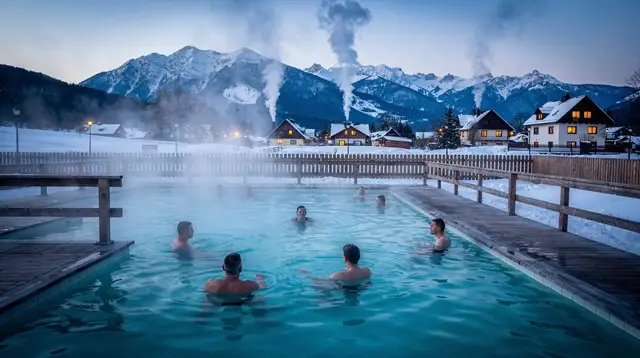
a Kraków-departure day that pairs a Dunajec kayak paddle with a castle stop and a thermal-baths finish is built for exactly the two-activity problem described above — the operator handles the transfers between the castle, the river and the baths, which is the part that is hardest to do alone in one day.
a combined day of Dunajec river rafting and an alpine coaster ride is a good match for families who want the traditional raft trip plus something faster-paced, on a day separate from the castles.
Both of these depart from the Zakopane or Kraków area and are worth checking against your own dates, since the wooden-raft season runs 1 April to 31 October and slows outside July-August.
When to go
May to September is the practical window: the raft season is open, the castles keep normal opening hours, and the Trzy Korony trail is clear of snow and ice. July and August bring the largest crowds to both castles and the lake shore, with midday queues at Niedzica’s ticket office; June and the first half of September offer the same weather with noticeably fewer people. Outside this window, the castles’ opening hours shorten and the wooden rafts stop running altogether, though the lakeshore walk and the castle ruins remain open year-round for anyone visiting in winter for the view alone.
Niedzica and Czorsztyn: frequently asked questions
Is Niedzica Castle the same place as the Chochołowska valley?
No. They are unrelated despite the similar-sounding names. Niedzica Castle and Lake Czorsztyn are in the Pieniny, east of Zakopane. The Chochołowska valley is a separate Tatra National Park valley west of Zakopane, known for its April crocus bloom, with no castle and no lake.
Can I visit Niedzica Castle and go Dunajec rafting on the same afternoon?
Not comfortably. The raft trip alone runs about 2.5 hours on the water, and the castles, the lakeshore walk and the drive between sites add several more hours. Plan them as two separate outings, or book a combined tour where the operator handles the transfers between activities.
What is the difference between Niedzica Castle and Czorsztyn Castle?
Niedzica Castle, built 1320-1326, is the intact, restored one, with a museum inside and the clearer view back across the lake. Czorsztyn Castle, on the opposite shore, is a ruin that was never rebuilt after a 17th-century fire; it is cheaper to enter and gives the better photograph of Niedzica across the water.
How do I get from Zakopane to Niedzica and Czorsztyn?
By car, it is about 70 km and 1.5 to 2 hours via Nowy Targ and Krościenko nad Dunajcem. There is no dedicated public minibus line, so most visitors without a car book an organised day tour that includes transport. For the wider picture of getting around this corner of southern Poland without a car, see the guide to Kraków-Zakopane transport options.
Is Trzy Korony accessible from Niedzica, or only from Szczawnica?
The standard route up Trzy Korony starts from Szczawnica, not from Niedzica or the lakeshore. It is a separate three-to-four-hour round trip walk and should be planned as its own leg of the day, not as a stop on the castle visit.
How much time should I plan for Niedzica and Czorsztyn?
Half a day covers Niedzica Castle, the lakeshore walk, and the Czorsztyn ruins. A full day is needed to add the Trzy Korony climb from Szczawnica as well.
Is Lake Czorsztyn a natural lake?
No. It is a reservoir formed by a dam on the Dunajec river, completed in 1995, covering about 11 square kilometres of former valley land between the two castles.
What’s the best time of year to visit?
May to September, with the wooden-raft season running 1 April to 31 October. June and early September give the same castle and lake views as July-August with noticeably smaller crowds.