Private Guides in Zakopane and the Tatras
What does a private guide add to a Zakopane or Tatras trip that self-planning does not?
A private guide's main value is logistical: securing timed Kasprowy Wierch tickets and the Morskie Oko car park before they sell out, adjusting the day around afternoon storms, and knowing TOPR's emergency numbers (985, +48 601 100 300, or 112) if something goes wrong. It does not remove the compulsory Tatra National Park entry ticket or guarantee weather or availability.
Where the friction actually is
Zakopane looks simple from a map: one town, a national park, a handful of cable cars. What a brochure rarely explains is that the friction in a Tatra trip is almost never the walking itself. It is the paperwork around the walking — a park ticket that is compulsory on every marked trail, not just at the famous spots, a Morskie Oko car park that has to be reserved online days ahead in summer, and a Kasprowy Wierch cable car that sells dated, timed tickets which routinely run out by mid-morning on a clear day. A first-time visitor discovers these constraints one at a time, usually the hard way. A guide who works the valley every week has already absorbed them into the plan before the trip starts.
This page looks at what a private guide changes about a day in Zakopane and the Tatras, and what it does not change. It is not an argument that a guide is necessary — plenty of visitors plan this trip well on their own, and the practical guides on this site exist for exactly that. It is a look at the specific bottlenecks a local guide is positioned to manage, and the ones no guide can do anything about.
The two bottlenecks that reward planning ahead
Two constraints shape almost every itinerary in the Tatras, and both are booking problems more than skill problems.
The first is the Tatra National Park (TPN) entry ticket, required on every marked trail — 11 PLN standard, 5.50 PLN reduced, 55 PLN for seven days (2026 prices), bought online at tpn.gov.pl or at trailhead booths. It is not optional at “attractions” only; the walk into the Kościeliska valley needs one as much as the walk to Morskie Oko does. See booking Morskie Oko, Kasprowy and TPN tickets for the mechanics.
The second is availability itself. The Palenica Białczańska car park for Morskie Oko has to be reserved online, often several days ahead in July and August, and no vehicle — car, taxi or bus — goes past it: the 9 km to the lake are covered on foot or by horse carriage to Włosienica. The Kasprowy Wierch cable car, from Kuźnice, sells dated, timed tickets online up to two hours before departure, and on a fine summer day the online allocation can be gone by late morning. Neither constraint has anything to do with fitness or experience. It is a booking window that a visitor planning their own two- or three-day trip may simply not know to open early enough.
This is the first place a guide’s local knowledge pays off in a way that is hard to replicate from abroad: knowing which dates typically sell out, checking allocations the moment they open, and having a credible plan B — Gubałówka instead of Kasprowy, or the Kościeliska valley instead of Morskie Oko — when a slot is already gone.
What a guide can plan around, and what nobody can
Weather. July and August bring frequent afternoon thunderstorms in the Tatras, and the practical response is the same one every serious hiker in the range follows: start early, be off exposed ridges by early afternoon.
A guide who checks conditions daily can shift a departure time, swap a ridge walk for a valley walk, or call off a summit attempt on Giewont before a storm builds — which matters because the 22 August 2019 lightning strike on Giewont’s summit, which killed four people and injured more than a hundred, is recent history on that mountain, not a cautionary story from decades ago. See Zakopane’s summer thunderstorm pattern for how predictable this actually is by time of day.
What a guide cannot do is make the cable car run in a halny — the warm föhn wind that can blow at any season and shuts Kasprowy Wierch regardless of who booked the ticket — or open a trail that TPN has closed for the winter season, typically from 1 November to about mid-June on the higher routes. Local knowledge changes the odds of a good day. It does not override the mountain or the ticketing system.
Route-reading for terrain that punishes guessing. Some routes in this range are genuinely technical: Orla Perć, rated the hardest marked trail in Poland, or the chained final stretch to Rysy at 2,499 m, are not places where a wrong pace or a late start is easily recovered.
A guide who has walked a route dozens of times reads pace, weather, and turnaround time in a way that is hard to learn from a map the night before. For gentler ground — the paved Kościeliska valley, Rusinowa Polana, the funicular up to Gubałówka — this advantage matters much less, because the terrain itself does most of the work of keeping a visitor safe.
What a guide does not replace
TOPR remains TOPR. The Tatra volunteer mountain rescue service, founded in 1909, is reached on 985, +48 601 100 300, or the general emergency number 112, and rescue — including helicopter evacuation — is free of charge in Poland regardless of whether the person calling is on a guided tour or hiking alone. A guide who knows these numbers by heart and can describe a location precisely to a dispatcher is useful in an emergency. A guide is not a substitute for TOPR, and a solo hiker with the numbers saved has the same access to rescue as a guided group. The full picture — what TOPR does and does not cover, and what still needs travel insurance — is in the TOPR safety guide.
The park’s rules apply the same way to everyone. Marked trails only, daylight hours only, no dogs outside the Chochołowska valley’s lower section and the Droga pod Reglami path, no drones, no wild camping. A guide does not carry any exemption from these; the value is in planning a day that fits inside them comfortably rather than testing the edges.
Where a guided day adds the most — and the least
| Situation | What a guide typically adds | What stays the same either way |
|---|---|---|
| Morskie Oko or Kasprowy Wierch in July-August | Early booking, a fallback plan if slots are gone | The reservation still has to exist; nobody can create a sold-out slot |
| A single long day trip covering Zakopane, Kraków or the Dunajec gorge | A driver-guide removes transfer timing and minibus connections from the day | Distances and road conditions on the Zakopianka are unchanged |
| A ridge hike toward Giewont or Rysy | Weather judgment, pace-setting, route knowledge on exposed sections | The TPN entry ticket, the chains, and the exposure are the same for everyone |
| The paved Kościeliska valley, Gubałówka, Rusinowa Polana | Mostly convenience and local context, less risk management | These trails are gentle enough that independent visitors manage them easily |
| An evening in town — Krupówki, a highlander feast, local food | Introductions and context a first visit would otherwise miss | Nothing here depends on route-finding or bookings |
A Zakopane town walk with a private guide covers this last category well: for a visitor with limited time, a half-day guided walk through Zakopane town adds context to the wooden villas along Krupówki and the Zakopane-style architecture that is easy to miss walking past alone. For a trip that mixes the town with a full day in the mountains, a customizable private day in the Tatras lets the plan bend around whichever of the two bottlenecks above — ticket availability or weather — turns out to matter on the day.
Day trips and transfers: where a driver-guide changes the logistics most
The single case where a private guide’s value is least about the mountains and most about time management is a long day trip from Zakopane, particularly toward Kraków, about 110 km and 2 to 2.5 hours away by bus but subject to Zakopianka traffic on Friday evenings, Sunday afternoons and snowy weekends. Public buses and trains run all day and cover this route reliably; what a driver-guide removes is the need to build the day around a fixed departure and return time.
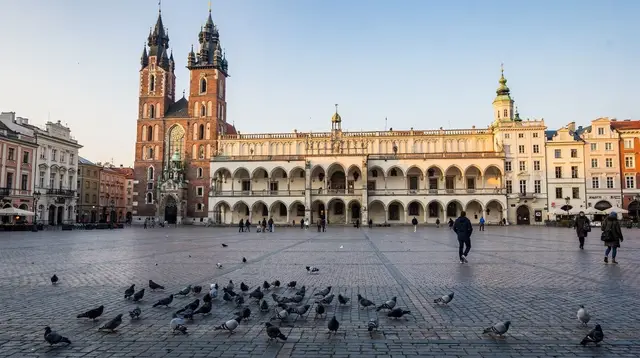
For a Kraków day trip built around this constraint, a private guided day trip to Kraków’s Old Town from Zakopane or, run in the other direction, a chauffeured private tour of Zakopane from Kraków both fold the transfer and the sightseeing into one booking rather than two separate ones. See the Kraków day trip guide for what a self-planned version of the same day involves.
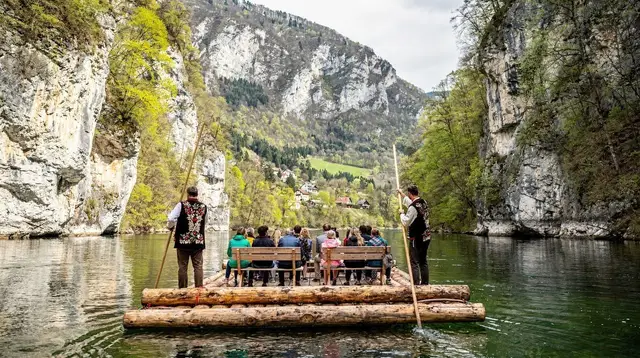
The same logic applies to the Dunajec gorge: the traditional wooden-raft descent from Sromowce to Szczawnica runs April to October on a fixed schedule regardless of who booked it, but getting from Zakopane to the launch point and back on public transport takes planning of its own. A private tour combining the Dunajec rafting descent with transport from Zakopane removes that connection question; the raft, the raftsmen, and the gorge itself are identical to what an independent visitor experiences arriving by minibus.
Food and culture: a smaller but real gap
Podhale food — oscypek (only genuinely in season from May to September), kwaśnica, bundz and bryndza, highlander feasts with live music — is easy to find on Krupówki but not always easy to tell apart from a version aimed squarely at passing tourists.
This is one area where local introductions add something a map cannot: a private food tasting tour through Zakopane’s Polish traditions covers the difference between genuine sheep’s-milk oscypek and the cow’s-milk gołka often sold under the same name in winter, which the oscypek guide on this site also covers for anyone tasting their way through independently. For visitors who would rather figure this out with a drink in hand, the same logic applies to Zakopane’s tourist-trap patterns more broadly.
Planning either way
None of this is an argument for or against booking a guide. A visitor with several days, a clear head for weather, and the patience to book the TPN ticket, the Morskie Oko car park and the Kasprowy Wierch slot in advance can manage all of it alone — the guides on this site are written for exactly that trip. What a private guide most reliably buys back is time and certainty on a short visit: fewer of those bookings left to chance, a plan that bends when a storm builds instead of pushing through it, and someone on hand who already knows TOPR’s number rather than looking it up mid-hike.
For a first visit trying to decide how many days that even requires, start with how many days a first Zakopane trip actually needs, and for where to base a stay that makes either approach easier, see where to stay between Zakopane, Kościelisko and Białka. Anyone driving themselves instead should read the Zakopianka traffic and parking guide before committing to a self-drive itinerary, guided or not.
Private guides in Zakopane and the Tatras: FAQ
Do I still need a Tatra National Park entry ticket if I book a private guide?
Yes. The TPN entry ticket is compulsory on every marked trail in the park, including Morskie Oko and the Kościeliska valley, and a guide books or carries the reader through this the same way a solo visitor would, not around it.
Can a guide guarantee a spot at Morskie Oko or Kasprowy Wierch in July or August?
No. The Palenica Białczańska car park and the Kasprowy Wierch cable car both sell out on fine summer days regardless of who is booking. What a guide changes is timing the booking early enough and having a fallback plan if a slot is gone.
What happens if a storm rolls in during a planned hike?
A guide who knows the terrain can turn a group back toward a hut or a lower trail before a ridge like Giewont becomes dangerous. Afternoon thunderstorms are common in July and August, and the 2019 lightning fatalities on Giewont are the reason this matters more than it sounds.
Is a private guide necessary for Rysy or Orla Perć?
Not legally required, but both routes involve chains, exposure, and long days above 2,000 m, and Orla Perć is rated the hardest marked trail in Poland. Experienced, well-equipped hikers do both independently; less experienced parties often prefer local knowledge of conditions and pace.
Who do I call if someone gets hurt on a marked trail?
TOPR, the Tatra volunteer mountain rescue, on 985 or +48 601 100 300, or the general European emergency number 112. Rescue in Poland, including helicopter evacuation, is free of charge; this applies whether or not a guide is present.
Does a private guide replace travel insurance?
No. TOPR rescue is free in Poland, but medical treatment, evacuation on the Slovak side, and any follow-up care are not automatically covered, so insurance still matters independently of whether the day is guided.
Is a driver-guide useful for visiting Kraków or the Dunajec gorge from Zakopane?
It removes the need to time the Zakopianka road, minibus connections, and rafting departure points yourself, which matters most on a single long day trip rather than a multi-day stay where public minibuses cover the same ground at a slower pace.
Are dogs or drones allowed if I’m with a private guide?
No. Both are banned inside Tatra National Park regardless of who is leading the group, with the narrow exception of dogs in the Chochołowska valley up to the hut and on the Droga pod Reglami path.
Private guided tours
Verified deep-linked GetYourGuide tours. Book through these links and we earn a small commission at no cost to you.
GetYourGuide does not provide a product photo for this activity — the image shows the meeting point, photographed by us.