Multi-Day Hut-to-Hut Trekking in the Polish Tatras: A 2-3 Day Planning Guide
Can you hike hut-to-hut for several days in the Polish Tatras?
Yes, but only on marked trails, with a Tatra National Park entry ticket valid on each day you walk, and overnight stays only in one of the park's eight mountain huts — wild camping and bivouacking are banned everywhere in the park. Some high-altitude connecting trails close from 1 November to around 15 June, which narrows route choice outside the summer season.
The rules come before the route
A hut-to-hut trek in the Polish Tatras is not a route you improvise on a map and then adjust on the ground. It is a plan that has to fit inside a fixed set of park rules, and those rules matter more than any single trail choice. Get them wrong and the trip does not happen; get them right and the Valley of Five Polish Lakes and its neighbouring valleys open up as a genuine two- or three-day walk rather than a single long day from a car park.
Three rules shape everything else. First, Tatra National Park (TPN) requires a paid entry ticket on every marked trail, every day you walk, not only on your first day inside the park. Second, you may only walk on marked trails — no cross-country routes, no shortcuts off the path, whatever the map or a passing local suggests. Third, and the one that defines a multi-day trip more than any other: overnight stays are legal only inside one of the park’s eight mountain huts. Wild camping and bivouacking anywhere in the park are banned, full stop, and rangers do check.
On top of these year-round rules sits a seasonal one. A meaningful share of the high-altitude connecting trails and ridge routes close from 1 November to around 15 June, mainly for avalanche risk, and secondarily to protect the chamois rut in autumn and nesting birds in spring. That window rules out most ambitious hut-to-hut plans for roughly seven months of the year — a useful reality check before you build an itinerary around a pass or ridge you have seen in a summer photo.
What the eight mountain huts actually are
The Polish Tatras have eight staffed mountain huts (schroniska), spaced along the main valleys and ridgelines at intervals that roughly match a comfortable day’s walk. That spacing is what makes hut-to-hut trekking possible here in the first place: you are never planning a route in the abstract, you are planning it around where a bed and a hot meal actually exist.
Every hut works the same broad way. Rooms are dormitory-style, not private, and bookings run directly through the individual hut rather than through a single central booking system for the whole network — there is no one website that covers all eight. In the busiest stretches of July and August, and around any long weekend, the more accessible huts fill up days or weeks in advance, which means a multi-day trek needs its beds confirmed before the trailhead dates are fixed, not the other way round.
Huts serve simple hot food and drinks, refill water, and give you somewhere to dry out after an afternoon storm, but none of that is a guarantee — kitchens can run short on the busiest evenings, and cash still matters even where cards are increasingly accepted.
This page will not name a specific hut, quote a nightly rate, or promise a bed will be free — availability and prices move by season and by hut, and the only reliable source is the hut itself at the time you book. What matters for planning is the shape of the system: eight huts, booked individually, reachable only on foot, and the sole legal place to sleep once you are inside the park boundary.
A realistic sector: the Valley of Five Polish Lakes
The Valley of Five Polish Lakes is one of the more approachable multi-day sectors in the Polish Tatras, and a reasonable example of how a 2-3 day trip is actually built around the rules above rather than around a single dramatic photo.
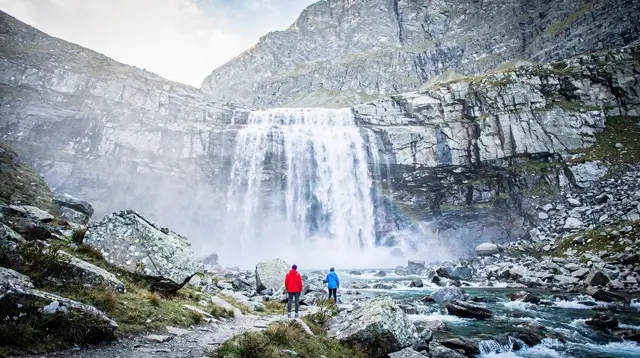
The approach starts at the Palenica Białczańska car park — the same trailhead used for Morskie Oko — and follows the paved road before branching onto the path up the Roztoka valley. Along the way the trail passes Wodogrzmoty Mickiewicza, a series of cascades, before climbing to Siklawa, at roughly 70 m the highest waterfall in Poland, and on to the five tarns that give the valley its name. There are no chains on this approach and no technical scrambling, which is exactly why it suits a first multi-day trip better than a route built around a ridge.
A typical shape for this sector runs over two or three days: a first day walking in from Palenica Białczańska to a hut within the valley system, with time to explore the lakes and the approaches to Czarny Staw if energy and weather allow; a second day either exploring further within the same sector — the ridgelines and passes around the valley reward a light day without a full pack — or beginning the walk out; and, on a three-day plan, a further day linking toward a neighbouring valley before descending.
The exact combination depends on which hut has beds, what the weather is doing, and how much ridge walking the group actually wants — this is a sector to build a plan around, not a fixed script to follow. Travellers who would rather not arrange huts, tickets, and route-finding themselves can book a private Morskie Oko trek with a mountaineer that starts from the same Palenica Białczańska trailhead, with pacing and navigation handled by a guide.
| Ticket type (TPN, 2026) | Price | Useful for |
|---|---|---|
| Single day, standard | 11 PLN | A one-day add-on to a shorter trip |
| Single day, reduced | 5.50 PLN | Students, seniors, and other reduced categories |
| Seven-day pass | 55 PLN | Any trek of three days or more |
| Under 7 | Free | Children |
For anything beyond a single overnight, the seven-day pass is the sensible default: it removes the need to queue at a booth or buy online again each morning, and in July to September the online ticket quota itself can sell out days ahead, so buying the multi-day pass early is also a hedge against availability.
What to refuse: Orla Perć is not a hut-to-hut route
It is worth being direct about one route that keeps coming up in trip planning for this region: Orla Perć, the “Eagle’s Path,” a 3.9 km chained ridge between Zawrat and Krzyżne that crosses Kozi Wierch, the highest summit entirely within Poland. It is rated the hardest marked trail in the country, has claimed roughly 100 lives across its history, and has carried a one-way rule on its most exposed Zawrat-to-Kozi Wierch section since 2007 specifically because two-way traffic on chains that narrow was getting people killed.
None of that makes it off-limits to everyone — experienced scramblers with a head for exposure and good conditions do walk it, often with a guide. But it is not a piece to slot into an ordinary multi-day hut-to-hut itinerary the way you might slot in a valley walk or a lake circuit. Treat any plan that casually includes Orla Perć “if the weather looks good” as a plan that needs rethinking, not a flexible option. The same caution applies to Giewont, whose summit chains and exposed final approach have their own history of lightning deaths, most recently in August 2019 — a mountain to visit deliberately, in good weather, not to fold into a long trekking day as an afterthought.
Weather, timing, and the parts nobody can promise
Afternoon thunderstorms are a routine feature of July and August in the Tatras, not an unlucky exception, and the standard local advice — start early, be off ridges and summits by early afternoon — matters even more on a multi-day trek, where a bad decision on day one can force a change to every day that follows. The halny, a warm föhn wind that can blow at any time of year, closes cable cars and turns exposed ridges genuinely dangerous; it is not predictable weeks out, only watched day by day.
No route on this page comes with a weather guarantee, and no hut-to-hut plan should be built as if one exists. The practical response is to build slack into the itinerary — a spare day, or an easy descent option from each hut back to a valley road — rather than a fixed sequence of passes that has to work exactly as drawn.
TOPR, the Tatra mountain rescue service founded in 1909, is free of charge in Poland, reachable on 985, +48 601 100 300, or 112 — but a free rescue is not a substitute for a plan that avoids needing one. Carry more water and food than the day seems to require, know the nearest bail-out point from wherever you are on the trail, and treat any forecast beyond about 48 hours as a rough guide rather than a fact.
Booking the pieces before you fix the dates
A workable multi-day trek in the Polish Tatras comes together in a specific order, and doing it out of sequence is the most common way plans fall apart. Confirm hut beds first, since availability is the least flexible constraint — huts fill from weeks out in peak summer, and a route without a confirmed bed at the end of the day is not really a plan. Buy the park ticket next, ideally the seven-day pass rather than single-day tickets bought morning by morning, and buy it before the trip if you are travelling in July, August, or around a long weekend, since the online quota can run out.
Only once beds and tickets are settled does it make sense to lock exact daily distances and route choices — building the itinerary around real availability rather than forcing availability to match an itinerary drawn from a map. Travellers who would rather skip this sequencing entirely can book a 2-day Tatra Mountains hiking tour with a guide, which folds hut logistics, tickets, and route choice into a single pre-arranged booking.
For travellers who want the structure of a multi-day mountain trip without the trekking-specific planning above, the 5-day Tatras hiking itinerary and the 3-day Tatras classic itinerary lay out day-by-day plans that mix valley walks, Kuźnice and the cable car, and one or two nights based back in Zakopane rather than in a hut — a useful comparison for deciding whether a genuine hut-to-hut trek, with its stricter rules and booking demands, is actually what a given trip needs.
Gentler multi-day alternatives, if the rules above feel like a lot
Not every multi-day trip in this region has to run through high passes and mountain huts booked weeks in advance. The Kościeliska valley, entered at Kiry, is a gentle paved 9 km track suitable for a relaxed day that still counts toward a longer stay in the area, and the neighbouring Chochołowska valley adds a longer, similarly gentle walk with its own seasonal draw each April, when crocuses cover the valley floor for about two weeks.
Neither requires a hut booking, since both are comfortably walked from Zakopane as a base and returned from the same day, which makes them a lower-friction way to spend two or three days hiking in the Tatras without the logistics this page has focused on. For a broader look at hiking and trekking options across the whole area, including single-day routes that need none of the hut-booking planning above, that category page is the wider starting point.
Whichever version of a multi-day trip ends up on the itinerary, the same three constraints apply throughout: marked trails only, a valid park ticket every day, and a bed in one of the eight huts — never a tent, and never open ground — as the only legal way to spend the night inside Tatra National Park.
Questions about planning a multi-day Tatra trek
Can you camp or bivouac overnight in the Tatra National Park?
No. Wild camping and bivouacking are banned across the entire Polish side of the Tatras. The only legal overnight option on the trail is one of the park’s eight mountain huts (schroniska). Anyone found sleeping outside a hut risks a fine and, if the weather turns, an unnecessary rescue call-out.
How many mountain huts are there in the Polish Tatras?
Eight. They sit at intervals along the main valleys and ridges, spaced roughly a walking day apart, which is what makes 2-3 day hut-to-hut routes possible in the first place. Each is reached only on foot, serves basic hot food, and offers dormitory-style beds.
Do you need a separate park ticket for each day of a multi-day trek?
You need a valid Tatra National Park (TPN) entry ticket for every day you are on a marked trail inside the park, not just for the first day. A seven-day pass covers a multi-day trek without buying a new ticket each morning, and is worth it for anything longer than two days.
Is the Orla Perć ridge a normal route for a hut-to-hut trip?
No. Orla Perć is the hardest marked trail in Poland — a chained ridge with around 100 deaths in its history and a one-way rule on its most exposed section. It is not a sensible way to link huts on an ordinary multi-day trek and should only be attempted by experienced scramblers in good conditions, ideally with a guide.
When do high-altitude trails close in the Polish Tatras?
Many of the highest connecting trails and ridge routes close from 1 November to around 15 June each year, mainly for avalanche risk and to protect chamois during the rut and nesting birds in spring. Any hut-to-hut plan built on high passes needs to check current closures before booking anything.
Can you book a mountain hut bed in advance?
Huts take advance bookings, and in July and August, and around any long weekend, popular huts fill up well ahead of time. Booking is done directly through each hut, since the network is not centrally managed, so confirm your beds before you commit to a fixed daily plan.
What happens if the weather turns during a multi-day trek?
Afternoon thunderstorms are common in July and August, and the halny, a warm southerly wind, can close cable cars and make ridges dangerous at any time of year. A workable multi-day plan builds in a spare day or an easy bail-out route to a valley trailhead, and treats every forecast as provisional rather than guaranteed.
Is the Valley of Five Polish Lakes a reasonable first multi-day route?
It is one of the more approachable sectors for a first hut-to-hut trip: no chains, a clear path from Palenica Białczańska past Wodogrzmoty Mickiewicza to the Siklawa waterfall and the lakes, and a hut within a comfortable day’s walk. It still needs the same park ticket, hut booking, and weather sense as any other route.
Multi-day tour packages
Verified deep-linked GetYourGuide tours. Book through these links and we earn a small commission at no cost to you.
GetYourGuide does not provide a product photo for this activity — the image shows the meeting point, photographed by us.