A Five-Day Hiking Itinerary Through the Polish Tatras
Why This Order, Not Another
Four valleys and one chained summit sound like a checklist, but they are not interchangeable. Kościeliska and Chochołowska are paved and gentle enough to walk on tired legs; the Five Lakes valley is a full day of distance without technical difficulty; Giewont is the only route with chains and the only one where a bad weather call has killed people. Put Giewont first and a sprained ankle or an exhausted body ruins the rest of the week.
Put it last, after four days of walking have shown you how your legs handle distance, and you arrive at the chains with real information about your own condition, not enthusiasm. This itinerary for Zakopane hikers follows that logic: rest, then easy, then long, then hard, with the hardest day made conditional on the sky, not the calendar.
Every day here starts with a TPN entry ticket, bought online before the trailhead if you can, since queues form at the booths in July and August. No day on this plan needs a rental car: minibuses reach every trailhead from the town centre or the bus station area.
| Day | Valley or peak | Distance (round trip) | Climb | Chains |
|---|---|---|---|---|
| 1 | Zakopane, rest | — | — | No |
| 2 | Kościeliska | about 18 km | gentle | No |
| 3 | Chochołowska | about 20–23 km | gentle to moderate | No |
| 4 | Five Lakes valley | full day | moderate | No |
| 5 | Giewont | about 12–14 km | steep, final section | Yes |
Day 1: Arrival and Rest in Zakopane
Do not hike on arrival day. Altitude, travel fatigue and unfamiliar trail signage are a bad combination for a first outing, and the whole point of a five-day plan is that you have the days to spare. Use day one to settle in, walk Krupówki at an easy pace, sort out where you are staying for the week — Kościelisko and Białka Tatrzańska are worth comparing against the town centre if you have not booked yet — and buy the week’s TPN tickets online rather than at the trailhead.
If arrival is early enough for a half day out, this is the moment for something that is not a hike: a light introduction such as a guided day out across Zakopane and the Tatra foothills gives a useful overview of the terrain before you commit to four days of walking it yourself, and an afternoon at the rope park on top of Gubałówka is a fun way to burn restless energy without tiring your legs for tomorrow. Neither is required. Early nights matter more than either: day two starts the real work.
Day 2: Kościeliska Valley from Kiry
The Kościeliska valley is the right opening move because it is genuinely easy: a paved track along the valley floor, about 9 km one way from the entrance to the Ornak hut and back, roughly 18 km round trip with almost no real climbing. A minibus from Zakopane reaches Kiry, the entrance, in about 20 minutes. From there the walk passes the Mroźna and Raptawicka caves (both worth a short detour), the Ornak meteorological station, and — for those who want more — the side path to the Smreczyński pond.
The point of day two is not the scenery alone, though it is real: limestone walls closing in on both sides, streams crossing the path, larches turning gold from September. The point is to test your pace and your feet on flat, forgiving ground before the terrain gets harder. Treat it as a full but comfortable day, not a warm-up to rush through. For the pace and logistics in more detail, the Kościeliska valley family hike guide covers timing and the cave stops. Back in town, an early dinner and an early night: day three is longer.
Day 3: Chochołowska Valley from Siwa Polana
The Chochołowska valley is the longest valley in the Polish Tatras, and it shows: the round trip from the Siwa Polana entrance to the head of the valley and back runs 20 to 23 km depending on how far up you go, still on a largely flat, paved track for the first stretch. A minibus covers the short hop from Zakopane to Siwa Polana; a small road train and bike hire operate on the lower section for those who want to save their legs for the upper valley.
This is a longer day than Kościeliska in distance, though not in difficulty — the gradient stays gentle almost throughout, with only the final approach to the passes at the head of the valley gaining real height. If your visit falls in the first two weeks of April, this valley is worth seeing for the crocus bloom alone, though that is a different season from the one this itinerary assumes; see the Chochołowska valley crocus season guide for that specific window.
For a June-to-October hiking trip, the value here is distance and quiet: Chochołowska sees far fewer visitors than Kościeliska or Morskie Oko, and by mid-afternoon on the return leg you will likely have long stretches of the valley to yourself. Save some energy: day four is the longest day of the week.
Day 4: The Valley of Five Polish Lakes and Siklawa
This is the full-day centrepiece. From the Palenica Białczańska car park, the same starting point as the walk to Morskie Oko, the route to the Valley of Five Polish Lakes branches off past the Wodogrzmoty Mickiewicza waterfalls and climbs the Roztoka valley to Siklawa, at around 70 metres the highest waterfall in Poland, before reaching the five tarns themselves. Budget a full day: this is longer and involves more sustained climbing than either Kościeliska or Chochołowska, without being technical.
A minibus from Zakopane to Palenica Białczańska takes about 30 to 40 minutes; note that the car park itself requires online reservation in season if you are travelling by car, though it is irrelevant if you arrive by minibus. Start early. Afternoon thunderstorms build over the high Tatras through July and August, and while this route does not go over an exposed ridge, a soaked, cold descent through the Roztoka valley in a storm is avoidable simply by being back below the treeline before early afternoon. This is also the day to pay attention to your legs and knees on the descent: tomorrow is Giewont, and a rolled ankle here cancels it.
Day 5: Giewont, Chains and a Storm Check
Giewont is the only day on this itinerary with chains, and it is deliberately last: four days of walking behind you means you know your pace, your knees and your appetite for exposure before you commit to it. From Kuźnice, reached by a 30 to 40 minute walk from the centre or a short minibus ride (private cars cannot drive in), the route climbs past Kalatówki and the Kondratowa hut to the base of the final approach, about three hours to the top. The last 100 to 200 metres run on chains bolted into polished limestone, with queues forming in season where the path narrows.
Do not attempt this day if an afternoon storm is forecast. On 22 August 2019, a storm broke over Giewont’s summit and its 15-metre iron cross while walkers were still on the chains; four people died and more than a hundred were injured. That is recent history, not a cautionary story from decades ago, and it is the single fact this itinerary insists on: check the forecast the night before and again at breakfast, and if there is any real chance of a building afternoon storm, swap this day for a rest day or a return to one of the gentler valleys instead.
The Giewont hike guide and the background on what changed after the 2019 strike are both worth reading before you go, and the TOPR mountain safety guide is worth reading regardless of which day you’re hiking — rescue is free in Poland, but that is not a reason to need it. TOPR’s number is 985, or 112 in any emergency.
If the summit is a reasonable go, the reward is the best panorama of the range from a summit rather than a ridge: the whole chain from Rysy to Kasprowy Wierch on one side, Zakopane and the Podhale spread out on the other. Come down the way you went up, take the chains slowly, and do not linger at the cross if cloud is building.
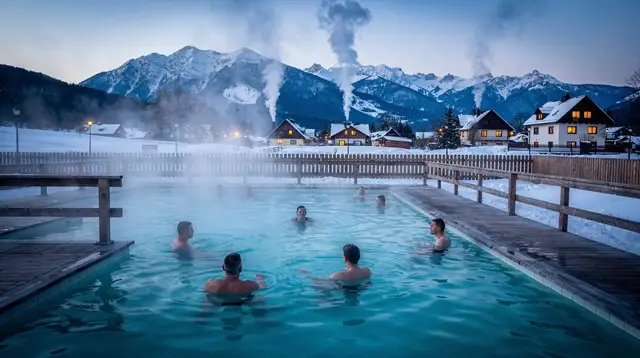
Back in Zakopane that evening, a soak does more for stiff legs than a beer does: a shared evening trip out to the Zakopane hot springs is a genuinely good way to end a five-day week, and for anyone who would rather have handled the whole route with a guide from the start, a guided trip through the Tatra Mountains covers similar ground without the solo route-finding.
Notes for Adjusting This Week
None of these four days requires technical skill beyond Giewont’s chains, but they add up: this is a five-day week with four real hiking days and no lift-served shortcuts. A few adjustments are worth knowing about before you commit to the plan as written. Dogs are allowed on the Chochołowska approach up to the hut but not in Kościeliska or the Five Lakes valley — the park’s dog rule is easy to get wrong if you travelled with one.
If Giewont is not something you want at all — nerves, a knee that is not up to chains, or simply a preference for valleys over summits — dropping day five turns this into a comfortable four-day valley tour, closer in shape to the 4-day car-free itinerary; the shorter 3-day classic route covers similar highlights at a faster pace for those with less time. And if the whole week runs outside June to October, most of this plan does not hold: high trails close from around 1 November to mid-June, and Giewont in particular should not be attempted in snow or ice without mountaineering equipment and experience neither this itinerary nor most visitors have.
FAQ: Hiking Kościeliska, Chochołowska, the Five Lakes Valley and Giewont
Do I need a Tatra National Park ticket for every day of this itinerary?
Yes. TPN entry tickets (11 PLN standard, 55 PLN for seven days in 2026) are required on every marked trail in the park, including Kościeliska and the walk to the Five Lakes valley, not only at named attractions.
Can I hike Giewont on any day of this itinerary if the weather looks fine?
Only attempt Giewont if no afternoon thunderstorm is forecast and you still have full-day energy left, which is why it sits on day five. The 22 August 2019 lightning strike that killed four people on the chained summit happened in a building afternoon storm, and TOPR rescues people from the same mistake every season.
Is this itinerary possible outside June to October?
No. The high trails to Giewont and parts of the Five Lakes valley close from around 1 November to mid-June for avalanche risk and snow, so this five-day sequence only works in the snow-free season, roughly mid-June to October.
Do I need a car for this itinerary?
No. Minibuses run from Zakopane to Kiry for Kościeliska, Siwa Polana for Chochołowska, Palenica Białczańska for the Five Lakes valley, and Kuźnice for Giewont. A car mostly adds parking hassle without saving time.
How fit do I need to be for day five, Giewont?
Fit and comfortable with exposure. The climb from Kuźnice via the Kondratowa hut takes about three hours up, and the final 100 to 200 metres are on chains over polished limestone with queues in season, so it is not a route for a first hiking day or tired legs.
What if I only want the easier valleys and not Giewont?
Kościeliska and Chochołowska are gentle, largely flat, paved valleys suitable for a slower pace, and the Five Lakes valley is a long day but has no chains. Dropping Giewont turns this into a comfortable four-day plan.
tours.5 days
Verified deep-linked GetYourGuide tours. Book through these links and we earn a small commission at no cost to you.
GetYourGuide does not provide a product photo for this activity — the image shows the meeting point, photographed by us.