Four Days in the Tatras Without a Car
Day 1: landing in Zakopane and walking Krupówki
Most visitors arrive by bus or train from Kraków, and this itinerary assumes exactly that: no rental car, no Zakopianka traffic to worry about, just the minibuses that connect every trailhead to the town centre. If you’re coming straight from the airport, the transfer options from KRK run about 2 to 2.75 hours; if you’re already in Kraków, compare the bus, train and driving options before you pick one — the bus wins on frequency, the train on comfort, and the car only wins outside peak hours.
Once you’re checked in, spend the afternoon getting your bearings on Krupówki, the roughly 1.1 km pedestrian street that is the actual centre of Zakopane. It is touristy — oscypek stalls, souvenir shops, highlander bands — and that is fine on arrival day, when the point is to eat, orient yourself, and confirm where the minibuses to tomorrow’s destinations actually leave from. They cluster around the bus station (Dworzec PKS) and along Kościuszki street, a five to ten minute walk from Krupówki’s northern end. Walk that stretch this evening so you’re not hunting for a stop at 7 a.m. tomorrow.
This first evening is also the moment to buy your Tatra National Park entry tickets online for the next three days — see the booking guide for Morskie Oko, Kasprowy Wierch and TPN tickets — and, if you haven’t already, your timed Kasprowy Wierch cable car slot for Day 2. In July and August both sell out days ahead, and a no-car itinerary has no fallback plan if you show up without a reservation.
If your legs want an easy warm-up rather than a rest, the funicular to Gubałówka is a five-minute ride from the top of Krupówki and gives you the whole Tatra skyline before you’ve set foot in the park — useful for planning which peaks you’re looking at over the next three days. Families or anyone travelling with kids can also use the ridge-top rope park above the funicular station to burn off arrival-day energy without any further transport. Have dinner, sort your daypack, and set an early alarm — every day from here runs on minibus departure times, not your own schedule.
Day 2: minibus to Kuźnice, cable car to Kasprowy Wierch
Kuźnice is closed to private cars, which for once works in a no-car traveller’s favour: you lose nothing by not driving here, because nobody drives here. From the bus station and Kościuszki street, minibuses to Kuźnice run regularly through the morning; the ride takes well under fifteen minutes, and it beats the 30-40 minute walk if you want your legs fresh for the ridge above.
At Kuźnice, the PKL cable car climbs to Kasprowy Wierch at 1,987 m in about 20 minutes with a change partway up at Myślenickie Turnie. This is the one part of the day that runs on a fixed clock: tickets are dated and timed, bought online up to two hours ahead, and on a clear summer day the popular slots go first. If you locked in a morning departure last night, be at the base station with time to spare — the cable car guide has the current booking window and the difference between standard and “express” tickets, which cost more but skip the queue.
At the top, the panorama is the payoff: the full ridge of the High Tatras on the Polish and Slovak sides at once, weather permitting. From the upper station you can simply enjoy the view and ride back down, or extend the day on foot along the ridge toward Kopa Kondracka — a worthwhile detour for anyone comfortable on exposed paths, but not a requirement for this itinerary. Whichever you choose, come back down by early-to-mid afternoon: the cable car stops running in strong wind, and afternoon cloud builds fast on a Tatra ridge in summer. There’s no shame in taking the first available car down rather than the last one.
Back at Kuźnice, minibuses return to central Zakopane all afternoon and into the evening, so there’s no need to time your descent against a departure board — you’ll rarely wait more than fifteen or twenty minutes for the next one. If you’d rather not plan the cable car booking and transfers yourself, a guided day trip covering Zakopane and the Tatra Mountains bundles the transport and the ticket logistics into one booking — worth weighing if Day 2 is the day you’d rather not watch a countdown clock.
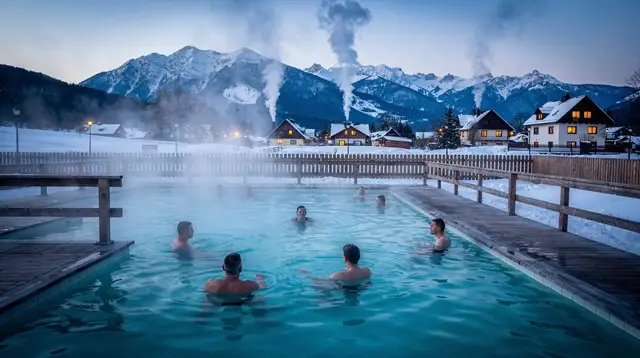
Either way, this is a good evening to soak tired legs: the town’s thermal option and the comparison of Podhale’s thermal baths both apply if you want to swap Krupówki for warm water tonight instead.
Day 3: minibus to Palenica Białczańska, on foot to Morskie Oko
This is the longest day of the trip, and the one where not having a car changes nothing about the plan except the anxiety level. Palenica Białczańska, the car park that serves Morskie Oko, requires an advance online reservation for anyone driving in — a real headache for drivers in July and August. Arriving by minibus sidesteps that entirely: the minibus drops you at the same trailhead without needing a parking slot of its own, so this is genuinely one of the few days where skipping the car is a straightforward upgrade, not a compromise.
From Palenica, it’s 9 km of paved road on foot to the lake, climbing about 400 m, and most walkers take 2 to 3 hours each way. Start as early as your minibus schedule allows — the earliest departures from Zakopane put you on the road before the day’s heat and before the crowds that build from mid-morning.
If your legs would rather save themselves for the walk back, a horse carriage (fasiąg) covers most of the distance to Włosienica, about 1.5 km below the lake, for roughly 80-100 PLN uphill; queues form early, so this isn’t a guaranteed option if you arrive mid-morning. The full comparison of walking against the carriage, including realistic timings, is in the carriage versus walking guide.
Morskie Oko itself — the largest lake in the Tatras at 1,395 m — is worth the effort: turquoise water ringed by peaks, with Rysy, Poland’s highest point at 2,499 m, visible above it. Fit walkers with time in hand can continue 50 minutes further to the quieter Czarny Staw, well short of any technical ground, for a view with a fraction of the lakeside crowd. The complete Morskie Oko visitor guide covers both options and the practicalities of the entry ticket, which is compulsory here as on every marked trail in the park.
Budget the whole day for this: walking there, time at the lake, and walking back leaves little room for anything else, and the last minibuses back to Zakopane run into the evening but not indefinitely — check the return times before you set off rather than after you’re back at Palenica. Travellers who’d rather have someone else manage the transport end to end, including from Kraków, can look at the organised day tour to Morskie Oko, which removes the ticket and transfer planning at the cost of a fixed group schedule.
For why the reservation rules exist in the first place, see why Morskie Oko requires booking. This is the one day of the four where lightning risk deserves a second thought too — the same afternoon storm pattern that closes Giewont builds over this whole basin, so check the mountain safety notes from TOPR before you commit to a late start.
Day 4: minibus to Kiry, the gentle Kościeliska valley
After the long Morskie Oko day, Day 4 is deliberately easier. Minibuses to Kiry, the entrance to the Kościeliska valley, run from the same bus station area and Kościuszki street stops as the rest of the trip, about 8 km west of central Zakopane — a short ride, and one more example of a trailhead that a no-car traveller reaches exactly as easily as a driver, since Kiry itself has limited parking that fills fast on fine weekends.
The valley is 9 km of gentle, paved track, the flattest walking of the whole itinerary and a deliberate contrast to the previous day’s climb. It suits sore legs, and it suits anyone who skipped hiking altogether so far: prams manage the first stretch, and the family hike notes for Kościeliska cover exactly how far to go with younger kids before turning back. Along the way, short detours lead to the Mroźna and Raptawicka caves and to the Ornak mountain hut, where a bowl of soup on the terrace is a fair reward for four days of minibus timetables.
Turn back with enough daylight to catch a minibus from Kiry before the evening thins out — the frequency drops off after the afternoon compared with the morning wave, so don’t assume the same five-minute wait you had on Day 2 or Day 3. Back in Zakopane, this is the natural evening for one more soak: the shared trip to the Zakopane area’s hot springs covers the transfer if your legs have had enough walking for one trip, or simply return to Krupówki for a last plate of kwaśnica before heading home tomorrow.
Why this plan doesn’t need a car
Every trailhead in this itinerary — Kuźnice, Palenica Białczańska, Kiry — sits on an existing minibus line from central Zakopane, and in two of the three cases (Kuźnice’s car ban, Palenica’s mandatory parking reservation) a car is a liability rather than a convenience. The only place a car would save real time is the Kraków transfer on either end, and even there the bus versus train versus the Zakopianka comparison shows the private car losing that advantage on the frequent jam days.
What a car doesn’t fix is capacity. Minibuses are privately run, frequent but not scheduled like a timetabled service, and in July and August the Palenica and Kuźnice lines in particular fill during the morning wave. This itinerary works because every day starts early and treats the minibus as a queue to join, not a shuttle guaranteed to have a free seat the moment you arrive. Build a 20-30 minute margin into any morning where you’re also racing a timed ticket — the Kasprowy Wierch cable car on Day 2 above all — rather than assuming the first minibus you see will have room.
Budget travellers should also check the Tatras on a budget guide before finalising costs: minibus fares, park tickets and cable car fares add up across four days, and knowing the current złoty prices before you arrive avoids surprises at the ticket booth.
FAQ: doing the Tatras in four days without a car
Do I need to rent a car for any part of this four-day plan?
No. Every destination in this itinerary — Zakopane, Kuźnice, Palenica Białczańska and Kiry — is served by minibuses from the bus station area and Kościuszki street, and two of the four locations actively restrict private cars, so a rental adds cost without adding access.
How early should I catch the minibus on days with a timed ticket?
Aim to be at the minibus stop with at least 45-60 minutes of margin before a timed Kasprowy Wierch slot or before you want to start the Morskie Oko walk, since minibuses queue passengers rather than run to a fixed timetable and summer mornings are the busiest window.
Is four days enough to cover Zakopane, Kasprowy Wierch, Morskie Oko and Kościeliska properly?
Yes, at a realistic pace with one full destination per day and Day 1 kept light for arrival. Travellers who want to add more should look at the five-day hiking itinerary instead of compressing this plan.
Can I do Morskie Oko and Kasprowy Wierch on the same day if I’m short on time?
It’s possible but not advisable without a car, since both days already run close to a full minibus-and-walking schedule on their own; splitting them, as this itinerary does, leaves margin for a missed minibus or a weather delay without losing the whole day.
What happens if the Kasprowy Wierch cable car is closed for wind on Day 2?
Build in flexibility: the cable car stops in strong wind and for maintenance in parts of spring and late autumn, so check conditions the evening before and, if needed, swap Day 2 and Day 4 in this plan rather than losing the day entirely.
Do minibuses run in winter as well as summer?
Yes, minibus service continues through winter to the ski and cable car access points, though some high trails, including sections used on quieter days, close from 1 November to about 15 June — check current closures before planning a winter version of this route.
Is a Tatra National Park ticket needed on all four trailhead days?
Yes for Days 2, 3 and 4 — the entry ticket is compulsory on every marked trail inside TPN, including the paved Kościeliska valley, not only at named attractions like Morskie Oko.
Should I book minibus seats in advance?
Most lines don’t take advance bookings; they run on frequency instead. The practical fix is arriving early rather than trying to reserve a seat, especially on the Palenica Białczańska and Kuźnice lines in July and August.
tours.4 days
Verified deep-linked GetYourGuide tours. Book through these links and we earn a small commission at no cost to you.
GetYourGuide does not provide a product photo for this activity — the image shows the meeting point, photographed by us.