Zakopane on a Budget: How Money Actually Works Here
What currency does Zakopane use, and is card enough?
Zakopane uses the Polish złoty (PLN); Poland is not in the eurozone, and euros are not accepted at tills. Cards work almost everywhere, but keep some cash for horse carriages, market stalls and mountain hut cafés.
The Currency Question First: Złoty, Not Euro
Poland is a member of the European Union, but it has never adopted the euro. Every till in Zakopane, every ticket booth in the Tatra National Park, and every minibus driver on the road to Kuźnice deals exclusively in the Polish złoty, abbreviated PLN and written with the zł symbol on receipts. There is no rough mental conversion offered here on purpose: exchange rates move, and a figure that looked right last month can mislead this month. What follows instead are the actual złoty prices that things cost in 2026, checked against official sources, so you can convert them yourself at the rate on the day you travel using the site’s own currency tool or your bank’s app.
This distinction matters more than it sounds. Travellers arriving from Slovakia, Germany or Austria are used to paying in euros right up to the border, and the Polish-Slovak crossing near Ždiar is open with no checks under the Schengen agreement — but the currency still changes the moment you cross. Carry złoty on the Polish side and euros on the Slovak side; neither currency works reliably on the other, and a card handles the gap better than cash you would need to exchange twice.
Card or Cash: Where Each One Actually Works
Poland has one of the highest contactless-payment adoption rates in Europe, and Zakopane, despite its small-town feel, follows that pattern closely. Restaurants, supermarkets, pharmacies, the PKL ticket counters for the Kasprowy Wierch cable car and the Gubałówka funicular, the Tatra National Park booths, and most guesthouses all take cards without hesitation. A trip built entirely around card payments works for the large majority of spending.
A short list of exceptions is worth carrying cash for:
- Horse carriages (fasiąg) toward Morskie Oko, run by independent highlander drivers, typically cash-only or card-reluctant.
- The Thursday and Saturday market in Nowy Targ, where stallholders selling cheese, leather and sheepskin mostly expect cash.
- Street food stands on Krupówki, especially the small oscypek grills, which often run card-free.
- Café counters inside mountain huts (schroniska), where connectivity is patchy and some huts still prefer cash for small orders.
- Tips, which are almost always handed over in cash even when the bill itself was paid by card.
A reasonable approach is to withdraw a modest amount of złoty from an ATM in town on arrival — avoid the standalone currency-exchange-branded ATMs that offer “dynamic currency conversion” at a poor built-in rate, and choose to be charged in złoty rather than your home currency when the machine asks — and top up only if a specific carriage ride or market stop calls for it.
What the Park and the Lifts Actually Cost (2026)
Rather than inventing a daily budget figure that would age badly, here are the dated, checked prices for the costs every visitor to the Tatras runs into. These are the entry points that a generic “how much does a trip cost” estimate tends to guess at — and guessing at them is exactly what this page avoids.
| Item | Price (2026) | Notes |
|---|---|---|
| TPN entry ticket, standard | 11 PLN | Required on every marked trail, not only at named sights |
| TPN entry ticket, reduced | 5.50 PLN | Students, seniors, other reduced categories |
| TPN entry ticket, 7 days | 55 PLN | Worth it for a multi-day hiking stay |
| TPN entry, under 7 | Free | — |
| Kasprowy Wierch cable car, high season return | 99–165 PLN | Dated, timed tickets; “express” slots cost more |
| Kasprowy Wierch cable car, low season return | 129 PLN | Online booking recommended in both seasons |
| Gubałówka funicular return | 37–49 PLN | 3–4 minutes, 300 m of climb |
| Ski day pass (Kasprowy, Białka Tatrzańska, others) | 150–190 PLN | Varies by resort and by weekday vs weekend |
Two things follow directly from this table. First, the Tatra National Park entry ticket is compulsory on every marked trail inside the park boundary, including the walk toward Morskie Oko and the gentle path through the Kościeliska valley — it is not an optional add-on reserved for named viewpoints, so budget for it on every hiking day, not only on days with a specific attraction in mind.
Second, the Kasprowy Wierch price range is wide on purpose: online booking well ahead, off-peak timing and low-season travel all push the figure toward the bottom of the range, while a same-day, high-season, peak-hour ticket sits at the top — or is unavailable at all, since tickets frequently sell out on fine summer days.
Why Christmas-New Year and February Cost More
Two windows of the Zakopane calendar behave differently from the rest of the year on price: Christmas through New Year, and the Polish winter school holidays, which run roughly from mid-January to the end of February in staggered regional blocks. During both, demand for rooms, restaurant tables and lift tickets in Zakopane spikes at once, and prices on Krupówki and at the ski resorts rise to match — commentators and locals alike describe these weeks as reaching Western European price levels, a real jump from the shoulder-season baseline.
If you can shift a trip outside these two windows, the same hotel room, the same table at a highlander feast, and the same lift queue all cost and take noticeably less. The Christmas and New Year guide and the winter school holidays guide go into which exact weeks to watch for and what else changes besides price.
Outside those two peaks, prices settle into a calmer, more predictable pattern that tracks the rest of Poland’s Podhale region rather than Western Europe — still not cheap for the standard of a small mountain town, since Zakopane’s whole economy is built on tourism, but noticeably lighter than the holiday weeks.
Everyday Costs: Food, Transport, Tours
Beyond the park and the lifts, day-to-day spending in Zakopane centres on food, short minibus rides, and paid activities. A grilled oscypek from a Krupówki street stall, a bowl of kwaśnica in a highlander-style restaurant, or a plate of pierogi are all modest by Western European standards, though tourist-facing spots directly on Krupówki charge more than a side-street restaurant with the same menu — a pattern covered in detail in the guide to where to eat in Zakopane without the tourist markup.
Private minibuses to the trailheads (Kuźnice, Kiry, Palenica Białczańska) and to the thermal baths run frequently and cheaply from the bus station area and Kościuszki street, and are the standard way to get around without a rental car — the minibus guide covers routes and fares.
Guided tours and private transfers sit at a different price point from everyday costs, since they bundle a guide’s time, a vehicle and sometimes park or attraction fees into one booking. If a guided day in town appeals more than navigating Krupówki and the Tatra Museum alone, a private walking tour of Zakopane covers the wooden-villa architecture and the town’s layout with someone who can also flag where prices are inflated for tourists.
For a full day away from the mountains, a private guided day trip to Kraków’s Old Town folds transport and a guide into a single fixed cost, which can work out simpler to budget for than piecing together a bus ticket, entry fees and an independent guide. And for a first serious walk into the high peaks without organising logistics yourself, a guided Tatra Mountains hike with hotel pickup bundles transport, a guide and route-finding into one price, which removes the minibus, the map and the park-ticket queue as separate decisions.
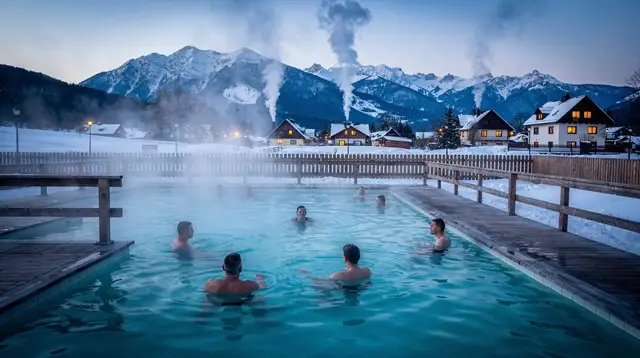
Thermal bath sessions are one area where timing changes the price noticeably: evening sessions at Termy Chochołowskie and the other Podhale baths tend to be both cheaper and quieter than daytime slots, and day-trip packages sold from Kraków often bundle a bath visit with transport at a combined rate — the thermal baths comparison lays out which baths suit which budget and schedule.
Tipping: What’s Actually Expected
Tipping in Zakopane follows the wider Polish pattern: about 10 percent in a sit-down restaurant, and rounding up rather than a fixed percentage for smaller services like a coffee, a taxi ride or a carriage driver. The gesture that signals “keep the change” is handing over cash while saying “dziękuję” (thank you) rather than waiting for coins back — a useful phrase to know even if the rest of the interaction happens in English, which is common among younger staff on Krupówki and less reliable in the villages and mountain huts. Card payment doesn’t usually include a built-in tip prompt the way it might elsewhere, so carrying a little cash specifically for tipping is worth doing even for travellers who pay for everything else by card.
Getting There Without Overspending on Transport
The route between Kraków and Zakopane is itself a budget decision. The bus is the cheapest and most frequent option — more than 50 services a day, roughly 2 to 2.5 hours — and the train costs a little more for a comparable or slightly longer journey. A rental car adds fuel, and on the single road connecting the two, the Zakopianka, Friday evenings, Sunday afternoons, holidays and snowy weekends can double the drive time, which turns a marginal cost saving into a real loss of a day.
The Kraków-to-Zakopane transport guide compares bus, train and car costs and timing directly, and the Kraków airport transfer guide does the same for the roughly 115 km run from KRK. For travellers who prefer not to manage buses, timetables or a rental car at all, a private guide and transport package between Kraków and Zakopane converts several separate costs — bus or fuel, a guide, and sometimes entry fees — into one known figure decided before the trip starts.
Where to Stay and How It Affects the Rest of the Budget
Accommodation choice ripples into every other cost on this page. A room near Krupówki costs more but cuts transport spending to nearly zero; a room in Kościelisko or Białka Tatrzańska costs less but adds minibus or taxi fares for every trip into town or to a trailhead. The where-to-stay guide weighs that trade-off area by area, and pairs naturally with a first look at how many days a first Zakopane trip actually needs, since a longer stay makes a slightly pricier, more central room easier to justify against the transport it saves.
For a final walk through the town itself once the numbers are settled, a private walking tour of Zakopane’s old town is a fixed-cost way to see the wooden villas, the old church and Pęksowy Brzyzek cemetery without guessing at which sights are worth an entry fee and which aren’t. And before finalising any budget, it’s worth reading through the common Zakopane mistakes and tourist traps that quietly inflate a trip’s cost — several of them are pricing issues rather than planning ones.
Money and Prices in Zakopane: Frequently Asked Questions
Can I pay in euros in Zakopane?
No. Poland uses the złoty (PLN), and shops, restaurants and ticket booths in and around Zakopane price and charge in złoty only. Some souvenir stalls near Krupówki may quote a euro price out of habit, but the actual transaction still runs through a złoty till, usually at a poor rate. Withdraw or exchange złoty rather than carrying euros.
Is Zakopane cheap or expensive compared to the rest of Poland?
Zakopane is the most expensive town in the Podhale region because it lives on tourism, but it is still noticeably cheaper than Western Europe outside the Christmas-New Year and February school-holiday weeks. In those two windows, room rates and restaurant prices on Krupówki climb close to Western European levels, then fall back once the holidays end.
Where do I actually need cash in Zakopane?
Horse carriages toward Morskie Oko, stalls at the Nowy Targ market, some oscypek and food stands on Krupówki, and cafés inside the mountain huts (schroniska) are the places most likely to want cash. Card readers are common in restaurants, shops, ticket offices and the PKL cable car and funicular counters.
How much is the Tatra National Park entry ticket?
In 2026 the standard TPN ticket costs 11 PLN, the reduced rate is 5.50 PLN, and a seven-day pass costs 55 PLN; entry is free under age 7. The ticket is required on every marked trail inside the park, not only at named attractions, and can be bought online at tpn.gov.pl or at trailhead booths.
Why do prices jump so much around Christmas and February?
Christmas-New Year and the Polish winter school holidays (roughly mid-January to the end of February) are the two busiest windows of the year in Zakopane. Accommodation, restaurants and lift queues all peak with demand, and prices on Krupówki and at the ski lifts rise to match Western European levels for those weeks specifically.
Do I need cash for the funicular, cable car or ski lifts?
No. The PKL company, which runs the Gubałówka funicular and the Kasprowy Wierch cable car, along with the main ski lift operators, takes cards at the counter and sells tickets online. Cash is not required for any of these; it becomes useful only for smaller, informal purchases like carriage rides or market stalls.
Popular day trips
Verified deep-linked GetYourGuide tours. Book through these links and we earn a small commission at no cost to you.
GetYourGuide does not provide a product photo for this activity — the image shows the meeting point, photographed by us.