Christmas and New Year in Zakopane
What is Zakopane like at Christmas and New Year?
Zakopane's Christmas market runs on Plac Niepodległości from mid-December to mid-January, and the town usually has snow, which gives it a strong festive winter feel. This is one of the two busiest and most expensive weeks of the year, alongside the school holidays that follow in mid-January, and the national park's high trails stay closed until around mid-June, so the season is built around the town, skiing and the thermal baths rather than high-mountain hiking.
Ask a Pole where to feel Christmas in Poland, and a good number of them will say Zakopane before they say anywhere else. The wooden houses, the smoke over the rooftops, the mountains closing the skyline, and a market that runs for a full month give the town a version of Christmas that a big city cannot easily match. It is also, without much competition, one of the two most crowded and most expensive weeks anyone will spend here. This page sets out what the season actually looks like, what is open, what is firmly shut, and how to plan around both.
The Christmas Market on Plac Niepodległości
The market on Plac Niepodległości, a short walk from the top of Krupówki, is the fixed point of the whole period. It opens in the middle of December and stays open through Christmas, New Year and into the middle of January, which means it overlaps with the first days of the winter school holidays rather than closing before them. Wooden stalls sell mulled wine, grilled oscypek substitutes made from cow’s-milk cheese since sheep’s-milk oscypek is only produced from May to September, roasted meats, honey and handicrafts, and the square becomes the natural evening gathering point for the whole town, locals and visitors together.
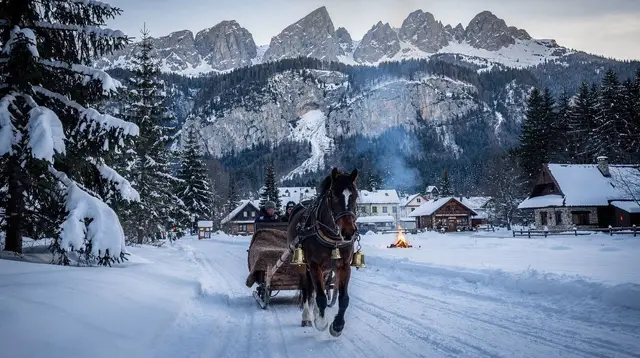
This is not a one-off fair for a weekend. Because it runs for roughly a month, it sets the tone for the whole period covered by this guide: strings of lights along Krupówki, horse-drawn sleighs waiting near the centre, and a steady flow of people moving between the market, the restaurants and the funicular station at the top of the street. Anyone visiting for a specific date should check the market’s own published dates for that particular year rather than assume an exact opening day, since the calendar shifts by a few days from one year to the next.
Snow, festivity and where this sits in the winter calendar
Zakopane’s altitude, from around 830 m in the lower town up past 1,000 m towards Gubałówka, means that snow on the ground for Christmas is common, but “common” is not “guaranteed”. Some winters deliver a full white town from late November; others arrive at Christmas with thin or patchy cover that thickens only in January. What is far more reliable than the snow itself is the atmosphere: it is a period the whole town organises itself around, and the sense of a proper mountain winter is present even in years when the snow is not deep.
For the wider picture of how the season unfolds month by month, the winter season guide lays out December through March in full; this page is specifically about the Christmas and New Year window inside that season. Time zone matters little for planning but is easy to get wrong when booking transport from abroad: Zakopane runs on Central European Time, UTC+1 in winter, the same clock as Paris, Berlin and Rome.
Why this is one of the two priciest weeks of the year
Two windows dominate the Zakopane winter calendar for crowding and cost: Christmas and New Year, and the Polish winter school holidays that follow, staggered by region from mid-January to the end of February. The school holidays and crowds guide covers the second window in detail. Christmas and New Year comes first, and it draws not only domestic visitors but a strong international crowd looking for a snowy setting to spend the turn of the year.
The practical effect is straightforward: accommodation fills up early, minibuses to the trailheads and ski areas run at capacity, restaurant tables need booking ahead on Christmas Eve and New Year’s Eve specifically, and the Zakopianka road from Kraków sees its heaviest traffic of the year around these dates. Anyone planning a trip for this window should treat “early booking” as the operating rule for lodging, restaurants on the two key evenings, and any ski pass or thermal bath slot, rather than something to sort out on arrival.
| Period | Crowd level | What tends to sell out first |
|---|---|---|
| Christmas Eve to New Year’s Day | Peak | Restaurant tables, New Year’s Eve venues, accommodation |
| Early January (after New Year) | High, easing slightly | Ski passes on fine-weather days |
| Winter school holidays (mid-Jan to end Feb) | Second peak | Accommodation, minibuses, thermal bath slots |
| Late November to mid-December | Quiet | Nothing much — the shoulder before the market opens |
What stays closed: the high trails of the national park
The one thing this season does not offer is high-mountain hiking. Tatra National Park closes its high trails from around 1 November until about mid-June, because of avalanche risk, and this closure runs straight through Christmas, New Year and the school holidays that follow.
Routes that define the summer programme — the walk to Morskie Oko, the ridge to Giewont, the ascent of Rysy, the Valley of Five Polish Lakes — are not walkable in this window, and no amount of good planning changes that. Some lower, paved valley tracks can stay accessible depending on the year’s snow, but this is fundamentally not the season to build a trip around summit trails.
That closure is exactly why the Christmas and New Year programme in Zakopane looks the way it does: it is built around the town, the ski slopes, the thermal baths and day trips, not around the peaks. The booking guide for TPN, Morskie Oko and Kasprowy Wierch is worth reading before a summer visit, but for a Christmas trip it mostly explains what will not be available this time of year.
So what fills the days here at Christmas?
With the high trails off the table, four things carry the season: the town itself, skiing on the lower and mid-mountain slopes, the thermal baths of the surrounding villages, and day trips out to Kraków.
In town. Krupówki at Christmas is lit, busy and built for an evening stroll between the market stalls, the wooden villas of the Zakopane style and a stop for something warm. The Gubałówka funicular keeps running in most winter weather and gives the wide panorama of the whole Tatra chain from above the snow line, without needing a marked trail.
A walker who wants Zakopane’s history and architecture laid out properly, guided rather than self-directed, can book a private guided tour of Zakopane town, which covers the centre, the villas and the old church at a pace suited to short winter daylight.
Skiing. The Kasprowy Wierch cable car is the only genuinely high-mountain skiing in the area and, weather allowing, it operates through this period, though it can stop in strong wind or the halny föhn wind that periodically shuts it down regardless of season.
Most of the winter’s skiing, though, happens on gentler slopes that never depend on high-altitude access: Harenda, Szymoszkowa and Nosal close to town, and further out, Białka Tatrzańska’s Kotelnica area and Bukowina Tatrzańska. None of these need the national park’s high trails to be open, which is exactly why they carry the season. See the things to do in skiing and snowboarding category for the full spread of options.
Thermal baths. Evenings and half-days at the thermal complexes are a natural fit for short winter days: Termy Chochołowskie, the largest in Poland, and Terma Bania against Terma Bukovina for a side-by-side comparison of the two other big pools. None of them close for winter — if anything, sitting in outdoor water at 34 to 38 degrees with snow on the ground is part of the appeal. The thermal baths category page lists every option within reach of the town.
Kraków. With the mountains off-limits above the tree line, a day trip to Kraków becomes a stronger option in December and January than it might feel in summer, since it trades hiking for the city’s Christmas market, its old town and its own festive calendar.
The Kraków day trip guide sets out the logistics; for a guided version rather than independent travel, a private guided day trip to Kraków’s Old Town or a Kraków day trip covering Wawel with a guided walk and golf-cart ride both cover the ground without needing a rental car on the Zakopianka in winter conditions.
For those based in Kraków rather than Zakopane, the reverse trip works too, with a private guided tour of Zakopane with transportation included from the city.
New Year’s Eve specifically
New Year’s Eve in Zakopane concentrates everything the Christmas period brings, on a single night. Plac Niepodległości and the top of Krupówki become the centre of the town’s public celebration, restaurants run at full capacity with advance bookings essentially required, and highlander-style evenings with live music, in venues around town and in the surrounding villages, are sold out well ahead of the date in a normal year. Anyone arriving without a plan for dinner or a table on 31 December should expect to be turned away at the door of the obvious first choices; this is the one evening of the whole winter where the town’s usual capacity is most visibly tested.
A short comparison: Christmas week against the quieter weeks around it
| Window | What’s different |
|---|---|
| Late Nov – early/mid Dec | Market not yet open, thin crowds, snow cover uncertain |
| Mid-Dec – 1 Jan | Market open, peak crowds and prices, New Year’s Eve concentrates demand |
| Early-mid Jan | Market still running, crowds ease slightly before school holidays |
| Mid-Jan – end Feb | Winter school holidays, second peak, staggered by Polish region |
| March | Market long closed, skiing often still good, noticeably quieter |
Practical basics for a Christmas visit
Poland uses the złoty, not the euro, and cards are accepted at most market stalls and restaurants though some smaller stands prefer cash. The clock is Central European Time, UTC+1 through the whole winter. English is more common among younger staff on Krupówki than in the surrounding villages. For getting here, the Kraków to Zakopane transport guide and the driving guide covering the Zakopianka, parking and snow both matter more than usual in this window, since the single main road carries its heaviest traffic of the year around Christmas and New Year.
Anyone wanting a broader sense of what a winter stay without skiing can look like, beyond the market itself, can read the winter without skiing activities guide, and the best time to visit tool is a quick way to see how this window compares with the rest of the year at a glance.
Zakopane at Christmas and New Year: Common Questions
When does the Zakopane Christmas market open and close?
The market on Plac Niepodległości runs from the middle of December through to the middle of January, covering both Christmas and New Year and running a little into the start of the winter school holidays.
Is snow guaranteed in Zakopane for Christmas?
No. Zakopane has snow in town most years at this time of year because of its altitude, but it is not guaranteed every single year, and conditions can vary from a full white cover to patchy or wet snow depending on the winter.
Why is Christmas and New Year one of the most expensive times to visit?
It is one of two peak windows in the Zakopane winter, together with the school holidays that follow in mid-January. Demand for accommodation, minibuses and ski passes rises sharply over these dates, and the town fills with both domestic and international visitors, which pushes prices up across the board.
Can I hike in the Tatras over Christmas and New Year?
The high trails of Tatra National Park are closed from around 1 November until about mid-June because of avalanche risk, so classic high routes to places like Giewont, Rysy or the Valley of Five Polish Lakes are not walkable in this period. Lower valleys with paved tracks can stay open depending on conditions, but this is not the season for summit hiking.
What time zone is Zakopane in during winter?
Zakopane runs on Central European Time, UTC+1 in the winter months, the same as Paris, Berlin, Rome and Madrid.
Is Zakopane crowded on New Year’s Eve?
Yes. Krupówki and the area around Plac Niepodległości are at their busiest on New Year’s Eve, with the Christmas market, restaurants and highlander-style evenings all operating at capacity, so booking tables and rooms well ahead matters more here than at almost any other point in the year.
What can visitors actually do in Zakopane at Christmas if hiking is out?
The programme shifts to the town itself, the ski slopes that do not require high-altitude terrain, the thermal baths of the Podhale villages, and day trips to Kraków. Krupówki, the funicular to Gubałówka and the cable car to Kasprowy Wierch, when it is running, remain accessible.
How does Christmas and New Year compare to the winter school holidays?
Both are peak periods, but they are not the same window. Christmas and New Year runs through late December and the first days of January, then eases briefly before the Polish winter school holidays, staggered by region from mid-January to the end of February, bring a second wave of crowds and prices.
Winter adventures
Verified deep-linked GetYourGuide tours. Book through these links and we earn a small commission at no cost to you.
GetYourGuide does not provide a product photo for this activity — the image shows the meeting point, photographed by us.