Does Białka Tatrzańska earn a spot in your Zakopane trip?
Ask around Zakopane about Białka Tatrzańska and you will hear two things in the same breath: that it has the best skiing for families in the region, and that its thermal baths pull water from deeper underground than most of its neighbours. Both are true, and both come with a condition worth stating plainly before you book anything. Kotelnica, the ski area, is not a high-mountain resort. Terma Bania, the baths, is not a substitute for a day in the national park. What Białka Tatrzańska does well is give travellers an easy, reliable, low-drama day close to Zakopane — good skiing for people who are not trying to ski a mountain, and hot water for people who need a rest day from one.
That distinction matters more here than at most stops on this coast of the Tatras, because the comparison everyone reaches for is Kasprowy Wierch, and the two places are not interchangeable. This page sets out what Kotelnica and Terma Bania actually offer, what they cost in 2026, how they compare to their obvious rivals, and who should build a day around them rather than skip past.
Kotelnica: what the ski area actually is
Kotelnica is the ski area at Białka Tatrzańska, a Podhale village about 20-30 minutes from Zakopane by car or minibus. It carries roughly 20 km of marked pistes across 10 lifts, which makes it the largest ski area in the region outside Kuźnice and Kasprowy Wierch, and by a wide margin the most family-friendly. The runs are groomed, mostly blue and easy red in difficulty, and laid out so that a nervous first-timer and a competent intermediate can share the same lift system without either one being bored or terrified.
That gentleness is the whole point, and it is also the honest limit of the place. Kotelnica sits at valley and foothill altitude, not up among the peaks. Its slopes are covered by snowmaking machines that run through the winter regardless of what the sky is doing, which is exactly why the season here holds together from December to April in a way that unassisted snow cover at this altitude would not manage on its own. That is a practical strength — no one is stuck waiting for a storm — but it is also the tell that this is not alpine terrain. Real vertical, real altitude, and weather-made snow belong to one place in this massif, and it is not Białka Tatrzańska.
Kotelnica versus Kasprowy Wierch: two different sports
| Kotelnica (Białka Tatrzańska) | Kasprowy Wierch | |
|---|---|---|
| Altitude | Foothill / moderate mountain | High mountain, top station 1,987 m |
| Vertical drop | Gentle, family-scale | About 973 m, genuine alpine descent |
| Snow source | Snowmaking machines, reliable | Natural high-altitude snow, weather-dependent |
| Difficulty | Mostly blue, some easy red | Blue to genuinely demanding off-piste routes |
| Who it suits | Beginners, children, families | Confident intermediates and experienced skiers |
| Season | December to April, snowmaking-backed | Roughly December to April, weather permitting |
| Day pass (2026) | Roughly 150-190 PLN | Higher, cable-car-linked pricing, timed tickets |
The honest way to read that table: if your group includes a child on skis for the first time, or an adult who has never worn them, Kotelnica is the right answer and Kasprowy Wierch would be a bad day. If your group wants to say they skied a real mountain in the Tatras, only Kasprowy Wierch delivers that, and Kotelnica should not be sold as a stand-in for it. The two are not competing for the same skier — see how the region’s ski areas compare and the Kasprowy Wierch skiing guide before picking one over the other.
Skiing at Kotelnica: the practical details
Lift tickets are sold by the hour or the day, with a full day running roughly 150-190 PLN per adult in the 2026 season, cheaper for shorter windows and for children. Equipment rental, lessons and a locker are all available on site, so arriving without gear is normal rather than a problem. Because the runs are gentle and the base is low, the resort also runs night skiing sessions on some slopes in season, which suit a short evening outing better than a full high-mountain resort ever could.
Queueing here is also shorter and less weather-dependent than at the cable car up to Kasprowy Wierch, which sells timed, dated tickets that can sell out on a clear day — one more reason families with limited patience tend to end up at Kotelnica by the second visit, even if the first one was booked for the higher mountain.
Terma Bania: the deep-water thermal baths
The other reason to come to Białka Tatrzańska is Terma Bania, one of the thermal bath complexes strung across the Podhale villages. What sets it apart from some of its neighbours is the source: the water is drawn from about 2,500 m underground, arriving naturally hot in the 34-38°C range across its pools. That depth is unusual even by the standards of a region that has built its winter tourism around thermal water — it means less reliance on artificial heating and a mineral profile shaped by a genuinely deep aquifer rather than a shallow one.
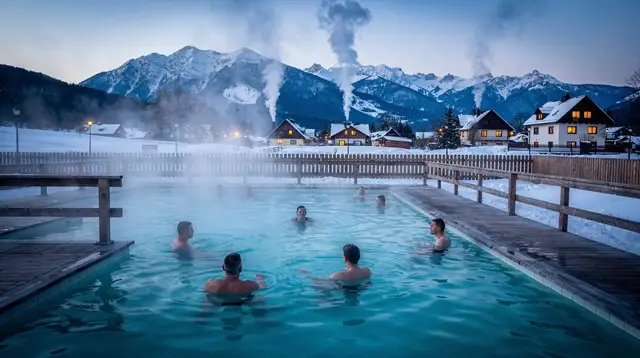
In practice that translates into large outdoor and indoor pool areas, whirlpools, saunas, and in season a view of steam rising off the water against a backdrop of snow-dusted hills — the same appeal that draws day-trip buses from Kraków, minus the two-hour drive each way.
A skip-the-line entry ticket to Terma Bania is the simplest way in if you are visiting independently and do not want to queue at the counter, and the site also sells a standard Terma Bania entry ticket for a straightforward half-day soak. Evening sessions tend to be cheaper and noticeably quieter than midday, and locals treat that slot as the smart one.
Terma Bania versus the other Podhale thermal baths
Białka Tatrzańska is not the only village in the valley with hot water. Chochołów runs Termy Chochołowskie, the largest thermal complex in Poland; Bukowina Tatrzańska runs Terma Bukovina; Szaflary has its own smaller baths at Gorący Potok. The honest differentiator for Terma Bania is depth of source and its pairing with Kotelnica next door, which makes a ski-then-soak day possible in one village rather than two.
For a fuller side-by-side, read how the region’s thermal baths compare and Terma Bania against Terma Bukovina specifically; if your priority is the single biggest pool complex rather than the deepest water, the guide to Termy Chochołowskie is the better starting point.
| Baths | Village | Water source | What it’s known for |
|---|---|---|---|
| Terma Bania | Białka Tatrzańska | About 2,500 m deep, 34-38°C | Deepest source, paired with Kotelnica skiing |
| Termy Chochołowskie | Chochołów | Similar range | Largest complex in Poland, about 30 pools |
| Terma Bukovina | Bukowina Tatrzańska | 30-38°C | 20 pools, quieter village setting |
| Gorący Potok / Termy Szaflary | Szaflary | 30-38°C | Closer to Zakopane, smaller scale |
Day-trip operators from Kraków also sell the baths bundled with transport, which removes the need for a rental car entirely; a round-trip transfer to Bania thermal baths from Kraków is built exactly for that, useful for travellers based in Kraków who want the water without also sorting out a Zakopane stay.
Getting from Zakopane to Białka Tatrzańska
Białka Tatrzańska sits roughly 20-30 minutes from central Zakopane by car or by the minibuses that run through the Podhale villages toward the thermal baths circuit. No cable car or funicular connects the two, and there is no train station in the village — this is a road trip, short but real.
Drivers should treat the same caution that applies to the whole valley: the Zakopianka road can be slow in winter and on weekends, though the side roads out to Białka Tatrzańska carry far less of that traffic than the main Kraków approach. Travellers without a car can catch a minibus from the Zakopane bus station area; ask for Białka Tatrzańska or Terma Bania specifically, since several villages share similar-sounding stops along that route.
For anyone building a longer stay rather than a single day, Białka Tatrzańska sits comfortably inside a three-day family itinerary or a three-day winter trip, usually as the “easier” day sandwiched between a harder hike or a Kasprowy Wierch morning and a rest day.
Beyond skiing and soaking: quads, sky walks and snowmobiles
Białka Tatrzańska and the villages around it also anchor a cluster of activity operators that combine the thermal baths with something more active — a pattern common across the Podhale valleys. A combined quad ride, sky walk and thermal baths day packages three different Podhale experiences into one booking, useful for a group that does not want to plan three separate outings.
For visitors who want the adrenaline element without losing the soak at the end, a snowmobile run paired with the thermal baths follows the same logic in winter conditions. None of these substitute for the ski area itself, but they explain why some travellers give Białka Tatrzańska a full day rather than a rushed afternoon.
Who should build a day around Białka Tatrzańska
This is the right stop for families with a child learning to ski, for beginners who would find Kasprowy Wierch intimidating or genuinely unsafe, and for anyone on a rest day who wants heat and water rather than another climb. It is also a sensible half-day for travellers based in Kraków who want thermal baths without committing to a full Zakopane stay, since transfers run directly to the baths.
It is the wrong stop for skiers chasing altitude, vertical drop or real alpine terrain — that booking belongs at Kasprowy Wierch, weather and ticket availability allowing. It is also not the place to expect the biggest thermal complex in the country; that title, on square metres of pool alone, sits with Termy Chochołowskie. Białka Tatrzańska’s case rests on the combination — solid family skiing next door to genuinely deep, hot water — not on either element being the single best version in the region.
Planning a day at Białka Tatrzańska
A half-day covers either the slopes or the baths comfortably: a morning of skiing finishing by early afternoon, or two to three hours in the pools without rushing. A full day lets you do both, typically skiing in the morning while the slopes are quieter and legs are fresh, then moving to Terma Bania in the afternoon once muscles start asking for heat rather than more runs. Book lift tickets and baths entry ahead in the Christmas-New Year and February school holiday weeks, when both fill up; outside those weeks, walk-up tickets are normally fine. Bring or rent gear for the slopes, and bring swimwear, a towel and flip-flops for the baths — rental exists on site but queues for it lengthen exactly when you are trying to save time.
Białka Tatrzańska FAQ: skiing, thermal baths and day-trip logistics
Is Białka Tatrzańska the same kind of skiing as Kasprowy Wierch?
No. Kasprowy Wierch is the only high-mountain skiing in the Polish Tatras, reaching 1,987 m with a genuine alpine vertical drop and a season shaped by the mountain’s own weather. Kotelnica at Białka Tatrzańska is moderate-altitude skiing on groomed, snow-cannon-covered slopes, built for beginners and families rather than for descending a real mountain.
How big is the Kotelnica ski area?
Kotelnica has about 20 km of pistes served by 10 lifts, making it the largest and most family-oriented ski area in the Zakopane region outside Kasprowy Wierch. It suits first-time skiers, children learning, and anyone who wants easy blue runs rather than steep terrain.
How deep is the water at Terma Bania, and does that matter?
Terma Bania draws its water from about 2,500 m underground, unusually deep for the region, which keeps the pools naturally hot, in the 34-38°C range, without relying only on heaters. It is one of the deepest thermal sources feeding the Podhale baths, alongside Termy Chochołowskie and Terma Bukovina.
How much does a day of skiing at Kotelnica cost in 2026?
A day lift pass runs roughly 150-190 PLN in 2026, depending on the season and whether it is bought online in advance. Equipment rental, a locker and lunch add to that, so budget for a family outing rather than a bargain day.
Can I ski at Kotelnica and visit Terma Bania on the same day?
Yes, they sit in the same village a few minutes apart, and combining a morning on the slopes with an afternoon in the thermal pools is the most common way locals and repeat visitors use Białka Tatrzańska. Budget enough time and money for both, since neither is a quick add-on.
Is Białka Tatrzańska suitable for beginners and young children?
Yes, more so than any other ski area near Zakopane. The slopes are gentle, the lifts are easy to use, ski schools operate on site, and the thermal baths have shallower pools and slides for children, which is why families and beginners are pointed here rather than to Kasprowy Wierch.
Do I need a car to reach Białka Tatrzańska from Zakopane?
No. It is a short drive or minibus ride of about 20-30 minutes from Zakopane, and minibuses running toward the thermal baths and the Podhale villages pass close to both Kotelnica and Terma Bania, so a rental car is convenient but not required.