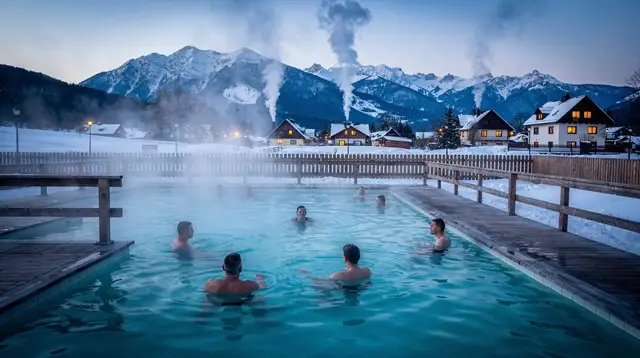
A village built around one thing: hot water
Szaflary is a small Podhale village on the road between Nowy Targ and Zakopane, about 17 km north of Zakopane’s town centre — a 20 to 25 minute drive or minibus ride outside the worst Zakopianka traffic. If you came looking for a wooden church, an old market square, or a viewpoint over the Tatra chain, this is the wrong stop: that kind of visit belongs to Chochołów or Nowy Targ, not here.
Szaflary’s reputation rests on two thermal bath complexes standing on its edge, Gorący Potok and Termy Szaflary, drawing on the same Podhale geothermal water that also feeds Termy Chochołowskie further west and the baths at Białka Tatrzańska and Bukowina Tatrzańska further east.
That is the honest scope of this page. Every credible source on the village describes the same offer: two thermal bath sites, a location convenient for a stop between Kraków and Zakopane, and evening sessions known for being cheaper and calmer than daytime ones. There is no second attraction to pad the itinerary with, and this guide will not invent one. If you are planning a day around Szaflary expecting hiking trails, a historic quarter, or a market, adjust the plan — this village earns its place on the map because of the water under it, not because of anything built above ground.
Gorący Potok and Termy Szaflary: two baths, not one
The first thing worth clearing up, because visitors often assume Szaflary has a single “thermal baths” site, is that it actually has two. Gorący Potok and Termy Szaflary sit close to each other on the edge of the village, but they are separate businesses with separate pools, separate pricing, and separate tickets. Both draw on the geothermal water that runs under this stretch of the Podhale, the same resource that heats the much larger Termy Chochołowskie complex and the baths further along the valley toward Białka Tatrzańska.
Practically, this means it is worth checking which of the two a booked ticket actually covers before arriving, rather than assuming either name gets you into both. A ticket for Gorący Potok gets you into Gorący Potok; a ticket for Termy Szaflary gets you into Termy Szaflary. Travellers who want the option to compare or to use whichever has shorter queues on the day should check current entry conditions locally rather than assume interchangeable access.
an entry ticket to the Gorący Potok pools covers the simplest version of the stop: arrive, soak, leave, without committing to a guided day trip built around it. For travellers who want to spend longer and use the site as a genuine half-day rather than a quick dip, a full-day ticket for the Szaflary thermal baths removes the pressure of a time-limited session.
And where the two names get confused online, a separate entry ticket specifically for Gorący Potok is worth having bookmarked so there is no doubt at the gate which site a booking is for.
Getting there from Zakopane, Kraków, and the villages around
Szaflary sits directly on the road connecting Nowy Targ to Zakopane, which is also the corridor most Kraków-bound traffic uses. From Zakopane it is about 17 km, roughly 20 to 25 minutes by car outside peak times, longer on Friday evenings, Sunday afternoons, and snowy weekends when the Zakopianka slows everywhere. Minibuses running the Zakopane-Nowy Targ route pass through the village and can drop passengers close to the baths, so a rental car is not required for this specific stop the way it sometimes helps for scattered Tatra trailheads.
From Kraków, Szaflary is close enough to the main road toward Zakopane that day-trip operators routinely fold a stop here into a longer itinerary rather than sell it as a destination on its own. This is in fact the most common way visitors actually reach Szaflary: not as a planned stop from Zakopane, but as one stage of a day that also includes a look at the mountains, sold as a combined package.
A tour built this way — a Kraków-based day combining a snowmobile ride with a thermal bath stop — is a realistic example of how Szaflary gets used in practice: as the relaxing half of a day whose main event happens elsewhere in the Tatras. For a route walkthrough covering how Kraków, Nowy Targ, and Zakopane connect by bus, train, and car, see getting from Kraków to Zakopane, and for what a Kraków-based day toward the mountains generally covers, see a day trip to Zakopane from Kraków.
Coming from the other Podhale villages, Szaflary is a short hop: Nowy Targ is a few minutes further along the same road, Kościelisko is on the opposite side of Zakopane, and Białka Tatrzańska and Bukowina Tatrzańska sit east of town — all reachable by the same web of local minibuses that link Podhale villages to Zakopane’s bus station area.
Day session or evening session: what actually changes
The one piece of practical advice that comes up consistently about Szaflary’s baths is the same one that applies across the region’s thermal complexes: go in the evening if the schedule allows it. Evening sessions are cheaper than daytime tickets and noticeably less crowded, because day visitors, families on a fixed school-holiday schedule, and organised groups concentrate their visits in the late morning and afternoon. An evening slot after a day of hiking or after a Kasprowy Wierch or Morskie Oko outing has the added advantage of timing itself naturally: sore legs and cooling temperatures make a warm pool more useful at 7pm than at noon.
This is not a Szaflary-specific quirk — it holds at Termy Chochołowskie and at the Białka and Bukowina baths as well — but it is worth repeating here because Szaflary’s small scale means the difference between a quiet evening pool and a packed daytime one is more noticeable than at a larger complex. Anyone weighing which of the region’s thermal baths suits a given day should compare the options directly: see how the Zakopane-area thermal baths compare and which thermal baths to choose in the Tatras for a side-by-side rather than picking blind.
What Szaflary does not have, and why that is fine
It is worth being direct about the limits of this stop, because the temptation with any place mentioned on a map is to write it up as a full day out. Szaflary does not have a historic old town, a museum, a marked hiking trail network, or a viewpoint that belongs on a Tatra-region shortlist. It is not a base for exploring the mountains the way Kościelisko or Zakopane itself is, and it is not a cultural stop the way Chochołów’s wooden village or Nowy Targ’s Thursday market are. There is no verified second attraction here to send readers chasing.
That is not a criticism of the village — it simply means Szaflary should be planned for what it is: a practical, well-located stop for warm water, not a place to build a full itinerary day around. Travellers who try to turn it into one, expecting sights that do not exist on the ground, end up disappointed by a stop that was never meant to carry that much weight. Treat it the way you would treat a service station with a very good coffee: useful, worth the detour, not the destination itself.
Who Szaflary suits, and who should skip it
Szaflary works well for a specific set of travellers. Hikers coming down from a long day on Kasprowy Wierch or around Giewont who want to soak out the stiffness before heading back to a hotel will get real value from an hour or two here, especially in the evening. Families with young children who need a lower-intensity afternoon between more demanding mountain days find it an easy, low-stakes stop.
Kraków-based travellers doing a single big day toward the Tatras, who want a Tatra glimpse plus something relaxing rather than two separate high-intensity activities, are a natural fit for the combined tours built around Szaflary. And budget-conscious travellers who specifically plan around the cheaper evening tickets get the best value the village has to offer.
Conversely, travellers with only one day in the region who want to maximise mountain time — a single shot at Morskie Oko or the Kasprowy Wierch cable car — should not carve time out of that day for Szaflary; the baths are a good use of a spare afternoon, not a competitor for a limited high-mountain window. Travellers who specifically want the largest, most feature-complete thermal complex in the region, with the widest range of pools and slides, are usually better served at Termy Chochołowskie, which is built and priced as a full-day destination rather than a stop.
Comparing Szaflary with the other Podhale thermal baths
The Podhale sits on the same geothermal field in several places, and Zakopane-area travellers often end up choosing between four or five thermal bath options rather than one. Szaflary’s two sites, Gorący Potok and Termy Szaflary, are on the smaller and more local end of that range — useful for a stop on the way through rather than a headline day out. Termy Chochołowskie in Chochołów is the largest, with around 30 pools, and is the one worth a dedicated half or full day.
Terma Bania in Białka Tatrzańska and Terma Bukovina in Bukowina Tatrzańska sit between the two in scale, each with their own draw — see the direct comparison at Terma Bania versus Terma Bukovina. Szaflary’s advantage over all of them is not size but position: it sits directly on the road most travellers already drive or ride between Kraków, Nowy Targ, and Zakopane, which makes it the easiest of the group to fold into a journey already happening rather than a trip taken on its own.
For travellers weighing a snowmobile, quad, or treetop-walk day that also wants a thermal stop built in rather than added separately, combined tours cover that directly: a Kraków-based day pairing quad riding, a treetop skywalk, and thermal baths folds Szaflary or an equivalent stop into an adventure-focused itinerary, which suits anyone who wants the mountains and the water in the same day without organising each piece separately.
Planning a stop: tickets, timing, what to bring
A visit to either Gorący Potok or Termy Szaflary does not need heavy planning, but a few practical points make it smoother. Bring a swimsuit, a towel — some complexes rent them, but having your own avoids a queue — and flip-flops for wet changing-room floors. A small amount of cash or a locker deposit coin is useful even where the main ticket accepts cards. Booking an entry ticket online ahead of arrival is not mandatory the way a Morskie Oko car park reservation or a Kasprowy Wierch cable car slot is, but it removes the uncertainty of a counter queue, especially on weekend evenings when locals as well as visitors come for the cheaper session.
Because the two sites are separate, decide in advance which one a booking covers, and do not assume a ticket for one grants access to the other. Travellers building a longer Podhale loop — Szaflary for a soak, Nowy Targ for its Thursday or Saturday market, Chochołów for its wooden village — can string these together along the same short stretch of road without much backtracking; a Zakopane weekend itinerary is a reasonable frame for fitting a Szaflary stop in alongside the main mountain days. For the fuller picture of what thermal bathing options exist across the region before settling on one, the thermal baths hub lists every site side by side.
Szaflary thermal baths — frequently asked questions
What is there to do in Szaflary besides the thermal baths?
Very little that needs planning around. Szaflary is a residential Podhale village on the road to Nowy Targ, without a historic centre, museum, or viewpoint that pulls travellers off the Zakopianka on its own merits. The reason to stop is the thermal water, and this page does not claim otherwise.
Are Gorący Potok and Termy Szaflary the same place?
No. They are two separate thermal bath complexes standing close together on the edge of the village, both fed by the same Podhale geothermal water but run and ticketed independently, each with its own pools.
How far is Szaflary from Zakopane, and how do you get there?
About 17 km, roughly 20 to 25 minutes by car or minibus outside peak Zakopianka traffic. Minibuses running between Zakopane and Nowy Targ pass through Szaflary and can drop passengers near the baths.
Are evening sessions at Szaflary really cheaper and quieter?
Yes, evening sessions are consistently cheaper and less crowded than daytime tickets at Podhale thermal baths generally, Szaflary included, because day visitors and organised groups concentrate their visits earlier.
Can Szaflary be combined with a Kraków day trip?
Yes — this is one of its main uses. Day trips sold from Kraków toward the Tatras often bundle a stop at the Szaflary baths with a look at the mountains, since the village sits directly on the Kraków-Nowy Targ-Zakopane route.
Is Szaflary worth a full day?
No. A soak plus changing and a meal fills two to four hours comfortably. Travellers wanting a full day of thermal bathing are better served by the larger Termy Chochołowskie complex.
Do you need to book tickets in advance?
It is not strictly required, but booking an entry ticket online ahead of time avoids a counter queue, especially on weekend evenings when the cheaper sessions draw more visitors.
What should I bring to a Podhale thermal bath visit?
A swimsuit, a towel or a rented one, flip-flops for wet floors, and a change of clothes. A locker deposit coin or a little cash helps even where the main ticket is paid by card.