Nowy Targ is the main town of the Podhale, sitting on the plain roughly halfway along the road between Kraków and Zakopane. It has no mountain, no lake and no ski lift of its own. What it has is a market: an open-air trade in sheepskin, leather and cheese that has run on Thursday and Saturday mornings since the town was granted the right to hold it in 1487. That is the whole case for stopping here, and this guide treats it as exactly that — a market-day stop on a route you are already taking, not a mountain destination to plan a day around.
Why this is a market stop, not a mountain stop
Every other page in this guide to the Tatras and the Podhale is built around a summit, a valley, a cable car or a lake. Nowy Targ breaks that pattern on purpose. The town sits on open, flat farmland at the northern edge of the Podhale, well short of the foothills that start rising again around Poronin and Szaflary to the south. There is no trailhead here, no cable car, no chained ridge, nothing that belongs on a hiking itinerary. If you are looking for a first taste of the mountains, keep driving: Nowy Targ is not it.
What Nowy Targ has instead is trade. It has functioned as the market town for the surrounding Podhale villages for over five centuries, and that function — not scenery, not architecture — is still the only reason to build a stop around it. The honest way to plan a visit is to ask one question first: is today Thursday or Saturday? If the answer is no, this page recommends against a special trip. If the answer is yes, read on.
The market: a right granted in 1487
The trading rights that created the Nowy Targ market date to 1487, when the town was granted permission to hold a regular market for the villages around it. That right has held for well over five hundred years, and the market still runs on the same two mornings it always has: Thursday and Saturday. It is not a festival, not a staged “folk market” for coach tours, and not open daily — it is the ordinary trading day for Podhale farmers and craftspeople, and visitors are welcome to walk through it on the same terms as everyone else.
That distinction matters for what to expect. There is no entry fee, no fixed opening ceremony, and no guarantee that any particular stall will be there on a given week — traders come and go with the season and with what they have to sell. The market is busiest in the first hours of the morning, when farmers bring in goods before the day warms up, and it thins out steadily through late morning. By early afternoon, much of it has already packed away. If your itinerary has you passing through Nowy Targ at 4pm, you will find a quiet provincial town square, not a market.
What is actually on the stalls
The traditional core of the Nowy Targ market is built around three things the Podhale has always produced: sheepskin, leather and cheese.
| Category | What to expect |
|---|---|
| Sheepskin and leather | Coats, slippers, belts, bags and the goral kierpce moccasins worn across the region |
| Cheese | Local sheep’s-milk cheese and other Podhale dairy products sold directly by producers |
| General produce | Seasonal vegetables, preserves and household goods aimed at local shoppers, not tourists |
This is worth being precise about, because it is easy to arrive expecting a souvenir fair and be disappointed, or to arrive expecting a folk-costume spectacle and find ordinary commerce instead. Nowy Targ’s market is a working trade market first. The sheepskin and leather stalls are the part most visitors remember, because they are distinctive to the region and not something sold the same way in Zakopane’s souvenir shops on Krupówki.
For the fuller regional picture of what Podhale food culture actually looks like away from the market stalls, see the guide to Podhale cuisine and the dedicated piece on oscypek sheep cheese, which is a Podhale specialty in its own right and worth knowing about before you go looking for it here or in Zakopane. Traders’ dress and habits at markets like this one also connect to the wider Górale culture of the region, though the market itself is commerce, not a costumed performance.
Cash, and why it matters here
Card readers are common across Zakopane’s shops and restaurants, but the Nowy Targ market is one of the specific places where that convenience breaks down. Stallholders selling sheepskin, cheese and produce here are farmers and small producers, not registered shops, and most work in cash only. Carry złoty in small denominations before you arrive — there is no reliable card payment to fall back on stall by stall, and hunting for an ATM mid-market wastes the early-morning window when the best goods are still out. This is not unique to Nowy Targ: horse carriages at Morskie Oko and some mountain hut cafés work the same way, but the market is the most concentrated example a traveller following this guide will meet.
Getting to Nowy Targ
Nowy Targ sits directly on the road between Zakopane and Kraków, which is what makes it a natural stop rather than a detour. From Zakopane it is about 25 to 30 minutes by car or by the minibuses that run the Podhale routes; from Kraków it is closer to an hour and a quarter by car, longer by public transport, since most Kraków-Zakopane buses either bypass the town centre or make only a brief stop. If you are driving yourself, note that the same road, the Zakopianka, carries the traffic patterns described in the driving and parking guide — weekday mornings are far easier than Friday evenings or Sunday afternoons.
Because Nowy Targ is roughly at the midpoint of the Kraków-Zakopane run, it works well as a planned pause on a travel day rather than as its own outing. Travellers using the bus, train and car options between Kraków and Zakopane can time a market-day journey to break here for an hour or two before continuing. For a walk-through of exactly how to structure that stop, see the dedicated Nowy Targ market day-trip guide, which covers timing in more detail than a destination overview can.
One stop or two: how much time to give it
Travellers planning a single day between Kraków and Zakopane face a real trade-off here, and it is worth stating plainly rather than pretending the market deserves unlimited time. A market morning rewards an hour to ninety minutes: long enough to walk the full run of stalls once, buy what catches your eye, and leave before the crowd and the day’s heat build up.
Stretching a stop much beyond that runs into diminishing returns, because the market does not have a second layer to explore — no museum wing, no old town circuit, no viewpoint — once the stalls are seen, the reason for being there is largely used up. If your day trip also needs to fit a proper look at Zakopane itself, or a stop at one of the Podhale thermal baths, the honest call is to treat Nowy Targ as the shortest of the day’s stops, not the anchor around which the rest of the schedule bends.
Why to skip it on any other day
This page is deliberately narrow about what it recommends, because the honest answer is narrow. Nowy Targ has no summit to climb, no valley to walk, no cable car, no lake and no museum or monument documented well enough here to recommend. Outside the Thursday and Saturday market, the reasons to stop shrink to almost nothing: a provincial town square, a petrol station, a place to change buses. None of that is a reason to build a day around a stop here.
If your route happens to pass through Nowy Targ on a Monday or a Tuesday, the right call is simply to keep driving toward Zakopane or Kraków, or toward whichever village on your itinerary — Chochołów for its wooden houses, Kościelisko for the entrance to the Tatra valleys, or Białka Tatrzańska for skiing — actually has something open that day. Building flexibility around the market schedule, rather than forcing a stop regardless of the day, is the difference between an interesting half-hour and a wasted one.
Nowy Targ or Chochołów: which to add to a tight itinerary
For travellers with only a little extra time on either side of a market stop, the choice often comes down to Nowy Targ itself versus the nearby wooden village of Chochołów, a short drive further along toward Zakopane. The two do not compete for the same kind of interest: Nowy Targ rewards a market morning and nothing else, while Chochołów rewards a walk through its preserved log houses regardless of the day of the week.
A traveller passing through on a non-market day has an easy answer — skip Nowy Targ, go to Chochołów. On a market morning with limited time for both, the market’s Thursday-and-Saturday-only schedule makes it the one to prioritise, since Chochołów’s wooden houses are there every day of the year and can be folded into a later leg of the same trip.
Fitting a market morning into a Kraków-Zakopane route
The most natural way to use Nowy Targ is as a deliberate break in a travel day that was already heading between Kraków and Zakopane. A traveller doing the one-day Zakopane trip from Kraków on a Thursday or Saturday can time the outbound leg to pass through Nowy Targ in the early morning, walk the stalls for an hour, and still reach Zakopane with a full day ahead. The same applies to longer routes: the three-day classic Tatras itinerary has enough road time built in that a market-day pause costs nothing in the schedule.
Some day tours running between Kraków and the Zakopane area already route through or near the Podhale on their way to the mountains and the thermal baths, which makes a market-day departure worth checking before you book independently. One option that covers the ground between the two towns while also building in time at the baths is the full-day trip from Kraków that combines a Zakopane visit with an afternoon at the thermal baths, which follows broadly the same corridor a self-driven market stop would use.
Continuing toward the thermal baths
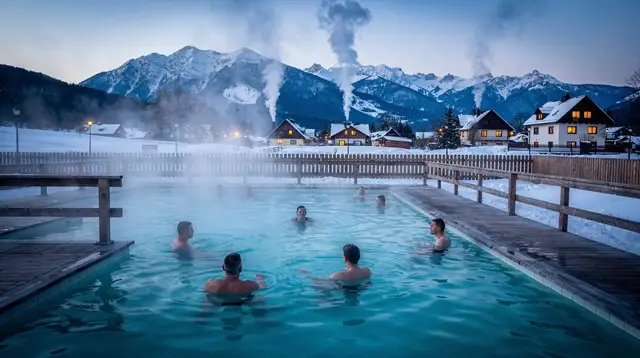
Nowy Targ’s position on the plain also puts it close to the cluster of thermal baths that draw on the same hot springs running under this part of the Podhale. Szaflary, a short drive south, and Chochołów, a short drive west, both sit within easy reach, and pairing a market morning here with an afternoon at one of the baths is a sensible way to fill a travel day without doubling back. The guide to Termy Chochołowskie and the comparison of Terma Bania against Bukovina both cover the practicalities of which bath suits which kind of visit.
For travellers coming from Kraków rather than staying in Zakopane, a shared day trip from Kraków to the Zakopane area’s hot springs can be booked to cover the same ground, with the option to add entry directly at the Chochołowskie thermal baths near Chochołów or at Terma Bania in Białka Tatrzańska if the afternoon plan runs that way instead.
None of these tours are built around Nowy Targ itself — they simply pass near it — which is consistent with how this page treats the town: worth a stop on the way, not a destination to build a booking around.
Whichever direction you are travelling, the practical planning still comes down to avoiding the common errors covered in Zakopane’s tourist-trap and mistakes guide: checking the day of the week before committing time to Nowy Targ is exactly that kind of avoidable mistake, and it is the single most important piece of planning information on this page.
Nowy Targ market: what travellers ask before a stop
What days is the Nowy Targ market open?
Thursday and Saturday mornings, following trading rights granted to the town in 1487. Stalls are busiest early; by early afternoon many traders have already packed up.
How did the Nowy Targ market get its 1487 trading rights?
The town was granted market rights in 1487, and the Thursday and Saturday market has continued on that basis ever since, making it one of the longest-running regular markets in the Podhale region.
What can you actually buy at the Nowy Targ market?
Sheepskin and leather goods, local cheese, and general Podhale produce and household items. It is a working trade market for the surrounding villages, not a curated craft fair aimed at visitors.
Is Nowy Targ worth visiting outside market days?
No. Outside Thursday and Saturday mornings, Nowy Targ has no mountain trail, lake, museum or monument that this guide can recommend, and the town’s interest for a traveller is tied specifically to the market.
How do you get from Zakopane to Nowy Targ?
By car or minibus in about 25 to 30 minutes; Nowy Targ sits on the main road between Zakopane and Kraków, roughly halfway along the route, so it fits naturally into a journey already heading that direction.
Is Nowy Targ a good base for hiking the Tatras?
No. Nowy Targ is a market town on the Podhale plain with no mountain access of its own; hikers base themselves in Zakopane or in villages closer to the Tatra National Park entrances, such as Kościelisko or Poronin.
How long should you spend in Nowy Targ?
Two to three hours is enough: arrive in the morning, walk the market stalls, and move on. There is no case for an overnight stay built around Nowy Targ itself.
Can you combine Nowy Targ with the thermal baths nearby?
Yes. Nowy Targ sits close to Szaflary and Chochołów, both on the Podhale thermal-bath circuit, so a market morning pairs naturally with an afternoon at one of the nearby baths on the same day.
Can you pay by card at the Nowy Targ market?
Not reliably. The stalls are run by farmers and small producers rather than registered shops, and most expect cash in złoty. Bring cash before you arrive rather than counting on a card or hunting for an ATM once you are among the stalls.