Nowy Targ Market: A Podhale Trading Town Since 1487
When is the Nowy Targ market, and what does it sell?
The Nowy Targ market runs on Thursday and Saturday mornings, a trading right the town has held since 1487. Stalls sell sheepskins, leather goods, and regional cheeses from the Podhale, alongside household goods and produce — it's a working market, not a staged tourist show.
The Podhale’s market town, not its mountain town
Ask most visitors to name a town in the Podhale and they will say Zakopane. But Zakopane is a resort town built around the Tatras — it grew because people wanted to reach the mountains. Nowy Targ grew for a different reason entirely: it is where the region has bought and sold things for more than five centuries.
That distinction matters if you are deciding whether a stop here belongs in your trip. Nowy Targ is not a mountain viewpoint, a cable car, or a thermal pool. It is the place where the Podhale does its shopping, and on two mornings a week that shopping spills out into an open-air market that has barely changed in character since long before Zakopane existed as anything more than a handful of huts.
That is the case for going: not scenery, but continuity. A market that has run on the same two weekdays for over five hundred years is a rarer thing than another viewpoint or another café on Krupówki, and it rewards a visitor who treats it as what it is — a working market — rather than as a performance staged for tourists.
A trading right that goes back to 1487
Nowy Targ’s right to hold a market was granted in 1487, under Polish royal charter. That date is worth sitting with for a moment. It predates the wooden villas of the Zakopane style, predates the Tatra Museum, predates skiing as a pastime, and predates the idea of the Tatras as a destination at all. Long before anyone climbed Giewont for the view or rode a cable car up Kasprowy Wierch, the villages of the Podhale were already bringing their sheep, their wool, their leather and their produce down into Nowy Targ to trade.
That charter is also why the market still matters as a place, not just an event. A market right of that age is not just a permission to set up stalls; historically it shaped the town itself — its central square, its role as the administrative seat of the Podhale, and its position as the point where mountain villages and lowland trade routes meet. Nowy Targ has functioned as this region’s commercial hinge for over five hundred years, and the market you can walk through on a Thursday or Saturday morning is a living continuation of that role, not a revival staged for visitors.
What actually appears on the stalls
The traditional core of the Nowy Targ market has always been built around three things: sheepskins, leather goods, and the cheeses of the surrounding Podhale farms. Around that core, a much wider range of everyday goods fills in the rest of the market — household items, plants, seasonal produce, clothing, tools. This is the detail that separates Nowy Targ from a curated craft fair: it is a general regional market that happens to carry, at its heart, the specialities the Podhale is known for.
Sheepskins and leather
Sheep farming has shaped the Podhale’s economy for centuries, and the market reflects that directly. Sheepskins and leather goods — belts, bags, the kind of tooled leatherwork associated with Gorale craft — have been a fixture of Nowy Targ trading for as long as the market has existed. If you want a sense of the wider culture behind these goods, including the embroidered trousers and moccasins still worn at highlander events, our Gorale culture and costume guide covers the dress and craft traditions that these market goods belong to.
Regional cheeses — and why the season matters
Cheese from the surrounding farms is the other traditional pillar of the market, and this is where timing genuinely changes what you will find. The best-known Podhale cheese, PDO oscypek, is a smoked sheep cheese made only between May and September, when flocks are up in the high pastures and producing the milk the recipe requires. Outside that window, cheeses sold as “oscypek” are typically made from cow’s milk instead — still a regional product, but not the protected original.
Our oscypek guide sets out the seasonality and how to tell a genuine PDO cheese from the winter substitute, and it is worth reading before you buy, because the market stall itself will not always spell out the difference. For the dishes these cheeses end up in — bryndza, bundz, and the smoked wedges grilled with cranberry sauce — see our guide to Podhale cuisine, from kwaśnica to pierogi.
Table: what to expect, by category
| Category | What’s traditionally sold | Notes |
|---|---|---|
| Leather and sheepskin | Belts, bags, tooled leatherwork, sheepskins | A market staple since the market’s earliest years |
| Regional cheese | Bryndza, bundz, smoked sheep cheeses | Genuine PDO oscypek only May–September; see the oscypek guide |
| General goods | Household items, tools, clothing, plants, produce | Makes up the bulk of stalls by volume |
| Food and produce | Seasonal vegetables, baked goods | Varies week to week, as at any working market |
This is not an exhaustive inventory — a market of this kind changes stall by stall and week by week, and no fixed list will ever describe a given Thursday exactly. What stays constant is the character: a regional trading market, not a display assembled for visitors.
Thursday, Saturday, morning — and nothing more precise than that
The Nowy Targ market runs on two days: Thursday and Saturday. Those are the two days its historic trading rights cover, and they remain the two days the full market operates, as opposed to the smaller, everyday commerce of the town centre. Outside Thursday and Saturday, the market stalls are simply not there — this is not a market that runs a reduced version on other days.
The market takes place in the morning. That is the honest limit of what can be said with confidence about timing: stallholders set up and pack down on their own schedules, which shift with the season, the weather, and how trade is going on a given day. Rather than chase a specific opening hour, the practical approach is to plan a morning visit and arrive on the earlier side, which gives you the fullest range of stalls before anything starts to wind down. If your day already has a fixed structure — a return bus, a booked activity elsewhere in the Podhale — build the market into the first part of the morning rather than the end of it.
Where Nowy Targ sits on the map
Nowy Targ sits in the Podhale, positioned between Zakopane and Kraków on the region’s main travel corridor, and close to a cluster of villages that regularly appear on the same day’s itinerary: Chochołów with its wooden houses and thermal baths, Szaflary with its own baths and aquapark, and Białka Tatrzańska further along. That position is the second reason Nowy Targ is worth including in a trip: it is not a detour that demands its own dedicated day, but a stop that sits naturally along a route you may already be travelling.
Because of that position, most visitors reach Nowy Targ in one of two ways: as a short excursion out from Zakopane on a market morning, or as a stopping point on a longer journey between Zakopane and Kraków. Both approaches work with the market’s own rhythm, since Thursday and Saturday are ordinary travel days on that corridor. For the practicalities of moving along this route, our guide to getting from Kraków to Zakopane by bus, train or car covers the options, and our guide to minibuses serving the valleys and Kuźnice covers the shorter regional connections that also serve towns like Nowy Targ.
If you are travelling with a driver rather than working out public transport yourself, a private touring day that already runs through the Podhale can simply be asked to route past Nowy Targ on a market morning — worth raising when booking a private driver-led day in the Tatra Mountains, since a private itinerary has the flexibility a fixed-departure coach usually does not.
What Nowy Targ is not
It helps to be clear about what a visit here does not offer, so expectations line up with the place. Nowy Targ is not a scenic mountain town — it sits in the lowland Podhale, not against the Tatra skyline the way Zakopane does. It is not a preserved open-air museum the way Chochołów is, with its rows of listed log houses. And it is not staged for visitors: there is no curated craft-market presentation, no fixed programme, no guarantee of what any particular stall will have on a given morning. What it offers instead is precisely the thing a staged market cannot: five hundred years of continuous, ordinary regional trade, still happening on the same two mornings a week.
That also means a visit outside Thursday or Saturday will show you very little of what makes the place distinctive. The town itself — its church, its central square, its role as the Podhale’s administrative centre — remains, but the market that gives Nowy Targ its reputation is simply absent on other days. If your travel dates do not line up with a market morning, it is honest to treat Nowy Targ as a pass-through stop rather than a planned destination.
Making it part of a longer day
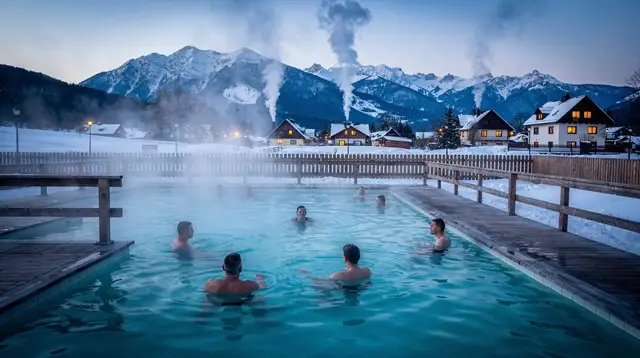
Because Nowy Targ works best as a stop rather than a standalone trip, most visitors pair it with something else in the same morning or afternoon. The thermal baths cluster of the Podhale sits within easy reach: Chochołów’s Termy Chochołowskie, the largest thermal complex in Poland, lies close by, and a market morning followed by an afternoon soak is a natural pairing — bookable in advance through a Chochołowskie thermal baths entry ticket.
Further along toward Białka Tatrzańska, the same logic applies with a Terma Bania thermal baths entry ticket, if your route runs that direction instead.
Travellers based in Kraków who want the Podhale’s market culture alongside the mountains themselves sometimes build it into a longer touring day that also takes in a Tatra viewpoint — the kind of itinerary covered by a Tatra Mountains Zakopane day trip with a treetop skywalk stop, where a market morning slots naturally into a day that otherwise focuses on scenery. For a simpler one-day frame that starts and ends in Kraków, see our one-day Zakopane itinerary from Kraków, and adjust its timing to a Thursday or Saturday if the market is part of what you want to see.
A practical way to think about the visit
Treat Nowy Targ as a morning stop, not a day-long destination. Go on a Thursday or Saturday, go early rather than late, and go with the understanding that what you find on the stalls will vary from one week to the next — that variability is the honest sign of a real market rather than a tourist reconstruction. Bring cash for smaller purchases, since a market built on five centuries of everyday trade was not designed around cards. And if cheese is part of what draws you, check the season first: genuine oscypek only exists between May and September, and a market visit outside that window will show you the town’s other traditional goods — the leather, the sheepskins, the general produce — rather than the cheese the region is best known for.
Nowy Targ Thursday market: your questions answered
The questions below cover what most visitors actually need to plan around: the days, the timing, what is for sale, and how a market morning fits into a wider Podhale trip.
What days is the Nowy Targ market open?
Thursday and Saturday. These are the two days covered by the town’s trading rights, granted in 1487, and they remain the only two days the full market operates.
What time does the Nowy Targ market start and finish?
It runs in the morning. Precise opening and closing times vary by season and by individual stallholder, so plan for a morning visit and arrive earlier rather than later for the widest choice.
How old is the Nowy Targ market?
The town’s market right dates to 1487, granted under Polish royal charter — a continuous trading tradition of well over five hundred years.
What can I buy at the Nowy Targ market?
Traditionally, sheepskins, leather goods, and regional cheeses from the Podhale. Around this core, the market also carries general household goods, produce, and seasonal items, as any working regional market does.
Can I buy oscypek at the Nowy Targ market?
You will find regional sheep cheeses, but genuine PDO oscypek is only produced from May to September. Outside that window, what is labelled oscypek is usually a cow’s-milk substitute — see our oscypek guide for how to tell the difference.
Is Nowy Targ worth visiting if it’s not a market day?
The town retains its centre, church, and role as the Podhale’s hub, but the market that gives it its character is only there on Thursday and Saturday mornings. Outside those days, it is better treated as a pass-through stop than a planned destination.
How do I combine Nowy Targ with a trip to Zakopane or Kraków?
Nowy Targ sits between the two on the region’s main route, and close to Chochołów, Szaflary and the thermal baths of the Podhale, so it works well as a stop along a journey rather than a separate excursion — either on a Zakopane-Kraków transfer or as a short trip out from Zakopane on a market morning.
Is the Nowy Targ market touristy?
No. It is a genuine regional market that locals use for exactly the goods it has always sold, with no fixed programme or staged presentation — which is also why there is no guarantee any particular stall will be there on a given morning.
Day trips from Kraków
Verified deep-linked GetYourGuide tours. Book through these links and we earn a small commission at no cost to you.
GetYourGuide does not provide a product photo for this activity — the image shows the meeting point, photographed by us.