A village and a valley that only share a name
Say “Chochołów” to someone who has spent a season in the Podhale and they will ask which one you mean. There is the village: a single long row of log houses on the road between Zakopane and Czarny Dunajec, home to the region’s biggest thermal baths. And there is the Chochołowska valley: one of the longest hiking valleys of the Tatra National Park, entered from Siwa Polana, famous for its carpet of crocuses each April. They are named after the same stream and sit in the same corner of the Podhale, but they are 10 km apart, reached by different roads, and doing one tells you nothing about the other.
This page is about the village and its baths. If you came here looking for the crocus walk, the guide you want is the Chochołowska valley in crocus season; the valley itself has its own entry point at Siwa Polana. Nothing below will get you onto that trail.
The best-preserved wooden village of the Podhale
Chochołów’s claim to the title is specific: about 50 log houses along its main street were listed as a protected architectural ensemble in 1970, and they have been kept that way since. Every spring, before the tourist season starts, the owners scrub the outer walls with soap and water — an old Podhale housekeeping habit turned into a preservation method, since the wash keeps the pine logs pale rather than letting them silver and darken the way untreated wood does elsewhere in the region.
The result is a street that looks closer to a 19th-century engraving than to a folk museum: working houses, some still lived in, arranged gable-end to the road in the traditional Podhale layout, with carved door frames and window surrounds that vary from one house to the next depending on which family built it.
Walk the length of the village and you are looking at vernacular architecture that predates the “Zakopane style” you will see in the town itself. Stanisław Witkiewicz, the architect who codified that style in the 1890s, drew directly on Podhale carpentry like this when he designed Villa Koliba and the wooden houses of central Zakopane. Chochołów is closer to the source: working farmhouses rather than villas built for wealthy guests. A slow circuit of the main row, with a stop at one of the small house-museums that are occasionally open to visitors, is the point of coming — read a fuller route in the Chochołów wooden village walk guide.
The village has one more claim to national memory: it was the site of an 1846 peasant uprising against Austrian rule, commemorated with a small monument, which is why you will sometimes see Chochołów mentioned in Polish history books that have nothing to do with tourism.
Termy Chochołowskie: the largest thermal baths in Poland
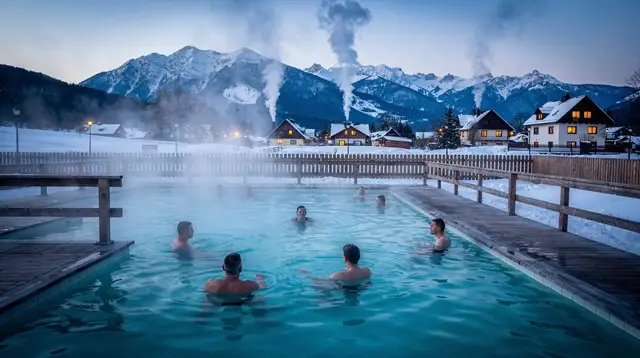
The other reason Chochołów appears on every Podhale itinerary is Termy Chochołowskie, a thermal baths complex on the edge of the village drawing on geothermal water from deep underground, delivered to roughly 30 pools — indoor and outdoor — held between about 32 and 38 degrees Celsius. It is the largest such complex in the country by pool count and water surface, ahead of its regional rivals at Białka Tatrzańska and Bukowina Tatrzańska. The layout mixes calm soaking pools, a few with jets and currents, outdoor pools that stay open through winter with steam rising off the water, and a sauna zone for an extra fee.
a transfer from Zakopane to the Chochołów pools bundled with a local food tasting covers the trip without needing a car, and it pairs the soak with a taste of the region’s food rather than leaving you to find dinner afterward.
Travellers coming from Kraków for the day can book a day trip to Chochołów’s thermal baths that also includes a cable car ride and tasting, which folds one of the Tatra viewpoints into the same outing. If you already have transport sorted and just need the door, a standalone entry ticket for Termy Chochołowskie skips the queue at the counter.
A practical note that matters more here than at most attractions on this coast-free stretch of Poland: evening sessions, generally from around 6 pm, cost less and draw smaller crowds than weekend afternoons. If your plan is baths after a cold or wet day rather than baths as the main event, going late works in your favour twice over.
Entry tickets to Termy Chochołowskie are sold by time block rather than as an all-day pass in peak season, so checking current session times before setting out saves a wasted trip. A towel is not included: rent one at the counter or bring your own, along with proper swimwear — cotton gym shorts are turned away at some pool complexes in Poland, though enforcement at Chochołów tends to be lighter than at municipal pools.
Lockers take a coin deposit or, increasingly, a wristband tied to the entry ticket that also opens a small tab for food and drink at the on-site bar, settled on the way out. The sauna zone, a separate cluster of dry and steam rooms, costs extra and is usually towel-only rather than swimwear, mixed-sex, and worth knowing about before wandering in from the pools by mistake.
How Chochołów’s baths compare with the region’s other thermal complexes — Terma Bania in Białka Tatrzańska, Terma Bukovina in Bukowina Tatrzańska, and the smaller Termy Szaflary — is its own question, answered in the guide to choosing between the Tatra region’s thermal baths and, side by side for the two biggest rivals, in Terma Bania versus Terma Bukovina.
What Chochołów is not
Two things worth stating plainly, because the name invites both mistakes. First, the village of Chochołów is not an access point to the Chochołowska valley: no trail links the two, and the valley’s actual entrance at Siwa Polana is a separate destination reached by a different road, about 10 km away. If a hiking day in the Chochołowska valley is the plan, that plan starts at Siwa Polana, not at the village.
Second, Termy Chochołowskie is not a mountain activity. It is a covered-and-outdoor pool complex — closer in spirit to a spa day than to a walk in the Tatras. Nobody needs hiking boots, a national park ticket, or daylight hours to enjoy it, and nobody should expect a view of peaks or a sense of altitude from the water. Treat it as recovery, not adventure: the right afternoon after a hard walk in Kościeliska valley, not a replacement for one.
Village or baths: choosing on a short visit
With only half a day, most travellers have to pick a priority between the two halves of Chochołów: a leisurely version of both, plus the drive there and back, fills an afternoon on its own. If the appeal is architecture and a sense of the Podhale before it became a ski town, come for the village alone and treat the baths as optional — the street rewards an unhurried visit and empties out by early evening.
If the goal is simply to warm up after a cold morning elsewhere, skip the village walk (an hour is enough, as the FAQ below notes, so little is lost) and go straight to the baths, ideally timed for the cheaper evening session. Combining both comfortably needs a full day rather than a half, which is worth admitting before building a tight itinerary around Chochołów alone.
Getting there
| From | Distance | Time | Notes |
|---|---|---|---|
| Zakopane centre | About 15 km | 20-25 min by car, similar by minibus | Minibuses toward Czarny Dunajec stop in the village |
| Kościelisko | About 7 km | 10-15 min by car | Same general road corridor |
| Siwa Polana (Chochołowska valley entrance) | About 10 km | 15-20 min by car | A separate road — not a walking connection |
| Kraków | About 130 km | 2-2.5 hours by car | Most visitors combine it with Zakopane rather than as a standalone day trip |
Driving is straightforward outside peak traffic hours, though the same warnings that apply to the road into Zakopane apply here in a smaller way: winter weekends and holiday weeks bring more cars onto the smaller Podhale roads too. Parking at the baths is on-site and generally easy to find outside the busiest weekend afternoons; parking in the village itself is limited to a small area near the main row of houses.
Minibuses from Zakopane’s bus station area run toward Czarny Dunajec and pass through Chochołów, but not every departure stops right at the village centre — confirming with the driver before boarding avoids a longer walk than planned. There is no dedicated shuttle laid on purely for the baths; most visitors either drive, book a transfer bundled with the baths ticket, or take the public minibus and walk the last stretch.
When to visit
The baths operate through the calendar and are, if anything, more appealing in winter, when outdoor pools steaming under a grey sky are exactly the kind of low-effort, high-reward stop that suits a Zakopane winter without skiing. Summer brings longer opening hours and busier weekends, when the outdoor pools fill with families on school-holiday trips.
The village looks its best in the warmer months, roughly May through September, right after the annual spring wash has left the log walls pale rather than weathered. Late autumn and winter still show the architecture clearly, but the street empties out and some of the small stalls and house-museums close for the season.
Fitting Chochołów into a wider trip
Because the village and the baths sit on the western side of the Podhale, near Kościelisko, they combine naturally with a loop that also takes in Kościelisko village and, for hikers, the gentle paved track of the Kościeliska valley — a walk suitable for prams and children, unlike the more demanding valleys further east. A day built around that loop, finishing at the baths in the late afternoon, is a common and sensible shape for a Podhale day that does not depend on Zakopane town itself.
For travellers mapping out a longer stay, the two-day Zakopane weekend itinerary and the three-day classic Tatras itinerary both leave room to slot in a half day here without derailing the mountain plans that anchor the rest of the trip. If your focus that day is specifically on thermal water rather than architecture, browse the category page for thermal baths across the region before booking, and see what else is on offer around Chochołów if you want to build a fuller day around the village.
For a broader sense of what a day here should cost, the Zakopane budget guide in złoty covers baths tickets, food, and transport together rather than treating them as separate line items.
What surprises visitors
A few things catch first-time visitors off guard. The village row is shorter than photographs suggest: most of the houses are private homes, not museums, and only a handful open their doors, so the visit is closer to a scenic half-hour walk than a half-day attraction in its own right. Coming purely for the architecture, without factoring in the baths, is a shorter stop than many itineraries assume.
At the baths, the outdoor pools that look so striking in winter photographs, steam rising against snow, are genuinely excellent, but the busiest indoor pools on a weekend afternoon can feel closer to a busy municipal swimming centre than a tranquil spa. The quiet, photogenic version of Termy Chochołowskie, covered in more depth in the dedicated Termy Chochołowskie guide, belongs to weekday mornings and evening sessions, not to the hours most day-trippers actually arrive. The complex also draws heavily on bus tours from both Kraków and Zakopane, and the car park and reception queue can be the slowest part of the whole outing on a clear Saturday — arriving right at opening avoids most of it.
Chochołów: village and baths, frequently asked questions
Is Chochołów village the entrance to the Chochołowska valley?
No. The village of Chochołów and the Chochołowska valley share a name but not a location. The valley’s entrance is at Siwa Polana, about 10 km from the village on a different road out of the Podhale. There is no path connecting the two on foot.
Do I need a car to visit Chochołów?
A car makes it easiest, but minibuses run from Zakopane’s bus station area toward Czarny Dunajec and stop in Chochołów; ask the driver to confirm the stop, since not every departure passes through the village centre.
How long does it take to see the village?
An hour is enough for a slow walk down the main row of houses and back; add another hour if you want to visit the small local museum houses or linger over coffee.
Are the Termy Chochołowskie the biggest thermal baths in Poland?
Yes, by pool count and total water surface, Termy Chochołowskie is the largest thermal baths complex in the country, with around 30 indoor and outdoor pools at 32 to 38 degrees Celsius.
Is a visit to Chochołów suitable after a day of hiking?
It suits a day that did not involve serious hiking better than one that did: most visitors combine the village and the baths with a gentle valley like Kościeliska, or with a rest day, rather than with Rysy or Giewont.
Can I do the village, the baths and the Chochołowska valley in one day?
It is possible but tight, since the valley walk alone takes half a day and the two sites sit 10 km apart on different roads. Most travellers pick one mountain activity and one relaxation activity per day rather than stacking all three.
Is oscypek sold in Chochołów?
Yes, smoked sheep cheese and other Podhale staples are sold from stalls and small shops along the main street, though the selection is smaller than on Krupówki in Zakopane.
Are the baths crowded?
Weekend afternoons and school holiday weeks bring the biggest crowds. Evening sessions, generally after 6 pm, are cheaper and noticeably quieter.
What should I bring to Termy Chochołowskie?
A swimsuit and, ideally, your own towel, since towel rental adds to the cost; flip-flops for the changing areas; and cash or a card for the locker deposit or wristband system, since some sessions run on a tab settled at the exit rather than paying per item.
Is entry to Chochołów village free?
Yes. Walking the main street and looking at the log houses costs nothing; the few small house-museums that open to visitors charge a modest entry fee of their own, separate from any ticket to the thermal baths.