Terma Bania vs Terma Bukovina
Terma Bania or Terma Bukovina: what is the difference?
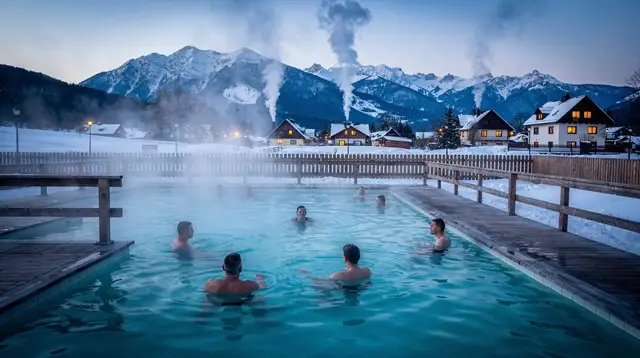
Terma Bania in Białka Tatrzańska draws its water from 2,500 metres deep, between 34 and 38°C, and sits next to the Kotelnica ski area. Terma Bukovina in Bukowina Tatrzańska has 20 pools between 30 and 38°C and sits next to the Rusiń-Ski slopes. Both are Podhale villages, separate from the Tatra National Park itself.
Two Baths, Two Neighbouring Villages
Terma Bania and Terma Bukovina are the two thermal baths of the eastern Podhale, a few kilometres apart in two villages that sit side by side on the road east of Zakopane: Białka Tatrzańska and Bukowina Tatrzańska. Visitors comparing them are usually doing so for one practical reason: they already know which of the two villages they will be skiing in, and they want to know what the thermal baths next door actually offer.
This page puts the two establishments side by side using only what is documented about each — the depth and temperature of the water, the number of pools, and the ski area each one adjoins. It does not rank one above the other on price, on crowds, or on saunas and toboggans, because those details are not part of what either resort publishes about itself. What follows is a factual comparison, not a verdict.
Both villages belong to the Podhale, the rolling foothill region north of the high Tatras. That distinction matters more than it might seem: neither Terma Bania nor Terma Bukovina sits inside the Tatra National Park (TPN), the protected mountain terrain around Zakopane where every trail needs its own entry ticket. The baths are commercial facilities in ordinary villages, open on their own hours, unrelated to the park’s rules on dogs, drones, or marked trails. If your trip plan already includes Zakopane town and a day in the high peaks, the thermal baths sit outside that logic entirely — they are a village amenity, not a park attraction.
Terma Bania: Water From 2,500 Metres Deep
Terma Bania sits in Białka Tatrzańska, the larger of the two villages and the one closer to Zakopane on the road toward Nowy Targ. What distinguishes it, according to the resort’s own figures, is the depth of its water source: drawn from about 2,500 metres underground, with pool temperatures running between 34 and 38°C. That is a genuinely deep geothermal source by regional standards, and it is the single fact Terma Bania is best known for among the region’s thermal baths.
Białka Tatrzańska is also home to Kotelnica, described among the region’s ski areas as the largest and most family-friendly of the Podhale, with roughly 20 km of pistes and 10 lifts. The pairing of a deep, warm thermal source with the biggest ski area in the region is what makes Białka Tatrzańska a natural stop for a full mountain-and-baths day: skiing at Kotelnica during daylight, then a soak at Terma Bania once the lifts close.
A ticket to Terma Bania’s aquapark in Białka Tatrzańska covers entry to the pools; travellers arriving from Kraków or Zakopane without their own transport can also book a round-trip transfer to Terma Bania from Kraków that bundles the ride with the entry ticket, which removes the need to work out minibus connections for a single afternoon trip.
Terma Bukovina: Twenty Pools at Bukowina Tatrzańska
A short distance further east, Bukowina Tatrzańska is home to Terma Bukovina. Where Terma Bania is defined by the depth of a single source, Terma Bukovina is defined by the breadth of its offer: 20 separate pools, with temperatures spread across a slightly wider band, from 30 to 38°C. Twenty pools at varying temperatures means a range of options across one visit rather than one dominant soaking temperature — a fact worth noting for a family or group with different preferences for how hot they like the water.
Bukowina Tatrzańska’s own ski area is Rusiń-Ski, the slopes that sit alongside the village. As with the Białka Tatrzańska pairing, the logic here is the same: a day on the Rusiń-Ski pistes followed by the pools at Terma Bukovina next door. Neither ski area competes in scale with Kasprowy Wierch, the only genuinely high-mountain skiing in the region, but that is true of every Podhale slope outside the park — see the region’s ski resorts compared for how Kotelnica, Rusiń-Ski, and the smaller hills stack up against each other.
Side by Side
| Terma Bania | Terma Bukovina | |
|---|---|---|
| Village | Białka Tatrzańska | Bukowina Tatrzańska |
| Water source | About 2,500 m deep | Not stated at this depth |
| Pool temperature | 34–38°C | 30–38°C |
| Number of pools | Not published as a fixed count | 20 pools |
| Paired ski area | Kotelnica (largest, most family-friendly) | Rusiń-Ski |
| Inside Tatra National Park | No | No |
The table only carries figures that are actually documented for each resort. Terma Bania’s headline fact is the depth of its source; Terma Bukovina’s headline fact is its pool count. That asymmetry is real — it simply reflects what each establishment publicises about itself, not a gap in one resort’s quality against the other.
Visiting Both in the Same Day
Because Białka Tatrzańska and Bukowina Tatrzańska sit only a few kilometres apart on the same road, it is tempting to treat Terma Bania and Terma Bukovina as a single stop with two pools attached. They are not. Each is a separate business with its own entry ticket, its own opening hours, and no shared pass between them. Visiting both on the same day means budgeting for two separate admissions and the short drive or minibus ride between the two villages, not simply a longer stay at one pool complex.
For a traveller with a full day free and no fixed ski base yet, that is a realistic plan: start at whichever bath sits on the way out from Zakopane, finish at the other before heading back. For a traveller with only a half-day window, picking one and skipping the drive between villages makes more sense than splitting a short visit across two separate admissions at two separate facilities. The decision does not need to hinge on which resort is “better” — the practical constraint is simply how much of the day is available for travel between two villages that, despite sitting close together on a map, still require a real drive to connect.
Pairing With Your Ski Day: Kotelnica or Rusiń-Ski
For a winter trip built around Zakopane, the choice between the two baths is, in practice, usually already made by the choice of ski area. Skiers based at Kotelnica in Białka Tatrzańska have Terma Bania on their doorstep; skiers on the Rusiń-Ski slopes in Bukowina Tatrzańska have Terma Bukovina on theirs. Since Kotelnica is described as the largest and most family-friendly ski area in the Podhale, families building a winter week around one base are more likely to end up at Terma Bania simply because they are more likely to end up at Kotelnica — see the Kotelnica family skiing guide for how that ski area is laid out.
None of this rules out visiting either bath as a standalone half-day trip, independent of skiing. Both villages are reachable from Zakopane by the same road east, and travellers who want the baths without the slopes can treat either one as an afternoon or evening outing on a winter itinerary that does not otherwise involve skis. A standalone entry ticket to Terma Bania works for exactly that kind of visit, booked for a fixed date without tying it to a transfer or a ski pass.
Getting There From Zakopane
Neither village has its own train station or a dedicated airport link; both are reached by road from Zakopane, either by private minibus or by car. Driving to Zakopane covers the wider regional road conditions that also apply on the shorter run out to Białka Tatrzańska and Bukowina Tatrzańska — winter driving on Podhale back roads can mean packed snow and limited lighting after dark, which is worth planning around for an evening return from either bath.
Travellers staying closer to Kościelisko or in central Zakopane should budget more time for the crossing than those already based in the eastern Podhale; the where to stay guide sets out how that base choice affects distances to attractions on this side of the region.
Groups without a car sometimes prefer to combine the thermal baths with another activity on the same transfer rather than travel out purely for a soak. A snowmobile outing paired with a thermal baths visit is one way that combination is sold from Kraków or Zakopane in winter, folding transport, an activity, and the pools into a single booked day rather than three separate arrangements.
A Stop on the Way to Nowy Targ
The road that runs past Białka Tatrzańska continues on toward Nowy Targ, the Podhale market town whose open-air market runs Thursday and Saturday mornings under rights granted in 1487. For travellers driving or taking a minibus out to Terma Bania on one of those two days, the market is a realistic add-on to the same outing rather than a separate trip from Zakopane: cheese, leather, and sheepskin stalls in the morning, then the pools at Terma Bania in the afternoon once the market has wound down. The Nowy Targ market day trip guide covers what the market itself involves.
Terma Bukovina, in the neighbouring village further along the same eastern road, is not on the direct route to Nowy Targ the way Terma Bania is. That makes the market-and-baths pairing work more naturally from the Białka Tatrzańska side of this comparison than from the Bukowina Tatrzańska side — a routing detail worth knowing before fixing a day’s plan around either bath.
Podhale, Not the Tatra Park
It is worth repeating because the two are easy to conflate: Terma Bania and Terma Bukovina are Podhale village facilities, not features of the Tatra National Park. The TPN entry ticket that every hiking trail requires — at Morskie Oko or in the Kościeliska valley — has no bearing on either thermal bath.
The two systems run on entirely separate rules: the park regulates a protected mountain area with marked-trail-only access, while the baths are ordinary paid attractions like Termy Chochołowskie further west or Gorący Potok in Szaflary. For a fuller picture of how all the region’s thermal baths compare, not only these two, see the thermal baths compared guide and which thermal baths to choose.
Paying at Either Bath
Both Terma Bania and Terma Bukovina are in Poland, where the currency is the złoty (PLN), not the euro. That distinction matters more here than it might elsewhere in this guide: the Slovak Tatras sit a short drive across an open Schengen border, and the currency switches to the euro the moment you cross it. Travellers who change money for a day at either bath will find those złoty useless on the Slovak side of a longer trip, and the reverse is just as true for anyone arriving with euros first. Cards are accepted at most attractions of this kind across Poland, but carrying some cash remains sensible for parking, snacks, or smaller businesses in either village along the road.
When to Go: Evening Sessions and the Winter Season
Both baths run year-round, but their busiest window lines up with the Podhale ski season, roughly December through March, when skiers from Kotelnica and Rusiń-Ski move straight from the slopes to the pools once lifts close for the day. Evening sessions tend to draw a different crowd than daytime ones, since day-trippers from Kraków and Zakopane typically visit earlier, and locals and overnight guests fill the later hours. Anyone planning a full day that starts on skis and ends in the water should expect the baths to be busiest in the two or three hours after the lifts shut, simply because that is when everyone on the mountain has the same idea at once.
Outside the ski season, both remain open as standalone attractions, and the absence of ski traffic generally means a quieter pool deck. A family travelling with young children and weighing Terma Bania against Terma Bukovina outside winter is choosing based on the same two facts this page opened with — a deep, warm single-temperature source at one, a spread of 20 pools at different temperatures at the other — since neither the ski season nor the park’s rules affect that particular decision.
Terma Bania and Terma Bukovina: Frequently Asked Questions
Where is Terma Bania located?
Terma Bania is in Białka Tatrzańska, a Podhale village east of Zakopane, next to the Kotelnica ski area.
Where is Terma Bukovina located?
Terma Bukovina is in Bukowina Tatrzańska, a neighbouring Podhale village, next to the Rusiń-Ski slopes.
What temperature is the water at Terma Bania?
Terma Bania’s pools run between 34 and 38°C, drawn from a source about 2,500 metres deep.
How many pools does Terma Bukovina have?
Terma Bukovina has 20 pools, with temperatures ranging from 30 to 38°C.
How deep is the water source at Terma Bania?
The water at Terma Bania is drawn from about 2,500 metres deep, which is the figure the resort states for its source.
Which ski area sits next to Terma Bania?
Kotelnica, in Białka Tatrzańska, sits next to Terma Bania. It is described as the largest and most family-friendly ski area of the region, with about 20 km of pistes and 10 lifts.
Which ski area sits next to Terma Bukovina?
Rusiń-Ski, in Bukowina Tatrzańska, sits next to Terma Bukovina.
Are Terma Bania and Terma Bukovina inside the Tatra National Park?
No. Both belong to Podhale villages outside the park boundary, distinct from the Tatra National Park (TPN) that covers Zakopane’s mountain terrain and requires its own entry ticket on every trail.
Can Terma Bania and Terma Bukovina be visited on the same day?
Yes. The two villages sit a few kilometres apart on the same road, but each bath is a separate business with its own entry ticket, so a same-day visit to both means budgeting time for two admissions and the drive between them, not one longer stay at a single pool.
Do Terma Bania and Terma Bukovina accept euros?
No. Both are in Poland, where the currency is the złoty, not the euro. Euros are used across the border in the Slovak Tatras, not at these two Podhale baths.
Top-rated experiences
Verified deep-linked GetYourGuide tours. Book through these links and we earn a small commission at no cost to you.
GetYourGuide does not provide a product photo for this activity — the image shows the meeting point, photographed by us.