What to Do in Zakopane in Winter Without Skiing
What can I do in Zakopane in winter if I don't ski?
Ride the Gubałówka funicular for the panorama, spend an afternoon in a thermal pool such as Termy Chochołowskie or Terma Bania, browse the Christmas market on Plac Niepodległości between mid-December and mid-January, and fall back on the Tatra Museum and the Zakopane-style villas on days when the weather turns. A traditional kulig sleigh ride is the classic evening add-on.
Zakopane calls itself Poland’s winter capital, and most of that reputation rests on skiing at Kasprowy Wierch and the smaller hills around town. But a large share of winter visitors have no interest in strapping on skis, or arrive to find the pistes patchy while the town itself is still very much worth three or four days. This guide sets out a non-skiing winter programme built around the four things that actually work here in the cold months: the panorama and gentle slopes of Gubałówka, an afternoon spent warm in a thermal pool, the Christmas market on Plac Niepodległości, and a set of indoor stops for the day the weather refuses to cooperate.
A winter day that never needs a lift pass
The shape of a non-skiing winter day in Zakopane is simple. Mornings belong to Gubałówka or a walk down Krupówki, when the light is best and the crowds are thinnest. Early afternoon is the natural slot for a thermal bath session, since the pools stay open into the evening and a two-to-three-hour visit fits comfortably after lunch. Evenings belong to the Christmas market in season, or to a kulig sleigh ride booked for a specific night. Museums and the wooden villas of the Zakopane style slot in wherever the weather forces a change of plan — they are the one category of activity here that genuinely does not care what the sky is doing.
None of this requires a car. Minibuses run from the centre to Kuźnice, to the villages with thermal baths, and to most trailheads; the funicular station sits at the top of Krupówki, a walk from almost any hotel in town.
Snow is not guaranteed, even in the middle of winter
It is worth saying plainly: a trip planned entirely around snow scenery can be disappointed. Zakopane town sits at 830 to about 1,000 metres — low enough, in a mild spell, for snow on Krupówki to turn to slush within a day or two, even in the heart of the winter season. The Tatras above town usually hold their white cover far longer, but a warm south wind, the halny, can strip snow and fog the views with little warning, and it is the same wind that most often shuts the Kasprowy Wierch cable car for the day.
Check the month-by-month weather before building expectations around a white landscape, and treat the activities in this guide — baths, culture, the panorama, a sleigh ride — as the backbone of the trip rather than a backup plan. They work whether or not it has snowed that week.
Gubałówka: the panorama, without a single ski run
Gubałówka, at 1,126 metres, is the easiest mountain view in the region and it has no meaningful skiing of its own. The funicular leaves from the top of Krupówki and takes three to four minutes to climb 300 metres of vertical; at the top, the whole chain of the Tatras opens up in one sweep, from Giewont’s silhouette to the ridge above Kasprowy Wierch. Souvenir stalls and cafés with a view line the ridge, and the walk along the top toward Butorowy Wierch takes thirty to forty-five minutes for anyone who wants to stretch the visit.
The fixed toboggan track at the top, built for the snow-free months, does not run in winter — but the same gentle slopes below the summit fill with local families sledging after a fresh snowfall, an entirely informal, entirely typical piece of Zakopane winter life. It is worth going up on a clear morning rather than at midday, when haze tends to soften the view of the peaks; see the full Gubałówka funicular guide for timing and what the ridge walk adds.
Thermal baths: the warm afternoon that resets the whole trip
Nothing recovers a cold, short winter day like an afternoon outdoors in hot water. Three thermal complexes sit within easy reach of Zakopane, each drawing on deep geothermal water and each keeping outdoor pools open through the winter, steam rising off the surface while snow sits on the deck chairs around them.
| Baths | Village | What sets it apart |
|---|---|---|
| Termy Chochołowskie | Chochołów | The largest complex in the region, drawing on some of the deepest local wells |
| Terma Bania | Białka Tatrzańska | Close to the Kotelnica ski area, easy to combine with a non-skiing companion’s day out |
| Terma Bukovina | Bukowina Tatrzańska | The furthest out, quieter outside weekends |
A half-day trip out to the thermal baths covers the transfer and entry in one booking, which matters in winter when the villages sit a minibus ride apart and public transport thins out after dark. Anyone also curious about the cable car can look at a combined thermal baths and Kasprowy Wierch cable car day that pairs the two, weather at altitude permitting.
Locals tend to go for the evening session, when the pools are quieter and the walk back to the changing rooms through cold air onto steaming water is, for many visitors, the single best hour of a winter trip — see the case for it in evening baths, the smart move, and the fuller comparison of all three complexes in thermal baths compared, with dedicated guides to Termy Chochołowskie and to Terma Bania against Terma Bukovina.
The Christmas market on Plac Niepodległości
From mid-December to mid-January, Zakopane’s main square, Plac Niepodległości, fills with a Christmas market: wooden stalls, mulled wine, oscypek grilled over open coals, and Górale wood carving and wool alongside the usual seasonal decorations. It runs alongside — and adds to — what is already the town’s busiest and most expensive stretch of the year, overlapping both the Christmas–New Year holidays and the start of the Polish winter school break, so an evening on Krupówki in this window means real crowds rather than a quiet stroll.
Anyone planning a trip specifically around the market should read the dedicated Christmas and New Year guide and consider the four-day Christmas-New Year itinerary, which spaces the market evening against quieter daytime activities on purpose.
Outside that window, Krupówki still works as an evening walk — heated stalls selling oscypek and hot food line the street most of the year — but the market stalls and lights specifically belong to the mid-December-to-mid-January stretch. For a broader read on the street itself, including when it is worth the crowd and when it isn’t, see Krupówki, love it or avoid it and the practical half-day walk down Krupówki.
Kulig: the traditional sleigh ride
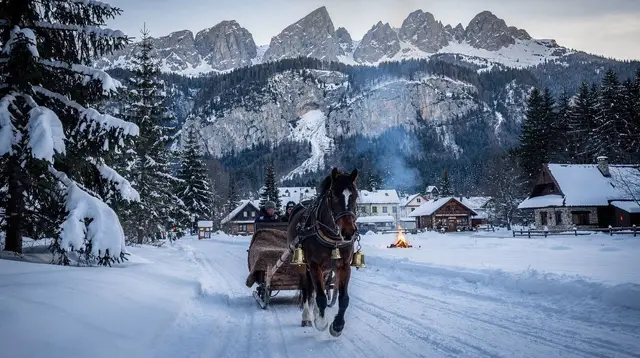
A kulig — a horse-drawn sleigh ride through the snow-covered Podhale countryside, usually finishing at a highlander hut with live music, a bonfire and a hot meal — is the classic evening activity of a Zakopane winter, and one that needs no snow above 1,500 metres and no lift ticket at all. It is a regional tradition rather than a single named attraction, run by a number of local operators out of the villages around town, and worth booking a specific evening ahead of time in the busiest weeks rather than turning up and hoping.
It sits well as a one-evening add-on to a trip already built around baths, the panorama and the market, and it is the single activity on this list that only exists because of the season — there is no summer equivalent. For anyone weighing a kulig against a simple horse-carriage ride, the distinction between the two is covered in sleigh ride versus horse carriage, and the full picture of what a kulig involves is in the traditional kulig sleigh ride guide.
Indoor culture for the day the weather turns
Winter in the mountains means at least one day, on most trips, when fog sits in the valley, the cable car is closed by wind, or rain rather than snow is falling on the town. That is exactly the day to move indoors, and Zakopane has enough genuine indoor culture to fill it without feeling like a consolation prize.
The Tatra Museum, founded in 1888, is the place to start: natural history, highlander ethnography and the region’s history in one building in the town centre. Alongside it sit the wooden villas of the Zakopane style, the architectural movement created by Stanisław Witkiewicz in the 1890s out of local Górale carpentry — Villa Koliba, the first house built in the style and now the Museum of the Zakopane Style, and Villa Atma, once the home of the composer Karol Szymanowski. A combined museum entry ticket is the simplest way to cover several of these stops in one booking rather than queuing at each door separately.
For visitors who would rather have all of this arranged around them, a private guided walk through Zakopane town can weave the museum, the villas, the old cemetery and Krupówki into a single half-day with a local guide doing the explaining — a useful option precisely on the days when independent planning around bad weather feels like more trouble than it’s worth. The full picture of the museum and gallery scene is in the Tatra Museum, Atma and Hasior guide, and the architecture itself, including the old church and the Pęksowy Brzyzek cemetery gate, is covered in the Zakopane style guide.
For an evening indoors that still feels regional rather than generic, a Polish beer tasting evening is a low-key way to close a bad-weather day without needing a car, a forecast, or a mountain in view at all.
Why the mountains themselves stay off this list
Everything in this guide deliberately stays below the treeline. Tatra National Park closes many of its high-altitude trails from around 1 November to mid-June, when avalanche risk and difficult conditions above the ridgeline make them unsafe and, in most cases, officially off-limits — routes like the Five Lakes valley or the approach to Rysy that fill this guide’s summer counterparts are simply not winter options.
That closure has no effect on anything above: the funicular, the thermal baths, the market, the museums and a kulig all sit in the valley or on modest, managed slopes, open regardless of what the high peaks are doing. Anyone tempted to combine this trip with a higher-altitude outing should check current trail status before planning around it, and read the safety context in the Tatra mountain safety guide rather than assume a route open in July is open in January.
Putting a non-skiing winter trip together
For a first winter visit with no interest in the pistes, a workable shape looks like this: one day centred on Gubałówka and a walk down Krupówki, one afternoon and evening at a thermal bath, one evening reserved for a kulig if the dates allow, and a museum-and-villas half-day held in reserve for whichever day turns out wet, foggy, or simply cold enough that staying indoors sounds better than staying outdoors.
Anyone building a longer stay around this pattern can look at the three-day winter itinerary as a starting frame, or, for the specific Christmas–New Year window, the four-day holiday itinerary already mentioned above, both written with exactly this kind of non-skiing day mixed in.
Non-skiing winter activities in Zakopane: FAQ
Is there enough to do in Zakopane in winter if I don’t ski?
Yes. The Gubałówka funicular, thermal baths, the Christmas market, museums, and the wooden villas of the Zakopane style fill a comfortable three or four days without a single lift pass. Add a kulig sleigh ride for one evening and the programme covers a full trip.
Does it always snow in Zakopane in winter?
No. Zakopane sits at 830 to about 1,000 metres, low enough that a mild spell can turn snow to slush in town even in January, while the peaks above stay white. A trip built only around snow scenery can disappoint; a trip built around baths, culture and the panorama does not depend on it.
What is a kulig, and do I need to book one in advance?
A kulig is a traditional horse-drawn sleigh ride through the Podhale countryside, usually ending at a highlander hut with live music, a bonfire and food. It is a regional winter tradition rather than a single fixed attraction, and it is worth booking ahead in the busiest weeks, when sleighs and evenings fill up.
Can I visit Gubałówka without skiing?
Yes, Gubałówka has no ski runs of its own worth mentioning. The funicular from the top of Krupówki takes three to four minutes and delivers a panorama of the whole Tatra chain, plus stalls, cafés, and gentle snow slopes where local families sledge after a fresh fall.
Which thermal baths are closest to Zakopane town?
Termy Chochołowskie, in the village of Chochołów, and Terma Bania, in Białka Tatrzańska, are both a short transfer from Zakopane and open through the winter with outdoor pools. Terma Bukovina, in Bukowina Tatrzańska, sits a little further out on the same side of the valley.
When is the Christmas market on Plac Niepodległości open?
It runs from mid-December to mid-January, overlapping the Christmas and New Year holidays and the start of the Polish winter school break, which is also when the town is at its most crowded.
What can I do on a rainy or foggy day in Zakopane?
Move the day indoors: the Tatra Museum, the Zakopane-style villas such as Koliba and Atma, and a thermal bath session all work regardless of weather, and none of them depend on visibility on the peaks.
Why are the high mountain trails closed in winter?
Tatra National Park closes many high-altitude trails from around 1 November to mid-June because of avalanche risk and difficult conditions above the treeline. It does not affect the valley walks, the funicular, or any of the activities in this guide.
Winter adventures
Verified deep-linked GetYourGuide tours. Book through these links and we earn a small commission at no cost to you.
GetYourGuide does not provide a product photo for this activity — the image shows the meeting point, photographed by us.