Evening Thermal Baths: The Smart Move
I didn’t plan my first evening visit. I’d been up since six for Morskie Oko, my legs were done, and by the time I got back to the car it was already past four. Driving past Szaflary on the way to Chochołów, I saw the car park at Termy Chochołowskie half empty, which was strange for a place I’d read was packed all summer. I went in on a whim. Two hours later I understood something that no guide had bothered to spell out: the smart time to go is not the time everyone else goes.
The maths behind an empty pool
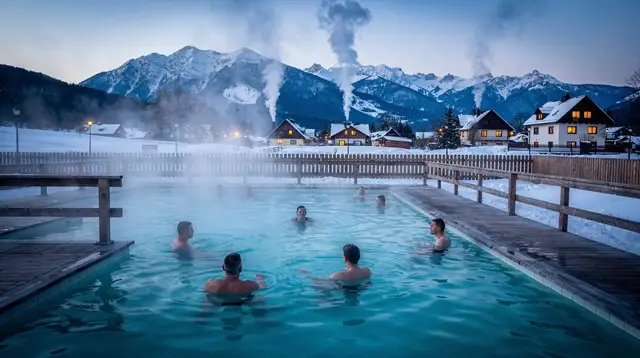
The pools don’t change after dark. Termy Chochołowskie, the largest thermal complex in Poland with around thirty pools, holds its water at 32-38°C whether it’s eleven in the morning or nine at night. Terma Bania in Białka Tatrzańska pulls its water from 2,500 m underground and keeps it at 34-38°C on the same constant supply. Terma Bukovina in Bukowina Tatrzańska runs 30-38°C across twenty pools. None of that is a daytime feature that gets turned off at closing time minus two hours — it’s geothermal, it’s continuous, and it’s exactly why the evening version of the same ticket is worth planning around.
What does change is who else is in the water with you, and what you pay for the privilege. Evening sessions across all three venues run cheaper than daytime and weekend tickets, and the difference in crowd is not subtle. I’ve stood in a queue at Terma Bania at two in the afternoon that took forty minutes to clear the entrance, and walked into the same building at eight with barely anyone at the till.
| Baths | Pools | Temperature | Best evening feature |
|---|---|---|---|
| Termy Chochołowskie | ~30 pools | 32-38°C | Largest complex, absorbs a late crowd easily |
| Terma Bania | Multiple pools | 34-38°C, from 2,500 m deep | Outdoor pools under a dark sky |
| Terma Bukovina | 20 pools | 30-38°C | Usually the quietest after dinner |
Why Kraków’s day trips clear out by five
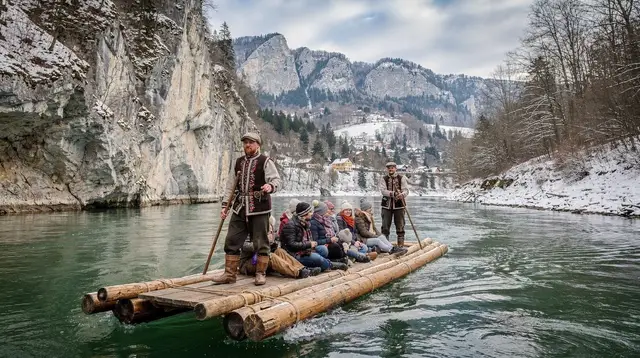
This is the part nobody explains clearly enough. A large share of daytime crowds at these baths aren’t staying in the region at all — they’re on a day trip out of Kraków, often one that bundles the pools with the Dunajec gorge or a wider Tatra loop into a single long day. Those groups need to be back in the city by evening, so they use the baths as an afternoon stop before the bus pulls out.
If you’re staying in Zakopane or one of the Podhale villages rather than doing the round trip from Kraków, you get to watch that whole wave leave without ever being in it. I’ve read up on the pattern of organised rafting-and-baths day trips enough times now to time my own visits around it deliberately: go late, let the coaches go first.
If you’d rather have someone else handle the transfer and the parking after dark, a Kraków-based evening thermal baths trip takes that off your plate entirely. There’s also a version built for either an evening or a morning session, which is worth booking around your own hiking days rather than the other way round — evening if you’ve been on a trail, morning if the baths are your only stop that day.
What it actually feels like
This is the bit that’s easy to undersell as a scheduling tip. After a day on something like the Giewont ridge or a long walk through Kościelisko valley, lowering yourself into 38°C water as the sky goes from orange to grey is not the same experience as doing it at noon in full sun with fifty other people around you. The steam sits differently in cooler evening air. The outdoor pools at Terma Bania, in particular, turn into something closer to a quiet soak under stars once the temperature drops outside and stays high in the water. It’s the one point in the day when the Tatras stop asking anything of you.
I’ve also done the combined version, where a snowmobile run out of Zakopane ends at the baths as the light fades — the Kraków snowmobile and thermal baths combination — and the same logic holds even in winter: cold, effort, then heat, timed for when the pools have thinned out. In summer, the equivalent is a day on the river followed by the water — the pontoon rafting, quad biking and thermal baths day ends the same way, with the baths as the last, least crowded stop rather than a rushed first one.
The one thing you still have to check
None of this is a reason to stop planning altogether. Closing time is the single variable that can wreck an evening visit, and it isn’t fixed — it shifts by venue and by season, later in summer, earlier in the shoulder months. I’ve arrived at a ticket counter twenty minutes before last entry more than once because I assumed a closing hour from a previous trip.
Check the current hours for whichever baths you’re heading to before you leave your accommodation, especially if you’re combining the visit with a late finish on a trail or a transfer from Kraków or Nowy Targ. Beyond that one check, the rest of the calculation is already in your favour: same water, same temperature, lower price, and a pool that finally has room to float in.
If you’re building this into a longer stay, it’s worth reading how the three main sites actually compare against each other before picking one, since the right choice depends on whether you want the biggest complex, the deepest source, or the quietest evening — and on how the rest of your Zakopane budget is shaping up for the trip.
FAQs about visiting the Podhale thermal baths in the evening
Are the thermal baths actually cheaper in the evening?
Yes. Termy Chochołowskie, Terma Bania and Terma Bukovina all run reduced evening rates compared with daytime and weekend tickets. The pools, the water source and the temperature stay identical; only the price and the crowd change.
What time do the thermal baths close?
Closing time depends on the venue and the season, and it moves around the calendar, so check the current hours for whichever pool you are heading to before you set off, rather than assuming a fixed time.
Which thermal baths are best for an evening visit?
Termy Chochołowskie in Chochołów is the largest, with about thirty pools at 32-38°C, so it absorbs an evening crowd easily. Terma Bania in Białka Tatrzańska draws its water from 2,500 m deep at 34-38°C. Terma Bukovina in Bukowina Tatrzańska has twenty pools at 30-38°C and tends to feel the quietest after dark.
Do I need to book an evening thermal baths slot in advance?
Walk-ins are normally fine outside the Christmas and February school-holiday weeks, but a transfer from Zakopane or an organised evening session takes the parking and the driving off your hands, which matters more after a day on the trails than the booking itself.
Why do Kraków day trips leave the baths crowded until late afternoon?
Many day trips from Kraków combine the thermal baths with the Dunajec gorge or a Tatra excursion in a single day, and those groups use the pools in the afternoon before their bus heads back. Once they leave, the water empties out.
Is the water really the same temperature all day?
Yes, all three main venues hold their ranges around the clock — 32-38°C at Termy Chochołowskie, 34-38°C at Terma Bania, 30-38°C at Terma Bukovina — because the water comes from a constant deep geothermal source, not from heating that gets switched off overnight.
Can I go to the thermal baths after a full day of hiking in the Tatras?
That is when the evening session makes the most sense. Coming down from a trail like Giewont or Morskie Oko straight into 38°C water, with the pools half empty and the sky darkening, feels like a different experience from the same pool at noon.
tours.Practical
Verified deep-linked GetYourGuide tours. Book through these links and we earn a small commission at no cost to you.
GetYourGuide does not provide a product photo for this activity — the image shows the meeting point, photographed by us.