A thermal village on the edge of the Podhale
Bukowina Tatrzańska sits about 20 km northeast of Zakopane, on the rolling hills where the Podhale meets the first foothills of the Tatras. It is easy to misread on a map: the name appears next to Zakopane, Białka Tatrzańska and the mountains beyond, and it is tempting to imagine a base for hiking or a village worth a morning of sightseeing. It is neither.
Bukowina Tatrzańska is a working farming village that has grown a second identity as a thermal and ski stop, and that second identity is the entire reason to come. There is no old town, no architecture trail, no museum, and no trailhead into the high peaks. What there is, and what the village does well, is water and gentle snow: Terma Bukovina, one of the larger thermal complexes in the region, and Rusiń-Ski, a small, family-oriented ski area on the slopes above the baths.
This page is deliberately narrow. Bukowina Tatrzańska is not a rival to Zakopane as a base, not a hiking hub like Kuźnice, and its ski slopes are not in the same category as Kasprowy Wierch, the only high-mountain skiing in the Tatras.
Comparing the two is a common way for a first-time visitor to end up disappointed: Rusiń-Ski has a top point of a few hundred metres of vertical on gentle terrain, while Kasprowy starts at nearly 2,000 m and drops through open, glacier-scraped terrain served by a cable car. Bukowina’s slopes exist for beginners, children, and anyone who wants an easy afternoon on skis before or after a soak, not for anyone chasing a big mountain day.
Getting there without a car
Like the other Podhale villages, Bukowina Tatrzańska is reached from Zakopane by minibus, the same informal network that serves Białka Tatrzańska, Szaflary and Chochołów. Minibuses run regularly from the bus station area and Kościuszki street in Zakopane; the ride takes roughly 30 to 40 minutes depending on the route and stops along the way, and costs a few złoty each way.
There is no need to rent a car for a normal visit: the road is straightforward, the minibuses run all day in season, and parking at Terma Bukovina is included for guests who do drive. Anyone staying in Zakopane and building a loose Podhale day around thermal baths can read the general mechanics of the minibus network on the minibus to the valleys and Kuźnice guide before setting out; the same logic of “wait at the stop, pay the driver, ask to be let off at the right turn” applies here.
Drivers coming from Kraków or arriving by their own car reach Bukowina Tatrzańska via the same roads that serve Białka Tatrzańska, turning off before Zakopane rather than driving into the town centre first. That makes Bukowina a realistic stop on the way in or out of the region for anyone travelling with their own vehicle, without the parking headaches that come with Zakopane’s centre or with Kuźnice, which is closed to private cars entirely.
Terma Bukovina: the reason most people come
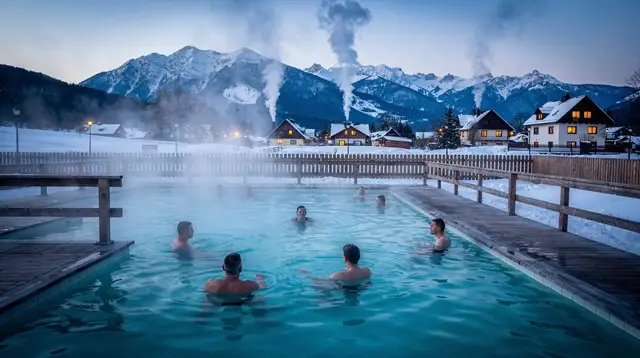
Terma Bukovina is the largest single reason to visit the village, and it is genuinely one of the larger thermal complexes in the Podhale, with about 20 pools at temperatures between 30 and 38°C, fed by geothermal water drawn from deep boreholes. The complex mixes recreational pools, family pools with slides, and quieter, mineral-rich pools meant for soaking rather than play, plus a sauna zone for guests who want the heat without the crowds of the water park side. It sits at the base of the Rusiń-Ski slopes, so a winter visit can combine a morning or afternoon of easy skiing with an evening soak without changing location.
a Terma Bukovina entry ticket booked in advance avoids the ticket-window queue that forms on weekends and during the Polish school holidays, when the complex fills with families from across the region. Evening sessions, roughly from early evening onward, are consistently the quieter and cheaper option: the day-trip buses from Kraków and the family crowds thin out, and the pools under floodlights in winter are, for many visitors, the more memorable version of the experience anyway.
Terma Bukovina is one of three thermal complexes travellers in this corner of the Podhale tend to compare: Terma Bukovina itself, Terma Bania in nearby Białka Tatrzańska, and Termy Chochołowskie in Chochołów, the largest of the three. None of them is objectively “the best” — they differ mainly in size, crowd levels and the exact mineral profile of the water — and the honest answer for most visitors is whichever one sits closest to where they already are that day.
| Complex | Village | Approx. pools | Water temperature | Notable for |
|---|---|---|---|---|
| Terma Bukovina | Bukowina Tatrzańska | About 20 | 30-38°C | Size, combined with Rusiń-Ski skiing |
| Terma Bania | Białka Tatrzańska | Several zones | 34-38°C | Water drawn from about 2,500 m deep |
| Termy Chochołowskie | Chochołów | About 30 pools | 32-38°C | Largest thermal complex in the region |
an entry ticket for Terma Bania in Białka Tatrzańska and an entry ticket for Termy Chochołowskie are worth keeping in mind for anyone splitting a Podhale trip across more than one village, since minibuses connect all three without much extra planning.
A side-by-side read of the three is in the thermal baths compared guide and the more detailed Terma Bania versus Bukovina comparison; anyone still undecided can work through which thermal baths to choose rather than guessing.
Rusiń-Ski: a small, family ski area, not a mountain
The ski area attached to Bukowina Tatrzańska, Rusiń-Ski, is built for beginners and families, not for anyone looking for a big mountain day. The runs are short and gentle, served by button lifts and a chairlift rather than a cable car, and the vertical drop is measured in a few hundred metres rather than the nearly 1,000 m that Kasprowy Wierch offers. That is not a flaw — it is exactly what makes the area useful for young children learning to ski, for adult beginners who want to build confidence without a queue of experienced skiers behind them, and for anyone who wants an easy morning on snow before spending the afternoon in the thermal pools next door.
It is not, however, a substitute for a real ski day, and this page will not pretend otherwise: travellers looking for the region’s one high-mountain skiing terrain should read the Kasprowy Wierch skiing guide instead, and anyone comparing all the area’s ski options side by side should start with ski resorts around Zakopane compared.
Within its own category — small, family-friendly Podhale ski areas — Rusiń-Ski sits alongside Białka Tatrzańska’s Kotelnica, which is larger and has more lift capacity, and the slopes at Szaflary and Harenda closer to Zakopane. Families weighing Bukowina against Białka Tatrzańska specifically can read the Kotelnica family skiing guide for the comparison; the short version is that Kotelnica offers more terrain and more lifts, while Bukowina’s advantage is the direct link to Terma Bukovina at the base, so a family can ski in the morning and walk straight into the pools without moving the car or catching another minibus.
Some evenings the slopes stay lit for night skiing, in the same spirit as the beginner night sessions described in the night skiing for beginners guide, though hours and openings vary by season and snow conditions and are worth checking locally before planning an evening around them.
What a visit actually looks like
A realistic day in Bukowina Tatrzańska has one of two shapes. In winter, it starts with a minibus from Zakopane in the morning, two to three hours on the Rusiń-Ski slopes for anyone skiing, lunch at one of the village’s simple restaurants, and an afternoon or evening session at Terma Bukovina before the minibus back. In the other seasons, skiing drops out and the day becomes a straightforward thermal visit: arrive by minibus or car, spend two to four hours in the pools, and head back to Zakopane or on to the next stop. Neither version needs a full day set aside purely for Bukowina Tatrzańska itself; half a day covers the baths alone, and a full day covers baths plus skiing in season.
Families building a longer Podhale stay around Zakopane sometimes fold Bukowina into a wider loop that also touches Białka Tatrzańska or Szaflary, since the minibus routes connect all of them without much extra cost or complexity. The Zakopane with kids guide and the family three-day itinerary both treat a thermal-and-gentle-skiing day of this kind as one manageable block rather than the centrepiece of a trip, which is the right proportion: Bukowina Tatrzańska earns an afternoon or a day, not a base of operations.
Winter visitors building a broader cold-season plan can also check the winter three-day itinerary for where a thermal day like this one fits against a Kasprowy Wierch day and a Zakopane town day.
Budget and timing
A day combining Rusiń-Ski and Terma Bukovina typically runs somewhere between 150 and 350 PLN per person, depending on how much skiing and how many hours of pool time are involved, plus lunch and the minibus fares. The thermal complex alone, without skiing, sits toward the lower end of that range.
Prices rise, and queues lengthen, during the Polish winter school holidays in January and February and around Christmas and New Year, the same weeks that put pressure on every other attraction in the region; visiting on a weekday, or choosing an evening session at the baths, avoids most of the crowding without changing the experience. Outside winter, the village is quiet enough that timing matters far less — a summer or autumn soak at Terma Bukovina can be booked and enjoyed with little advance planning.
There is no meaningful “closed season” for the baths, since indoor and outdoor thermal pools run year-round regardless of snow. The ski slopes, by contrast, depend entirely on winter snow and typically operate from December into March, weather permitting, in the same rough window as the region’s other small ski areas.
Bukowina Tatrzańska questions answered
Is Bukowina Tatrzańska worth visiting?
Yes, but for a specific reason: the Terma Bukovina thermal baths and, in winter, the small Rusiń-Ski slopes. It is not worth visiting for sightseeing, architecture or hiking, since it has none of the Podhale’s wooden-village character or trailheads into the Tatras — those belong to places like Chochołów and Kościelisko.
How do you get to Bukowina Tatrzańska from Zakopane?
By minibus from the bus station area or Kościuszki street, a ride of roughly 30 to 40 minutes, or by car on the same roads used to reach Białka Tatrzańska. No rental car is needed for a normal visit from Zakopane.
What is Rusiń-Ski like compared to Kasprowy Wierch?
They are not comparable. Rusiń-Ski is a small area with gentle, short runs built for beginners and families, with a few hundred metres of vertical served by button lifts and a chairlift. Kasprowy Wierch is the region’s only high-mountain skiing, reached by cable car from Kuźnice at nearly 2,000 m, with open terrain and around 1,000 m of vertical. Anyone wanting a serious ski day should look at Kasprowy Wierch, not Bukowina Tatrzańska.
How many pools does Terma Bukovina have and how hot is the water?
Terma Bukovina has about 20 pools, ranging roughly from 30 to 38°C, split between recreational and family pools with slides and quieter mineral pools for soaking, plus a separate sauna zone.
Is Bukowina Tatrzańska good for a day trip with children?
It is one of the better options in the region for younger children specifically because the skiing is gentle and the thermal pools include family and slide areas. It suits a relaxed, low-pressure day rather than an active hiking day.
Should you stay overnight in Bukowina Tatrzańska or visit from Zakopane?
Most travellers visit as a half-day or full-day trip from Zakopane, since the minibus connection is quick and Bukowina Tatrzańska offers little to fill an evening beyond the thermal baths themselves. Staying overnight only makes sense for skiers who want first access to the slopes before day-trip crowds arrive.
Can you combine Bukowina Tatrzańska with Białka Tatrzańska in one day?
Yes. Both villages sit on the same minibus corridor northeast of Zakopane, and travellers comparing a larger family ski area against a thermal-focused stop often visit one for skiing and the other for the pools, or vice versa, within the same day.
Does Terma Bukovina get crowded?
It does, particularly on weekends and during the Polish winter school holidays in January and February, when families from across the region fill the water park side of the complex. Evening sessions and weekday visits are consistently quieter.