Which Thermal Baths to Choose Around Zakopane
Which thermal baths should I choose near Zakopane: Chochołowskie, Bania, Bukovina or Szaflary?
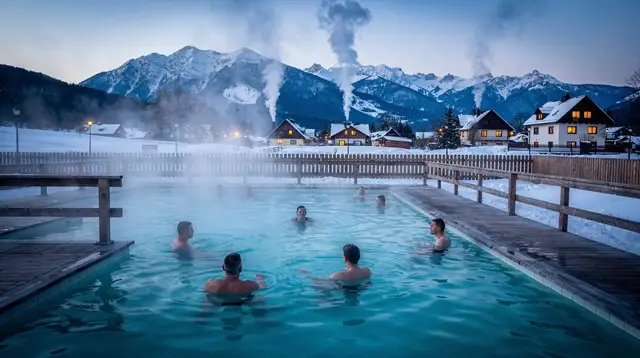
Termy Chochołowskie in Chochołów are the largest, with around thirty pools between 32 and 38 degrees. Terma Bania in Białka Tatrzańska draws water from 2,500 metres deep, also 34 to 38 degrees. Terma Bukovina in Bukowina Tatrzańska has twenty pools between 30 and 38 degrees. Termy Szaflary and Gorący Potok, 17 km from town, round out the choice. None is objectively best; each suits a different base and a different pace.
Four thermal complexes, one geothermal basin
Ask five people in Zakopane which thermal baths to visit and you will get five different answers, because the four main options draw on the same underground water and end up more alike than the marketing suggests.
What actually separates Termy Chochołowskie, Terma Bania, Terma Bukovina and Termy Szaflary with Gorący Potok is scale, location relative to where you are staying, and what else sits nearby — not water quality or temperature, which land in the same narrow band across all four. This page compares them on what can actually be checked, without ranking them into a “best” list, because the right pick depends on your base and your itinerary more than on any single feature.
All four sit in the Podhale villages north of Zakopane, drawing on one of the richest geothermal reservoirs in Poland. That shared source is why the numbers below cluster so closely: 30 to 38 degrees is the range you will meet everywhere, give or take a couple of degrees pool to pool.
The comparison, side by side
| Venue | Village | Approx. distance from Zakopane | Pools | Water temperature | Water source |
|---|---|---|---|---|---|
| Termy Chochołowskie | Chochołów | about 15 km | around 30 pools | 32 to 38°C | Podhale geothermal basin |
| Terma Bania | Białka Tatrzańska | about 20 km | fewer, larger zones | 34 to 38°C | drawn from 2,500 m depth |
| Terma Bukovina | Bukowina Tatrzańska | about 25 km | around 20 pools | 30 to 38°C | Podhale geothermal basin |
| Termy Szaflary / Gorący Potok | Szaflary | about 17 km | smallest of the four | 30 to 36°C | Podhale geothermal basin |
Distances are road distances from central Zakopane and vary by a few kilometres depending on the exact route and which entrance you use. None of these villages has its own train station connected to Zakopane; a minibus, a car, or a minibus to the valleys covers the last stretch in every case.
Termy Chochołowskie: the largest, in the village of Chochołów
Termy Chochołowskie is the biggest thermal complex in Poland by pool count, with roughly thirty basins spread across indoor halls and outdoor terraces, water sitting between 32 and 38 degrees depending on the pool. The scale is the whole story here: more zones, more variety of depth and temperature, and enough space that even a busy day rarely feels as packed as a smaller venue would at the same visitor count.
It sits at Chochołów, the best-preserved wooden village of the Podhale, which makes for an easy pairing — a walk past the log houses first, then the baths. It is not the same place as the Chochołowska valley, despite the similar name; the valley entrance at Siwa Polana is a separate spot on a different road, worth knowing before you plan a day around both. For the full detail on Chochołowskie’s zones and what the visit actually involves, see the dedicated Termy Chochołowskie guide.
A tour that bundles the baths with a look at the village and a cable car ride removes the planning entirely:
a day trip from Kraków that combines Chochołów’s thermal baths with a tasting and a cable car ride,
or, for a straightforward baths-only visit without the extras:
a standalone entry ticket for Termy Chochołowskie.
Terma Bania: deep-drawn water inside a ski area
Terma Bania, in Białka Tatrzańska, draws its water from about 2,500 metres underground — deeper than the other three — which locals point to as the reason for its mineral character, though the temperature range that reaches the pools, 34 to 38 degrees, is not far off what Chochołowskie or Bukovina deliver. The practical difference that matters more day to day is location: Bania sits inside the Kotelnica ski area, so anyone skiing or riding there already has the baths a short walk from the lift base.
That proximity makes it the natural pick for a mixed activity day. For a fuller side-by-side of Bania against Bukovina specifically, see Terma Bania vs Bukovina compared; for the skiing side of Białka Tatrzańska, the Kotelnica family skiing guide covers the slopes the baths sit next to.
Terma Bukovina: the middle-sized option
Terma Bukovina, in Bukowina Tatrzańska, has about twenty pools between 30 and 38 degrees — smaller than Chochołowskie’s roughly thirty, larger than Szaflary’s handful. It draws the same regional geothermal water as the others, and its in-between size is really its defining trait: enough variety to spend a full afternoon without Chochołowskie’s scale, and enough space that it rarely feels as tight as the smallest venue on a busy weekend.
Bukowina Tatrzańska is also a ski base in its own right (Rusiń-Ski), so travellers already staying there for the slopes or for the Bukovina complex itself have little reason to cross the valley for one of the others, unless a specific pool type or a lower crowd count is the deciding factor. The Terma Bania vs Bukovina comparison goes further into which of these two similarly sized options suits which kind of stay.
Termy Szaflary and Gorący Potok: the smallest, the closest to town
Szaflary sits about 17 km from Zakopane, the shortest run of the four, and hosts two neighbouring facilities, Termy Szaflary and Gorący Potok, often mentioned in the same breath because of how close they sit to each other along the same approach road. Between the two, this is the smallest thermal offering covered on this page, with water in the 30 to 36 degree range.
The smaller footprint is not a downside on its own — it tends to mean shorter walks between pools and, on an average day, fewer people per square metre of water than the two largest complexes. It suits a traveller who wants a soak without treating the outing as a half-day excursion in itself. Full detail on the two Szaflary venues and how they differ from each other is in the Szaflary and Gorący Potok guide.
Evening sessions: calmer and generally cheaper, without fixed numbers here
Across all four venues, the pattern locals repeat is consistent: evening sessions draw fewer visitors than daytime hours, and evening admission is typically priced lower than the middle of the day. That gap exists because families with young children cluster around late morning and early afternoon, leaving the pools noticeably quieter once dinner time approaches.
Exact prices and opening hours change by season and by venue, and none are repeated here because a number not tied to a checked date goes stale within months. Before a visit, check current admission and hours directly with the venue you have chosen rather than relying on a figure carried over from an earlier trip report. What holds steady, season to season, is the shape of the pattern itself: go later, expect it to be calmer, and expect to pay somewhat less for the privilege.
Matching a venue to your base and your day
| If you are… | Consider |
|---|---|
| Staying in or near Chochołów, or combining with the wooden village | Termy Chochołowskie |
| Skiing at Kotelnica in Białka Tatrzańska | Terma Bania |
| Based in Bukowina Tatrzańska, or want a mid-sized complex | Terma Bukovina |
| Short on time, want the shortest run from Zakopane | Termy Szaflary or Gorący Potok |
| Without a car and want the logistics handled | a bundled day tour from Kraków or Zakopane |
For a traveller without a car, a packaged option removes the transfer question entirely. A full day that pairs the baths with the Zakopane centre itself works well from Kraków:
a full-day tour from Kraków covering Zakopane and thermal baths together,
and for travellers who want a thermal soak alongside a skywalk stop rather than a village visit:
a Zakopane day combining a skywalk, the town, and thermal baths.
What none of the four thermal baths are
None of these four is a wellness-only spa in the Western European sense of hushed, adults-only pools; all four run as family-oriented aquaparks with a full mix of ages, water slides alongside the thermal basins, and a genuinely busy atmosphere at peak hours. None sits inside Zakopane town — the nearest, Szaflary, is still a 17 km trip out. And none should be confused with the Chochołowska valley, a hiking valley near but distinct from the Chochołów thermal complex, or with the Aqua Park inside Zakopane itself, which is a separate, smaller municipal pool rather than one of these four geothermal complexes.
If the plan is a winter trip built around thermal soaking rather than skiing, the Zakopane without skiing guide lays out how to structure days around the baths and other low-key activities. Families weighing which complex suits children best should also check the Zakopane with kids guide, since slide provision and shallow-pool space vary more between venues than water temperature does.
Getting there without a rental car
None of the four villages is reachable on foot from Zakopane, and none has a dedicated train connection. The practical options are a private minibus from the Zakopane bus station area, a taxi, or a booked tour that includes transfers. Driving yourself is straightforward outside peak traffic hours, though the single road network through Podhale can slow down on winter weekends the same way the Zakopianka does on the Kraków approach; parking at the larger complexes is usually ample, smaller venues less so.
Travellers staying without a car anywhere in the region should also check where to stay around Zakopane, Kościelisko and Białka, since the closer base is to a chosen complex, the less transfer time eats into the day.
For a shorter, activity-packed alternative to a straightforward soak, a combined quad and skywalk day that finishes at the baths is also on offer:
a quad adventure and skywalk day from Zakopane finishing at thermal baths.
Budgeting the day
None of the figures above should be read as pricing — admission at all four venues shifts by season, by time slot, and by whether a child, family, or evening rate applies, and a number copied from an old trip report is often already wrong by the time it is read.
What is worth planning for is the shape of the cost: a soak of a few hours, on top of transport, fits comfortably into most travellers’ Zakopane budgets in złoty without needing to be the single big-ticket item of a trip. First-time visitors unsure how many days to allocate to Zakopane overall, and where a thermal-baths afternoon fits into that schedule, can check how many days Zakopane actually needs for the wider context.
Choosing between the four: frequently asked questions
What is the difference between Termy Chochołowskie and Terma Bania?
Termy Chochołowskie, in Chochołów, are the largest thermal complex in Poland, with roughly thirty pools spread across indoor and outdoor zones, water temperature 32 to 38 degrees. Terma Bania, in Białka Tatrzańska, is smaller but draws its water from 2,500 metres underground, also 34 to 38 degrees, and sits inside the Kotelnica ski area, which matters if you are combining a soak with skiing.
Is Terma Bukovina worth a visit compared to the others?
Terma Bukovina, in Bukowina Tatrzańska, has about twenty pools between 30 and 38 degrees, a middle-sized complex between Chochołowskie’s scale and Szaflary’s smaller footprint. It suits travellers already staying in Bukowina Tatrzańska or Białka Tatrzańska who do not want to cross the valley to Chochołów.
Are Termy Szaflary and Gorący Potok the same place?
They are two neighbouring facilities in Szaflary, about 17 km from Zakopane, often mentioned together because they sit close to each other on the same approach road. Szaflary is the smallest and least crowded of the four options covered here, useful for a quieter soak without the queues of the bigger complexes.
Which thermal baths are closest to Zakopane town?
All four sit outside Zakopane itself, in the Podhale villages. Szaflary is the closest at about 17 km. Chochołów, Białka Tatrzańska and Bukowina Tatrzańska are each roughly 15 to 25 km away depending on the route, all reached by minibus or car rather than on foot.
Is an evening session at the thermal baths a good idea?
Evening slots are generally calmer than daytime hours across all four venues, with fewer families and shorter queues at the pools and changing rooms. They also tend to cost less than peak daytime admission, though exact pricing and opening hours change by season and are best checked directly with each venue before a visit.
Can I combine thermal baths with skiing or hiking on the same day?
Terma Bania sits inside the Kotelnica ski area in Białka Tatrzańska, which makes an après-ski soak straightforward without a second transfer. Termy Chochołowskie sit near the mouth of the Chochołowska valley, a common pairing with a flat valley walk earlier in the day. Bukovina and Szaflary work the same way with their own nearby trails and slopes.
Do the thermal baths near Zakopane use real geothermal water?
Yes. All four draw on the geothermal reservoirs of the Podhale basin, one of the richest in Poland. Terma Bania’s water comes from about 2,500 metres deep; the other three tap the same regional aquifer at comparable depths, which is why temperatures across all four cluster in a similar 30 to 38 degree range.
Should first-time visitors pick one thermal complex over booking a packaged tour?
Either works. Visiting independently gives more control over how long you stay in the water. A packaged half-day or full-day tour that bundles thermal baths with another stop, such as Chochołów village or a skywalk, suits travellers without a car or short on planning time.
Top-rated experiences
Verified deep-linked GetYourGuide tours. Book through these links and we earn a small commission at no cost to you.
GetYourGuide does not provide a product photo for this activity — the image shows the meeting point, photographed by us.