Driving to Zakopane: Zakopianka Traffic, Parking and Snow
Should you drive to Zakopane, and how do you handle the Zakopianka, parking and snow?
Driving is optional, not necessary: private minibuses reach every valley and trailhead. If you do drive, the single road from Kraków, the Zakopianka, can jam badly on Friday evenings, Sunday afternoons, public holidays and snowy weekends, sometimes doubling the normal off-peak drive. Kuźnice is closed to private cars, and the Palenica Białczańska car park for Morskie Oko must be reserved online in advance.
The single road that decides your trip
Ask anyone who has driven to Zakopane more than once and they will not tell you about the scenery on the way down from Kraków. They will tell you about the road itself: the Zakopianka, the one direct route that carries essentially all car, bus and lorry traffic between Kraków and the Tatras. There is no motorway alternative, no ring road that bypasses the bottleneck towns, no second option to switch to when the first one backs up. For most of its length it narrows to two lanes, and every driver heading south for a weekend in the mountains is funnelled onto the same stretch of tarmac at the same time.
That single-road structure is the fact that matters most before you decide whether to rent a car for Zakopane. It is not that the drive is long in absolute terms - outside peak periods it is a genuinely manageable trip. It is that the road has no slack. When demand spikes, there is nowhere for the extra traffic to go, and the drive that should take around an hour and a half can quietly turn into three hours or more, with no warning beyond a line of brake lights that starts kilometres before you expected it.
When the Zakopianka actually jams
The congestion on the Zakopianka is not random. It follows a predictable weekly and seasonal rhythm, and knowing that rhythm is more useful than any real-time traffic app, because the jams build up faster than most apps update.
- Friday evenings, as Kraków and the wider region empty out for the weekend and everyone heads south at once.
- Sunday afternoons, the mirror image, as the same crowd drives back north before the working week.
- National and religious holidays, especially long weekends, which multiply the Friday and Sunday effect across several days.
- Snowy or icy weekends in winter, when reduced speeds and a handful of minor incidents are enough to turn a normally busy road into a stationary one.
Outside these windows - a Tuesday morning, a Wednesday drive back to Kraków, an off-season weekday - the Zakopianka behaves like an ordinary regional road and the trip runs close to its theoretical time. The difference between a good departure slot and a bad one is not a matter of minutes; it is the difference between a comfortable transfer and losing half a day sitting in a queue of cars with the mountains visible in the distance and no way to get there faster.
What “it can double” means in practice
Under normal, off-peak conditions, the drive from central Kraków to Zakopane takes roughly an hour and a half. That figure assumes no incidents, no snow, and a departure outside the windows listed above. It is a realistic number for a Tuesday lunchtime in September, not a promise for any specific day.
On a bad day - Friday evening in July, the Sunday of a long weekend, the first heavy snowfall of December - that same drive can take twice as long. This is not an exaggeration built into travel folklore; it is the structural consequence of one road absorbing traffic volumes it was not built to move quickly. A driver who leaves Kraków at 4 p.m. on a Friday in peak season should plan around a three-hour journey, not a ninety-minute one, and build the evening’s plans - a booked dinner, a check-in deadline, a mountain hut reservation - around that longer figure rather than the optimistic one.
For anyone comparing options, the bus and train alternatives from Kraków are worth reading before committing to a rental car, precisely because they remove this variable entirely - a scheduled coach does not get faster on a good day, but it also does not double in length on a bad one in the way a private car in traffic does.
Driving in winter snow
Winter adds a second layer of uncertainty on top of the traffic pattern. The Zakopianka and the smaller roads that branch off it into the Podhale villages and the valleys climb in altitude as they head south, and conditions can shift within a few kilometres - dry tarmac in Kraków’s suburbs, packed snow by the time the road reaches Nowy Targ, genuine ice on shaded stretches closer to Zakopane. Ploughing and salting keep the main road passable in ordinary winter weather, but a heavy snowfall event slows everything, and the same Friday and Sunday peaks described above become sharper still when combined with reduced visibility and lower safe speeds.
None of this means driving in winter is unreasonable - plenty of visitors do it every season - but it changes what a sensible plan looks like. Winter tyres are not optional equipment here, daylight hours are shorter so an evening arrival plan needs more buffer, and a departure time chosen to dodge the worst of a Friday jam should also account for the possibility of a slower road surface.
What nobody driving south in January can reasonably expect is a guaranteed clear run: the honest planning assumption is variable conditions, not a fixed travel time. Readers planning a January visit around the ski jump or the winter school-holiday period will find more detail in the winter season guide and the note on Polish winter school holidays and crowds, both of which describe the same weeks that push the Zakopianka hardest.
Parking once you reach Zakopane
Arriving is only the first half of the problem. Zakopane’s centre was built as a mountain town with one pedestrian street, Krupówki, not as a place designed around car parks, and the practical answer for most visitors is to park once, near the accommodation, and not move the car again until departure. Central streets fill quickly in season, and circling for a space in the middle of a Saturday in July or a Saturday in February wastes more time than it saves. Many guesthouses and hotels include parking, which is the simplest way to avoid the search altogether.
The town itself does not require a car to get around: the distances between Krupówki, the Gubałówka funicular base and the old church and Pęksowy Brzyzek cemetery are all comfortably walkable. The car parking question really starts to matter once you look beyond the town centre, toward the trailheads.
Kuźnice: closed to private cars
Kuźnice, the base station for the Kasprowy Wierch cable car and the starting point for several of the best hikes in the Tatra National Park, is closed to private vehicles. This surprises a fair number of drivers who assume they can pull up near the cable car base the way they might at a ski resort elsewhere in Europe. There is no version of a Zakopane trip where you drive your own car to Kuźnice and park beside the lift station - that option simply does not exist.
There are three ways to reach Kuźnice instead:
- Walk from central Zakopane, which takes 30 to 40 minutes along a road that is pleasant enough outside the height of summer traffic.
- Take a minibus, the option most locals and repeat visitors use, running frequently from the town centre through the day.
- Park near the Rondo Kuźnickie roundabout, further out from the closed section, and cover the remaining distance on foot or by minibus.
Anyone planning a day around Kasprowy Wierch, Giewont or the trails above Hala Gąsienicowa should build one of these three options into the schedule rather than assuming the car will get them to the cable car door. The minibus guide to the valleys and Kuźnice covers the practical side of routes and frequency in more detail.
Palenica Białczańska: book the Morskie Oko car park before you leave
The same restriction, with an added booking requirement, applies to Morskie Oko, the largest and most visited lake in the Tatras. The car park at Palenica Białczańska, about 25 km from Zakopane, is the closest a private vehicle can get - and in season, a space there is not something you can count on finding by simply turning up. The car park must be reserved online in advance, and in July, August and September the available online slots can be taken several days ahead of the date you actually want to visit.
No car, taxi or private vehicle of any kind continues past Palenica Białczańska. The last 9 km to the lake are covered on foot, roughly two to three hours each way, or by horse-drawn carriage as far as Włosienica, about 1.5 km below the lake, with the final stretch on foot regardless. A driver who arrives at Palenica without a booking risks being turned away entirely on a busy day, having already spent the better part of two hours getting there from Zakopane.
The complete Morskie Oko visitor guide and the TPN ticket and reservation guide both walk through the booking process itself; the point to take from this page is simpler - treat the reservation as a precondition for the day, not an afterthought to sort out at the gate.
The other valleys: similar pattern, smaller stakes
The same “park at the entrance, walk or ride from there” pattern repeats across the Tatra National Park’s other valleys, even where booking pressure is lower than at Morskie Oko. Kiry, the entrance to the Kościeliska valley, and Siwa Polana, the entrance to the Chochołowska valley, both have car parks at the trailhead rather than anywhere further in - the valleys themselves are closed to private traffic beyond those points, much like Kuźnice and Palenica Białczańska.
These car parks fill on the best-weather weekends of the hiking season and during the two-week window when Chochołowska’s crocuses are in bloom each April, but they do not carry the same hard reservation requirement as Morskie Oko. Arriving reasonably early on a fine Saturday still matters more than any other single factor.
So: do you actually need a car?
For a normal Zakopane stay - a few days based in the town, day trips into the national park, a visit to a thermal bath or two, maybe a crossing into the Slovak Tatras - the honest answer is no. Private minibuses cover the valleys. They run from the bus station area and from Kościuszki street to every trailhead that matters - Kuźnice, Kiry, Siwa Polana, Palenica Białczańska, Wierch Poroniec - and to the thermal baths in Chochołów, Białka Tatrzańska, Bukowina Tatrzańska and Szaflary.
They are frequent, inexpensive relative to fuel and any parking arrangement, and they solve every problem this page has just described: no Zakopianka traffic risk on the final approach, no closed-to-cars trailheads to route around, no Palenica reservation to manage on your own vehicle’s behalf.
A car earns its place only in specific situations - covering several Podhale villages in one day at your own pace, carrying gear for a multi-day trip, or building flexibility into a Slovak-side day trip where public transport options thin out. Even then, a car is a convenience layered on top of a trip that would work without one, not a requirement. For getting from Kraków to Zakopane itself, the bus and train options sidestep the Zakopianka’s traffic risk entirely, and for the day trip market specifically, transport is often already included.
A sightseeing tour from Kraków with transport handled for you between Kraków and Zakopane removes the driving decision altogether for a single-day visit, which is worth considering if the Zakopianka’s congestion pattern lines up badly with your travel dates.
Visitors who want a driver for the town and surrounding sights without adding their own car to the road can look at a private guided tour of Zakopane with a driver included, and the same logic applies to the thermal baths: a day trip to the Zakopane-area thermal pools from Kraków covers the transfer as part of the booking.
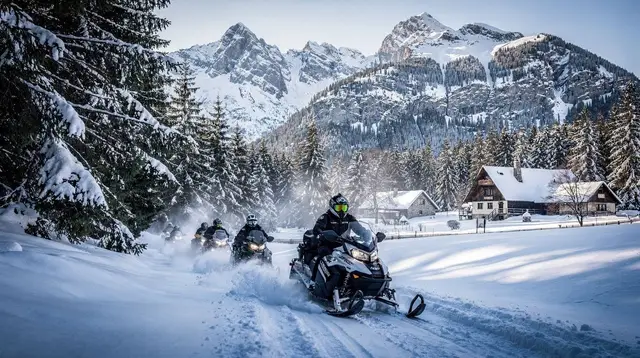
For visitors who do want the freedom of their own wheels for a morning without dealing with rental logistics or winter tyres, a guided buggy, quad or snowmobile excursion from Kraków delivers the driving experience for the mountain terrain itself, with someone else handling the approach.
Planning around the road rather than against it
The practical takeaway is not “avoid driving” as an absolute rule - it is “plan around the Zakopianka’s known pattern rather than hoping it behaves.” Choose a departure time outside the Friday evening and Sunday afternoon peaks where the itinerary allows it. Treat the 1.5-hour off-peak figure as a best case, not an average, especially on a snowy weekend or a public holiday.
Accept from the outset that Kuźnice and Palenica Białczańska are off-limits to private cars regardless of how the rest of the drive goes, and that the Morskie Oko car park needs a reservation made well before the day itself. And once you have arrived, default to the minibus network for getting around - it was built to solve exactly the problem this page describes, and it solves it every day without anyone needing to think about traffic at all.
Readers weighing up transport for the whole trip, not just the drive from Kraków, will find the broader comparison useful in Zakopane mistakes and tourist traps to avoid and in how many days to plan for a first visit, both of which touch on how much time transport choices end up costing across a short trip. For a first weekend, the two-day Zakopane itinerary is built around the minibus network rather than a rental car, which is the arrangement that works for most visitors most of the time.
Driving to Zakopane: quick reference
| Question | Short answer |
|---|---|
| Is a car required for a normal stay? | No - minibuses reach every valley and trailhead |
| Off-peak Kraków–Zakopane driving time | Around 1.5 hours |
| Worst-case driving time (Friday evening, Sunday, holiday, snow) | Can roughly double |
| Can I park at Kuźnice? | No - closed to private cars; walk, minibus, or Rondo Kuźnickie |
| Can I drive to Morskie Oko? | No further than Palenica Białczańska, and only with an advance online reservation |
| Best way around the valleys without a car | Private minibuses from the bus station area and Kościuszki street |
Winter adventures
Verified deep-linked GetYourGuide tours. Book through these links and we earn a small commission at no cost to you.
GetYourGuide does not provide a product photo for this activity — the image shows the meeting point, photographed by us.