Zakopane Mistakes and Tourist Traps to Avoid
What are the most common mistakes visitors make in Zakopane?
The recurring ones are driving toward Morskie Oko expecting to park near the lake, assuming Kasprowy Wierch cable car tickets are available on the spot, confusing the village of Chochołów with the Chochołowska valley, buying oscypek outside its May-to-September production season, underestimating Zakopianka traffic on Friday evenings and Sunday afternoons, and staying on Giewont's summit when an afternoon storm builds. Each one maps to a specific, checkable rule rather than bad luck.
The gap between what people assume and how Zakopane actually works
Most Zakopane mistakes are not carelessness. They are reasonable assumptions carried over from other trips — that a national park attraction has a car park next to it, that a cable car ticket can be bought at the base station, that a village name and a valley name sharing the same word are the same place. Zakopane and the Tatras run on a specific set of rules, and each mistake below traces back to one of them. None of this is about being a smarter traveller; it is about knowing the rule before it costs an afternoon.
Driving to Morskie Oko and expecting to park near the lake
This is the single most repeated mistake. Morskie Oko, the largest and most photographed lake in the Tatras, has no road access beyond a fixed point. Cars stop at the Palenica Białczańska car park, about 25 km from Zakopane, and in summer that car park must be reserved online in advance, often several days ahead for a July or August visit. From Palenica, the lake itself is still 9 km away on a paved road: two to three hours on foot with about 400 m of climb, or a horse-drawn carriage (fasiąg) as far as Włosienica, roughly 1.5 km below the lake, followed by a 20-minute walk. No private vehicle, taxi or tour bus goes past Palenica under any circumstance.
The mistake shows up in two forms. The optimistic version is a traveller who plans to “drive up, look at the lake, and leave” in an hour — that trip does not exist. The frustrating version is arriving at Palenica in August without a car park reservation and finding it full, which forces either a long approach from a farther lot or abandoning the plan entirely.
The fix is simple and has to happen before the trip, not at the gate: book the car park slot online, decide walking or carriage in advance, and budget most of a day. The full mechanics, including carriage prices and queue timing, are in the Morskie Oko visitor guide and the carriage versus walking comparison; the underlying booking logic is explained in why Morskie Oko requires booking.
For a first visit without the logistics to plan yourself, a private half-day tour of Zakopane with a local guide is a low-friction way to get oriented before tackling Morskie Oko on a separate day.
Turning up at Kuźnice hoping for a same-day Kasprowy Wierch ticket
The second recurring mistake is treating the Kasprowy Wierch cable car like a walk-up attraction. It is not. Tickets are dated and timed, sold online up to two hours before departure, and on a clear summer day they sell out — sometimes by mid morning. The cable car also closes for maintenance in late October to early November and for part of spring, and it stops running in strong wind at any time of year, including the warm, gusty halny wind that can appear without warning. A traveller who plans a “spontaneous” trip to Kuźnice on a beautiful day, expecting to simply buy a ticket at the base, regularly finds either a sold-out day or a multi-hour wait.
Kasprowy Wierch is the only genuinely high-mountain viewpoint reachable without a serious hike — 1,987 m, with the ridge to Giewont and the descent to Hala Gąsienicowa opening up from the top station — which is exactly why demand outstrips same-day supply on fine days. The fix is to check the forecast a few days out and book online as soon as a good weather window appears, not to leave it as a same-morning decision. The Kasprowy Wierch guide and the general booking guide for Morskie Oko, Kasprowy and TPN tickets both cover exact windows and seasonal pricing.
Mixing up Chochołów village and the Chochołowska valley
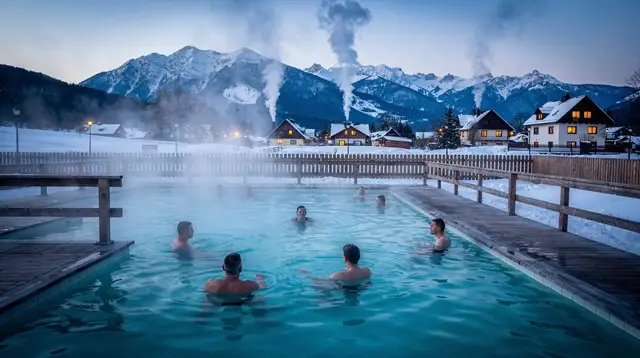
This one causes real confusion because the names look identical on a map at a glance, and both are worth visiting for different reasons. Chochołów is the best-preserved wooden village of the Podhale — about 50 listed log houses, scrubbed pale with soap every spring — and it also has its own Termy Chochołowskie, the largest thermal baths in Poland. The Chochołowska valley is the longest hiking valley in the Polish Tatras, entered from Siwa Polana, roughly 10 km away on a different road, and known for its carpet of crocuses in early April.
A traveller who books an evening at “Chochołów” thermal baths and then tries to combine it with a crocus walk in the same short window, assuming they are next to each other, loses time driving between two separate places rather than experiencing either properly. The safest habit is to treat “Chochołów” and “Chochołowska” as two different destinations that happen to share a root word, and to plan them as separate outings. The Chochołów wooden village walk and the Chochołowska valley crocus season guide make the distinction concrete, including which road leads to which.
Buying “oscypek” in winter and expecting the real thing
Oscypek carries a protected designation of origin, granted in 2008, and by law it is made only from May to September, from at least 60 percent sheep’s milk. The smoked, spindle-shaped cheese grilled with cranberry sauce on Krupówki stalls in December or during the ski-jump World Cup in January is almost always gołka, a similar-looking cow’s-milk cheese sold under the same informal name to tourists who do not know the difference. It is not a scam exactly — nobody is required to label it precisely — but it is not what the name promises, and travellers who build up a whole story about “authentic Zakopane oscypek in winter” are describing a cheese that, by definition, was not made that season.
This matters less for the cheese itself than for the pattern: winter visitors often assume every stall food on Krupówki is as traditional as it looks, when Podhale cuisine has a real seasonal calendar behind it. The reliable dishes year-round are kwaśnica (sour cabbage soup with smoked meat), moskole (potato flatbreads) and bryndza, none of which depend on a May-to-September window. See the winter oscypek explainer and the Podhale cuisine guide for what to order instead outside the cheese season.
Underestimating the Zakopianka on a Friday, a Sunday or a snowy weekend
The Zakopianka — the single main road linking Kraków and Zakopane — carries essentially all car and bus traffic between the two, and it has no real alternative route for most of its length. Under normal conditions the drive is about 90 minutes outside peak times. But Friday evenings, Sunday afternoons, public holidays and snowy weekends turn it into a queue that can more than double the travel time, and this is entirely predictable, not an occasional bad-luck event. Travellers who plan a Friday-evening departure from Kraków “to beat the weekend crowds” are often driving straight into the worst window of the week; the same mistake in reverse hits a Sunday-afternoon return.
Buses run all day, more than 50 departures daily, and while they sit in the same traffic, they at least remove the stress and parking problem at the Zakopane end. The bus, train and Zakopianka comparison and the Kraków-to-Zakopane transport guide lay out realistic timings by day and season, including why the drive is worth avoiding at the exact moments most travellers are tempted to do it. For a one-way trip without the driving decision at all, a private chauffeured day trip from Kraków sidesteps the parking and traffic questions together.
Staying on Giewont’s summit when an afternoon storm builds
Giewont, the “Sleeping Knight” ridge with its 15 m iron cross, is a genuinely popular hike from Kuźnice — about three hours up, with a final 100 to 200 m on chains over polished limestone. The mistake here is not attempting Giewont; it is misjudging the afternoon weather window. Thunderstorms build over the Tatras most afternoons in July and August, often quickly, and a summit crowned by a large metal cross on an exposed ridge is one of the worst places in the range to be caught in one. On 22 August 2019, a storm on Giewont killed four people and injured more than a hundred — recent, documented history, not a cautionary legend.
The practical rule that follows from this is straightforward: start early enough to be off the ridge by early afternoon, check the forecast the morning of the hike rather than the night before, and turn back if clouds are building over the peaks regardless of how close the summit looks. The chains also create genuine bottlenecks in season, which is another reason an early start matters even without a storm risk.
Full route timing and the safety context sit in the Giewont hike guide and the 2019 storm retrospective; general mountain judgment calls, including what TOPR mountain rescue actually covers, are in the Tatra mountain safety guide.
A handful of smaller traps that follow the same pattern
A few smaller mistakes come from the same source — assuming a rule from home applies here:
- Assuming a park ticket is only needed at “attractions.” A Tatra National Park entry ticket is required on every marked trail, including gentle valley walks like Kościeliska that look more like a scenic path than a mountain. There is no free side of the park.
- Bringing a dog into the park. Dogs are banned across almost the entire Tatra National Park, with two narrow exceptions (the Chochołowska valley up to the hut, and the Droga pod Reglami path). A dog owner who did not check this in advance has to leave the animal behind or change the plan entirely.
- Treating the złoty and the euro as interchangeable. Poland uses the złoty, not the euro; Slovakia, 30 to 60 km away across an open Schengen border, uses the euro. A day trip that crosses into the Slovak Tatras for Štrbské Pleso or the Bachledka treetop walk needs a plan for both currencies, usually solved with a card rather than carrying two cash stashes.
- Flying into Zakopane. There is no airport in Zakopane. Every air traveller lands at Kraków (KRK), about 115 km away, and continues by road.
Quick reference: mistake, rule, fix
| Mistake | The actual rule | What to do instead |
|---|---|---|
| Driving to Morskie Oko | Cars stop at Palenica Białczańska; 9 km on foot or carriage remain | Reserve the car park online, budget most of a day |
| Same-day Kasprowy Wierch ticket | Tickets are dated, timed, and sell out on fine days | Book online a few days ahead once the forecast looks good |
| “Chochołów” for the valley hike | Village and valley are ~10 km apart on different roads | Check which “Chochołów” a plan actually refers to |
| Winter “oscypek” | Genuine oscypek is made only May to September (PDO) | Order kwaśnica or bryndza instead in winter |
| Friday-evening Zakopianka drive | The road jams on Fri evenings, Sun afternoons, snowy weekends | Travel outside those windows, or take the bus |
| Giewont summit in a storm | Afternoon storms are frequent in July-August; the 2019 storm killed four | Start early, be off the ridge by early afternoon |
Frequently asked questions about Zakopane’s tourist traps
Can I drive all the way to Morskie Oko?
No. Private cars stop at the Palenica Białczańska car park, which must be reserved online in advance in summer, and from there it is 9 km on foot or by horse carriage to Włosienica, then a short walk to the lake. No vehicle, taxi or bus goes further.
Should I buy Kasprowy Wierch cable car tickets in advance?
Yes. Tickets are dated and timed, sold online up to two hours before departure, and routinely sell out on fine days, especially in July and August. Turning up at Kuźnice without a ticket often means a long wait or no ride at all.
Is Chochołów the same place as the Chochołowska valley?
No. Chochołów is a wooden village with its own thermal baths, and the Chochołowska valley is a separate hiking valley with its own entrance at Siwa Polana, about 10 km away on a different road. They share a name but nothing else.
Can I buy real oscypek in winter?
Not the genuine article. Oscypek is a protected designation of origin cheese made only from May to September from at least 60 percent sheep’s milk. What is grilled on winter stalls is usually gołka, a similar cow’s-milk cheese sold under the same name.
When is the Zakopianka road most congested?
Friday evenings, Sunday afternoons, public holidays and snowy weekends are the worst. The roughly 90-minute drive from Kraków can stretch past three hours, and the single-road bottleneck affects buses too, though less than private cars stuck in the same queue.
Is it safe to stay on Giewont’s summit during a storm?
No. The summit and its chained final section are fully exposed on an iron-crowned ridge, and lightning is the real danger — a storm on 22 August 2019 killed four people and injured over a hundred there. Afternoon storms are common in July and August, which is why early starts matter.
Do I need a park ticket for easy trails like the Kościeliska valley?
Yes. A Tatra National Park entry ticket is required on every marked trail, not only at named attractions — including gentle, paved valleys that look more like a park walk than a mountain hike.
Is Poland’s currency the euro?
No. Poland uses the złoty (PLN) and is not in the eurozone, while Slovakia across the border uses the euro. A day trip that crosses into the Slovak Tatras needs either both currencies in some form or a card that works on both sides.
Most of these mistakes disappear with one habit: check the specific rule for the specific place before the day arrives, rather than extending an assumption from a different trip. For a structured first visit that sidesteps several of these at once — parking, tickets and timing handled for you — a guided sightseeing day trip from Kraków or a combined thermal baths and cable car day from Kraków bundles the booking logistics into a single reservation, leaving the planning above for whichever days you spend exploring independently.
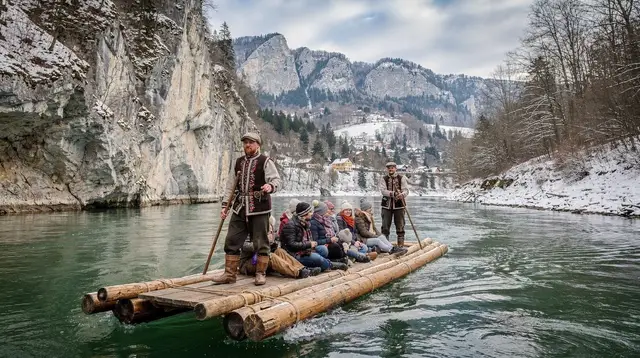
Rafting the Dunajec gorge runs on its own separate booking logic entirely, covered with a private Dunajec rafting trip if that is part of the same visit.
Popular day trips
Verified deep-linked GetYourGuide tours. Book through these links and we earn a small commission at no cost to you.
GetYourGuide does not provide a product photo for this activity — the image shows the meeting point, photographed by us.