Giewont looks close enough to touch from Krupówki: a jagged limestone ridge that, from the town, resembles a knight lying on his back under a blanket, a 15-metre iron cross planted where his chest would be. That closeness is part of the problem. Because the summit is visible from every café table in Zakopane, and because the walk starts at a cable-car base rather than a remote trailhead, Giewont gets treated as a casual add-on to a day in town. It isn’t one. This page sets out exactly what the climb involves — distances, times, the chains, and the storm risk that has killed hikers here — so you can decide honestly whether it’s the right mountain for you this trip.
Can you climb Giewont without hiking experience?
Not safely, and not comfortably. Giewont is a proper mountain hike with a technical finish: roughly three hours of climbing with 900 metres of ascent, followed by 100 to 200 metres of fixed chains on steep, often polished rock, before a summit with no shelter and a well-documented lightning history. None of that is unusual for the Tatras — it’s a normal grade of route by Polish mountain standards — but it is well beyond a “nice walk with a view” and well beyond what young children, unfit visitors, or people uneasy with heights should attempt. If that description doesn’t sound like your day, skip to the alternatives near the end of this page; there is no shame in choosing the Gubałówka ridge or the Kościeliska valley instead.
If it does sound like your day, treat it with the same respect you’d give any alpine route: start early, check the forecast that morning rather than the night before, and be willing to turn around. For a broader sense of what “hiking in the Tatras” covers before you commit to something this exposed, the Tatra mountain safety and TOPR guide is worth reading first, alongside the dedicated Giewont hiking guide for turn-by-turn route notes.
The Sleeping Knight: what you’re climbing
Giewont sits at 1,894 metres, on the northern edge of the High Tatras, close enough to Zakopane that its silhouette — head, chest, folded arms — is the town’s visual signature. The 15-metre iron cross on the summit was erected in 1901 by the Homolacs family and has been a pilgrimage site as much as a hiking objective ever since; it’s lit at night and visible from much of the Podhale.
The mountain is entirely within Tatra National Park, so a park ticket is compulsory on the approach, exactly as it is on every other trail in the 211.6 km² reserve — see booking Morskie Oko, Kasprowy and TPN tickets for current prices and how to buy in advance during busy months.
Giewont is not a technical rock climb — no ropes, no harness, no climbing gear — but it is graded harder than a normal marked trail because of the chained section near the top, and Polish hiking guidebooks class it alongside routes that demand a head for exposure and a reasonable level of fitness.
The route from Kuźnice to the summit cross
The standard approach starts at Kuźnice, the cable-car base at the southern edge of Zakopane. Kuźnice itself is closed to private cars, so plan on walking 30 to 40 minutes from the town centre, taking one of the minibuses that run along Krupówki and Kościuszki street, or parking at Rondo Kuźnickie and walking in from there.
| Stage | From → to | Distance / time | Notes |
|---|---|---|---|
| 1 | Kuźnice → Kalatówki meadow | ~1 hour | Gentle, wide track, no exposure |
| 2 | Kalatówki → Kondratowa hut (Schronisko na Hali Kondratowej) | ~45-60 min | Steady climb; good rest and water stop |
| 3 | Kondratowa hut → base of the chains | ~45 min | Trail steepens noticeably |
| 4 | Chains → summit cross (1,894 m) | ~30-45 min, longer with queues | Fixed chains, exposed, single file in season |
| — | Total ascent | ~3 hours | ~900 m of climbing from Kuźnice |
| — | Descent | ~2-2.5 hours | Same route; the chains are slower and more tiring downhill |
The Kondratowa hut is the last easy place to reassess: it has food, water and a clear view of the ridge ahead. Turning back from here costs nothing but time. Turning back from the chains, in a queue, with weather closing in, is a much harder decision to make well — which is exactly why it needs to be made before you’re there.
Some hikers reach Giewont from the other direction, off the ridge above Kasprowy Wierch via Kopa Kondracka. That approach is longer, more remote, and strictly for experienced mountain walkers already comfortable on exposed Tatra ridgelines; it is not a shortcut around the difficulty, it adds to it.
The chains near the top: what they actually involve
“Chains” here means fixed steel chains bolted into the rock face, not a via ferrata with clip-in cable and a harness. You hold the chain and use it for balance and pull as you climb over steep, frequently polished limestone — polished by decades of boots and hands, which makes it more slippery than the colour of the rock suggests, especially when damp. There is genuine exposure: a slip on the wrong stretch is not a minor tumble. In July and August, expect to share the chains with a queue of other hikers moving in both directions, which adds waiting time on exposed ground and reduces your control over your own pace — one more reason to start early and beat the crowds rather than climb into them.
Wet rock, morning dew, or any ice (possible well into June some years) makes the chains considerably harder and more dangerous. If the rock is wet when you reach the base of the chains, that is a legitimate turnaround point, not a challenge to push through.
The real danger on Giewont is lightning, not the chains
The chains get the attention, but the statistic that should change your planning is the storm risk. On 22 August 2019, an afternoon thunderstorm broke over Giewont’s exposed summit while it was crowded with hikers around the iron cross. Four people were killed and more than a hundred were injured, many by lightning strikes and falls in the panic that followed. It is recent, well documented, and it is the reason every serious guide to this mountain leads with weather rather than technique — read the fuller account in the 2019 storm and what changed on Giewont if you want the full picture before you go.
The pattern behind it is ordinary and predictable: in July and August, the Tatras build convective afternoon storms on hot, humid days, often with little warning beyond a darkening sky and a change in the wind. A summit with a 15-metre metal cross is about as poor a place to be caught out as exists in these mountains. The Zakopane summer thunderstorms guide and the Zakopane weather month by month page both cover the timing in more detail, but the operating rule for Giewont is simple and non-negotiable:
- Start early enough to be off the summit and chains by late morning or very early afternoon.
- Check the forecast the morning of your climb, not the night before.
- If you see building cumulus, hear thunder, or feel the wind shift while you’re still below the summit, turn back. The cross and the view will still be there another day.
- Never linger on the summit “for the photo” once weather is turning — this is the single most common mistake described in TOPR’s own incident reports.
If you or anyone in your party is caught in a storm or injured on the mountain, call TOPR (Tatra Volunteer Rescue) on 985 or +48 601 100 300, or the general emergency number 112. Rescue in Poland, including helicopter evacuation, is free of charge — cost is never a reason to delay calling for help.
When to go, and when to turn back before you start
Giewont is realistically a mid-June to September climb. Snow and ice linger on the upper slopes into May and sometimes June in a late year, and the high Tatra trails around Giewont typically close from 1 November to about 15 June for avalanche risk and chamois rut, regardless of what the weather in Zakopane town looks like. Outside that window, this is not a hike to attempt without full winter mountaineering experience and gear.
| Season | Condition | Verdict |
|---|---|---|
| November-mid June | Trail often closed; snow, ice on upper slopes | Do not attempt without winter mountaineering skills |
| Mid-June-early July | Trail open, less crowded, some snow patches possible | Good, check conditions the morning of |
| July-August | Warm, driest chains, but afternoon storms common and queues on the chains | Start very early (6-7am), watch the sky constantly |
| September-mid October | Stable weather, fewer crowds, cooler | Often the best window of the year |
Whatever the season, this is a full-day commitment from Zakopane once you count the approach to Kuźnice, the climb, the descent and a buffer for the chains. If your trip plan is tighter than that, it’s worth checking how many days first-time visitors actually need in Zakopane before you slot Giewont in alongside Morskie Oko or Kasprowy Wierch on the same visit — most people regret trying to do more than one big mountain day back to back.
What to bring for Giewont
- Proper hiking boots with ankle support and grip — trainers and sandals are a real cause of injury on the polished chain sections.
- Gloves for the chains, even in summer; bare hands on sun-baked or cold steel both become a problem.
- A rain shell and a warm layer regardless of the forecast — conditions on an exposed 1,894 m summit differ sharply from Zakopane town at 800-1,000 m.
- More water than you think you need; there is no reliable refill point above the Kondratowa hut.
- Your Tatra National Park ticket, bought in advance online in July-September when the daily quota can sell out.
- A fully charged phone for the TOPR emergency numbers, and a realistic turnaround time agreed before you set off.
If Giewont isn’t the right climb for you
There’s no shortage of ways to experience the Tatras that don’t involve chains or storm-exposed summits. A guided day out that shows you the mountains without technical ground is a sensible way to get the scenery: a full-day guided tour of Zakopane and the Tatra Mountains covers the classic viewpoints at a much gentler pace.
Families or anyone who wants height and adrenaline without exposure to real rock do better at the rope park above Gubałówka, reached by funicular rather than a three-hour climb.
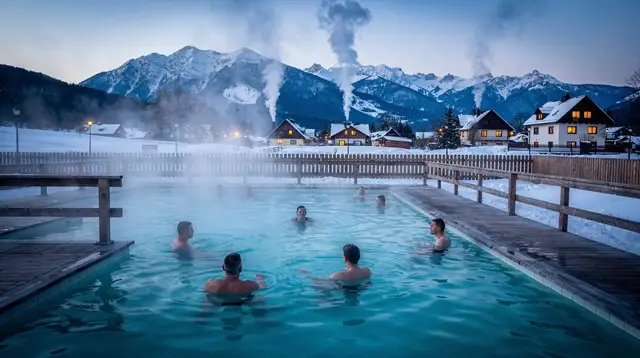
For a day that trades the mountain for motorised ground and a soak afterwards, a guided quad bike tour through the Tatra foothills covers similar countryside at a fraction of the physical demand, and if your legs are simply tired after a big hiking day elsewhere in the range, a shared trip to Zakopane’s thermal baths is the standard way locals and visitors alike recover.
For hikers who want the paved, low-risk version of a Tatra valley walk, the Kościeliska valley is the usual recommendation — nine kilometres of gentle, largely flat track suitable for most fitness levels, with none of Giewont’s exposure. Anyone building toward chained Tatra routes as a longer-term goal, rather than attempting one cold, should look at the multi-day hut-to-hut trek guide and the wider 5-day Tatras hiking itinerary for how experienced hikers sequence their acclimatisation before a route like this one.
And before any big mountain day in the park, it’s worth reading through the common Zakopane mistakes and tourist traps list — treating Giewont as a casual afternoon stroll is one of the most consequential ones on it.
Giewont hiking FAQ: chains, timing and safety
Is Giewont suitable for beginners or children?
No. The final approach uses fixed chains over polished limestone with real exposure, and there is no easy bail-out once you’re on them. Families and first-time hikers are better off on the paved Kościeliska valley or the Gubałówka ridge, which show the Tatras without technical ground.
How long does the Giewont hike take from Kuźnice?
Budget about 3 hours up via Kalatówki and the Kondratowa hut, and 2 to 2.5 hours back down. With rest stops and any queueing on the chains, a realistic round trip is 6 to 7 hours from Kuźnice.
What exactly are the Giewont chains?
They are fixed steel chains bolted into the rock over the last 100 to 200 metres below the summit, on steep, often polished limestone. They are not a via ferrata with harnesses; hikers pull themselves up hand over hand, and single-file queues form in July and August.
Is Giewont dangerous? What happened in 2019?
Yes, primarily from lightning. On 22 August 2019 an afternoon storm broke over the exposed summit and iron cross, killing four hikers and injuring more than a hundred. It is treated as a defining case study in Tatra safety, not a one-off tragedy.
Do I need a Tatra National Park ticket to climb Giewont?
Yes, on every marked trail in TPN, including the approach through Kalatówki. In 2026 it is 11 PLN standard, 5.50 PLN reduced, or 55 PLN for seven days, bought online at tpn.gov.pl or at the trailhead booth.
What is the best time of day and season to climb Giewont?
Start by 6 to 7am between mid-June and September, and aim to be off the summit and chains before early afternoon, when storms build. Snow and ice can linger into June, and high Tatra trails close from 1 November to about 15 June in most years.
Can I climb Giewont with dogs?
No. Dogs are banned on Tatra National Park trails, with the exception of the Chochołowska valley up to its hut and the Droga pod Reglami path — neither of which leads to Giewont.
What should I do if a storm builds while I’m on the mountain?
Turn back before you reach the chains or the summit, even if that means giving up on the day. Descend to treeline, avoid the ridge and the iron cross, and call TOPR on 985 or +48 601 100 300, or 112, if anyone is in difficulty — mountain rescue in Poland is free of charge.