First-Time Zakopane: How Many Days You Actually Need
How many days should a first-time visitor plan for Zakopane?
Plan around a week in winter, when skiing, sleigh rides and thermal baths spread naturally across several days, and 3 to 4 days in summer, enough to combine the town, one national park valley and one cable-car summit. Book the Morskie Oko car park and Kasprowy Wierch tickets in advance regardless of the season.
There is no single right number of days for Zakopane
Every generic answer to “how many days in Zakopane” gives one number, as if a skier arriving on 20 January and a hiker arriving on 20 July needed the same schedule. They do not. Winter and summer are close to two different destinations sharing one town, and the honest answer to how long to stay depends on which one you are visiting, what you want to do once there, and how tightly the calendar-driven bookings — the Morskie Oko parking reservation and the dated, timed Kasprowy Wierch cable car tickets — end up shaping what fits.
This page sets out a length by season rather than a flat figure, explains the booking constraints that decide your calendar before you do, and links each length to a sample itinerary you can adapt. If you have not chosen a season yet, that choice comes first; everything else follows from it.
Winter: a week matches the rhythm of skiing and thermal baths
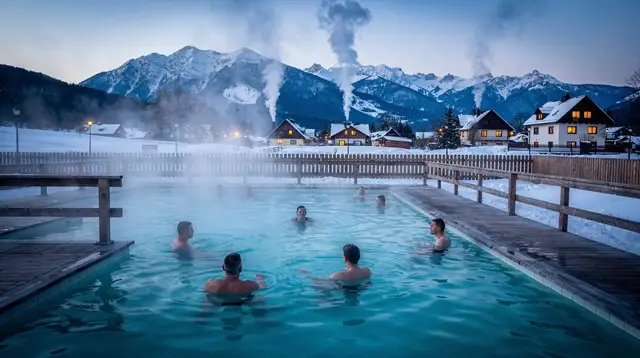
In winter, a week is the length that actually fits how the season works, not an arbitrary round number. Days are short — real daylight runs from roughly 8 am to 4 pm — and several of the signature activities are each worth a half-day or more on their own: a day of skiing at Kasprowy Wierch or one of the gentler resorts, a sleigh ride or a snowmobile outing through the Podhale valleys, an evening at one of the thermal baths after a day in the cold, and a slower morning in town around Krupówki and the Christmas market when it runs (mid-December to mid-January).
Trying to compress that into three or four days usually means dropping the thermal baths, or skiing only once, or never quite getting to Kasprowy Wierch because the cable car closed for wind on the one day it was booked. A week absorbs that kind of slippage without wrecking the trip: if one day is lost to weather, there is still time for everything else. It also matches how travellers actually arrive in winter — many are combining Zakopane with Kraków’s Christmas market or the January ski jump World Cup at Wielka Krokiew, and a week lets both fit without a rushed changeover.
A useful anchor: our 3-day winter itinerary is built as the core of a longer stay, not a complete one — it covers the town, one ski or snow day and one thermal-baths evening, and a week simply repeats and widens that pattern rather than replacing it. For the Christmas to New Year stretch specifically, see the dedicated 4-day itinerary, which accounts for shorter opening hours and higher demand across the holiday.
If skiing is not the goal and the trip is really about snow scenery, thermal baths and a gentler pace, four to five days can work — but budget the extra buffer day anyway, since a closed cable car or a snowed-in mountain road is far more common in January and February than in June.
Summer: 3 to 4 days is enough, if you plan it right
In summer, the calculation changes. Long daylight (sunrise before 5 am, sunset after 8 pm in June and July) means a single day can comfortably cover a full valley walk or a cable-car summit and still leave the evening free in town. Three to four days is enough for a first visit built around three components: the town itself, one Tatra National Park valley, and one cable-car or funicular summit.
A sensible shape for four days:
| Day | Focus | Why this order |
|---|---|---|
| 1 | Arrival, Krupówki, Gubałówka funicular | Gentle first day, no advance booking pressure |
| 2 | Kościeliska or Chochołowska valley | Paved, family-friendly, no TPN parking reservation battle |
| 3 | Morskie Oko or Kasprowy Wierch | The day that needed advance booking, done once acclimatised |
| 4 | Buffer or a second valley / Nowy Targ market | Absorbs a weather delay, or adds depth if the trip went smoothly |
This is close to what our 4-day itinerary without a car lays out, and it deliberately puts the booking-dependent day — Morskie Oko or Kasprowy Wierch — in the middle rather than on day one, so a delayed flight or a bad weather forecast on arrival does not cost the ticket that was hardest to secure.
Three days works if you accept trade-offs: either skip one of the two national park valleys, or treat the cable car as optional and let weather decide on the day. Our classic 3-day itinerary and the family-oriented 3-day plan both show how that trade-off plays out depending on who is travelling. Two days, covered in the Zakopane weekend itinerary, is workable for a first taste but usually means choosing between the town and the park rather than doing both properly — worth knowing before booking, not after.
If hiking further into the Tatras is the actual goal — the Valley of Five Polish Lakes, a proper ascent toward Giewont, or a multi-day hut-to-hut route — five days is closer to realistic, as covered in the 5-day hiking itinerary.
For travellers who want a structured two-day hiking introduction with a guide handling the logistics and the trail choice, that is exactly the shape of the two-day guided Tatra hiking tour, which works well slotted into the middle of a 4-day or longer stay.
The booking constraints that decide your calendar, not your wishlist
Zakopane’s two headline attractions do not run on a walk-up basis, and this shapes how many days a trip needs more than any preference does.
Morskie Oko requires the Palenica Białczańska car park to be reserved online before arrival. In July and August, slots for the coming days can sell out — sometimes several days ahead — which means the Morskie Oko day has to be chosen and booked before the rest of the itinerary is finalised, not slotted in wherever there happens to be a gap. Our complete Morskie Oko guide and the dedicated booking guide walk through the reservation process in detail.
Kasprowy Wierch tickets are dated and timed, sold online up to two hours before departure, and on clear summer days or around the winter holidays they routinely sell out. A trip that assumes “we’ll just buy tickets when we get there” risks losing the one clear-weather day to a sold-out slot. The practical fix is to check the forecast a few days out, then book the cable car for whichever day looks clearest — which again argues for a trip long enough to absorb a day’s shift if the weather does not cooperate.
Both of these facts push toward the same conclusion: a trip with zero slack — exactly enough days for exactly the planned activities, and no more — is fragile. A single missed reservation window, a windy morning that closes the cable car, or a forecast that changes overnight can knock out the centrepiece of a short trip entirely. Building in one buffer day, whether in a 4-day summer stay or a 7-day winter one, is the difference between a plan that survives contact with the actual weather and one that does not.
The weeks to avoid, or budget for
Two stretches of the year are both the busiest and the most expensive, and they change how much a given number of days actually delivers:
- July and August: Krupówki, Morskie Oko and the national park trails are crowded from morning to evening, TPN entry tickets and the Morskie Oko car park sell out fastest, and accommodation prices peak. A 4-day trip in this window needs its bookings locked earlier than the same trip in September.
- Christmas to New Year, and the Polish winter school holidays (mid-January to the end of February): this is the single most expensive and crowded stretch of the winter calendar. Some high trails are closed under the park’s standard winter closure (1 November to roughly mid-June), so the mix of activities shifts toward skiing, sleigh rides and thermal baths rather than high-mountain walking — see the guide to winter school holiday crowds for how much this changes prices and availability.
Outside those windows — May–June and September–October in particular — the same number of days goes further: fewer crowds, more available Kasprowy Wierch and Morskie Oko slots, and lower accommodation prices, though the trade-off in early spring is lingering snow above 1,500 m and a cable car that may pause for maintenance.
Matching your day count to what you actually want
One day, almost always as a day trip from Kraków, covers the town centre and perhaps the Gubałówka funicular. It does not reach the national park in any meaningful way, and it depends entirely on the Zakopianka road not being jammed — see why a Zakopane day trip from Kraków is worth weighing carefully before committing to this option. A private door-to-door option removes the bus-timing risk: the private Zakopane town tour covers the centre at a set pace without needing to catch a return bus.
Two days adds one national park valley or the Gubałówka summit to the town visit, but rarely both comfortably. It suits travellers who are combining Zakopane with a longer Kraków or southern Poland trip and want a genuine taste rather than a full visit.
Three to four days, in summer, is the sweet spot described above: town, one valley, one summit, one buffer day. In winter, three to four days works only if skiing or the thermal baths are not the priority — otherwise a week suits the season better.
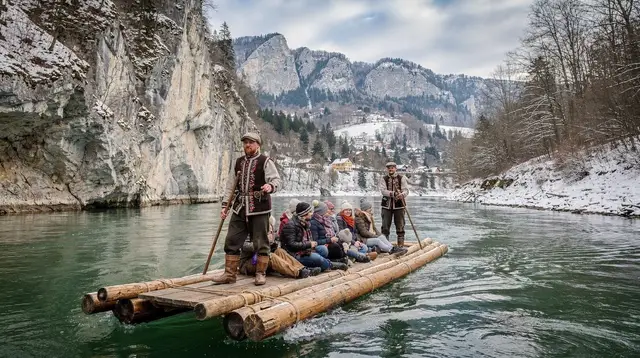
Five or more days opens up either deeper hiking — the Five Lakes valley, Giewont, or a hut-to-hut multi-day route — or a wider regional trip that adds the Pieniny and Dunajec gorge, the Slovak Tatras, or both, as in the 7-day Tatras and Pieniny itinerary. None of these fit inside a 3-day trip without cutting something else; they are additions, not detours.
For a first visit that wants a taste of the mountains without a heavy hiking commitment, a shorter activity day works well as one of the middle days — a relaxed soak at the Zakopane thermal baths pairs naturally with a low-key day, and travellers who want to combine the baths with a Kasprowy Wierch ride in one organised day can look at the thermal baths and cable car combination as a way to cover two bookings in one planned outing rather than juggling them separately.
For an extra half-day with families or younger travellers, the rope park at the top of Gubałówka gives the funicular trip a second purpose beyond the view.
What extra days should go toward, not just add to
If the season’s baseline number of days (a week in winter, 3 to 4 in summer) can be extended, the extra time is best spent on one of three things, roughly in order of value for a first-time visitor:
- A genuine buffer day against weather, closed cable cars or a missed booking window — the single highest-value addition, because it protects everything already planned.
- One more national park valley — pairing Kościeliska with Chochołowska, for instance, rather than doing only one, since both are gentle enough to combine without exhausting a trip.
- A day across the border or into the Pieniny — the Slovak Tatras or the Dunajec gorge rafting trip, each a distinct experience rather than a variation on what Zakopane itself offers.
What extra days should not go toward is repeating the town centre, which a first visit covers well in half a day, or trying to fit Auschwitz-Birkenau or the Wieliczka salt mine into the same trip — both are Kraków-area sites, roughly 2.5 to 3 hours from Zakopane each way, and are better handled as part of a Kraków stay before or after the mountains rather than squeezed into a Tatra-focused itinerary.
FAQ: how many days to plan for a first Zakopane trip
How many days do I need in Zakopane in winter?
Around a week works best. Winter days are short, the cable car can close for wind, and skiing, sleigh rides and thermal baths each want a half-day of their own rather than being rushed into one packed itinerary.
How many days do I need in Zakopane in summer?
3 to 4 days covers it well: one for the town and Krupówki, one for a national park valley such as Kościeliska or Chochołowska, one for a cable-car summit like Gubałówka or Kasprowy Wierch, and a spare day as a weather buffer for Morskie Oko.
Is 2 days enough for a first visit to Zakopane?
Two days is workable but tight: it usually means choosing between the national park and a proper look at the town, and it leaves no slack if a booking slot, a weather window or a sold-out cable car ticket does not line up.
Do I need to book Morskie Oko in advance?
Yes. The car park at Palenica Białczańska must be reserved online, and in July and August the slots for several days ahead can sell out, so this booking should be made before the rest of the itinerary is fixed, not after.
How far ahead should I book Kasprowy Wierch tickets?
Tickets are dated and timed and go on sale online up to two hours before departure, but on clear days in July, August and around the winter holidays they sell out hours or days ahead, so booking as soon as the date is fixed is the safer approach.
When are the busiest and most expensive weeks in Zakopane?
July and August, and the Christmas to New Year period combined with the Polish winter school holidays from mid-January to the end of February, are the busiest and priciest stretches of the year, with high trails sometimes closed in winter.
Can I visit Zakopane as a day trip from Kraków?
It is possible but rushed: the road trip alone is roughly 2 to 2.5 hours each way by bus, and a single day only allows a walk through the centre and maybe the Gubałówka funicular, not the national park or Morskie Oko.
Should I add extra days for the Slovak Tatras or the Pieniny?
Yes, if either interests you. The Slovak Tatras and the Dunajec gorge in the Pieniny are separate half-day to full-day trips, not detours that fit inside an already full Zakopane itinerary, so they are best added as extra days rather than squeezed in.
Popular day trips
Verified deep-linked GetYourGuide tours. Book through these links and we earn a small commission at no cost to you.
GetYourGuide does not provide a product photo for this activity — the image shows the meeting point, photographed by us.