What Is a Kulig? The Traditional Sleigh Ride in Zakopane
What is a kulig in Zakopane?
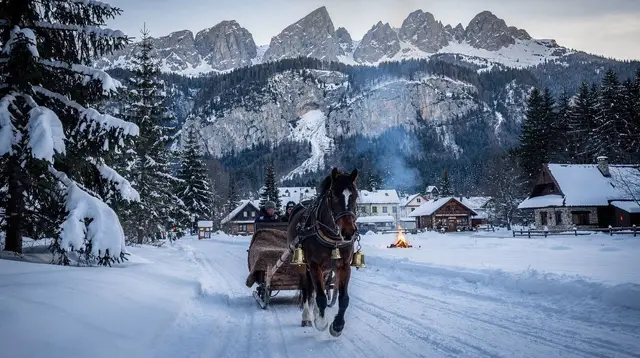
A kulig is the traditional Górale sleigh ride of the Podhale region: one or more horses pull a wooden sleigh across the snow, usually in the evening during the winter season from December to March. It is very often combined with a highlander-style feast, a bonfire and live folk music, though the sleigh ride itself is the core of the custom.
Kulig, Defined: A Górale Winter Custom
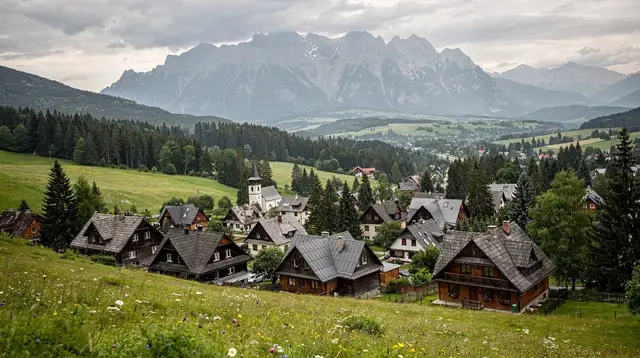
The word gets used loosely by anyone selling a winter activity in Zakopane, so it is worth starting with what a kulig actually is. At its core, a kulig is a horse-drawn sleigh ride: one or more horses pull a wooden sleigh, or a line of sleighs, across snow-covered ground. The custom belongs to the Górale, the highlander culture of the Podhale region that surrounds Zakopane and stretches out toward villages such as Chochołów and the wider Tatra foothills.
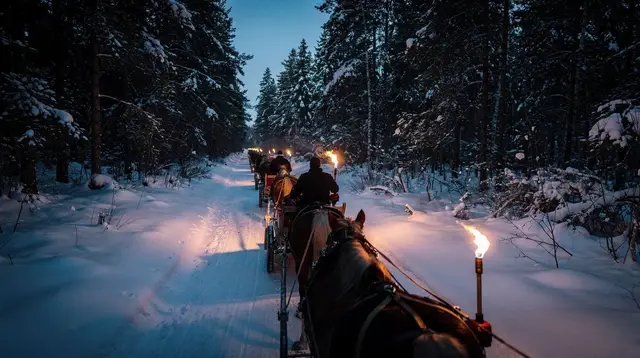
Historically, a kulig was not a single sleigh but a procession — a chain of sleighs moving together between homesteads and villages, often at carnival time, with stops along the way for food, drink and music at each household. That collective, village-to-village picture is the folk-history version of the word. What is sold to visitors today in and around Zakopane is a narrower, modern descendant of it: typically a single sleigh, or a small group of them, taking guests out for an evening through the snow, usually finishing at or combined with a meal. The sleigh ride is the fixed point of the custom; everything built around it — the meal, the music, the fire — is a very common addition rather than a strict requirement of the word itself.
It helps to be precise about this because “kulig” gets applied to different products by different operators. Some outings are built almost entirely around the ride itself. Others use the sleigh as the opening act for an evening whose main event is the highlander feast that follows. Both are legitimately called a kulig; neither is more “authentic” than the other in any verifiable sense, so the honest approach for a visitor is to read carefully what a specific outing includes rather than assume the word guarantees a fixed format.
When Kulig Season Happens
A kulig needs snow, which means it is strictly a winter-season activity. In practice that means roughly December to March, the same window covered in the Zakopane winter season guide. Zakopane itself sits at 830 to about 1,000 metres above sea level, low enough by Tatra standards that snow cover in the town and the surrounding valleys is reliable most winters but not physically guaranteed on any specific date — a sleigh needs a base of snow on the ground, not just cold air.
Within that window, the Christmas to New Year period and the Polish winter school holidays (roughly mid-January to the end of February) are the busiest and most booked-up stretches, as covered in the Christmas and New Year guide and the winter school holidays guide. Outside those peak weeks, December weekdays and early March tend to be quieter, though snow reliability drops off toward the end of the season. None of this is a promise: a mild or dry stretch can leave the lower valleys without enough snow even inside the nominal season, which is exactly why any kulig booking is weather-dependent rather than fixed months in advance.
One more weather factor worth knowing before an evening outdoors: the halny, a warm föhn wind that blows down from the mountains, can occur at any time of year, including winter. It is best known locally for shutting the Kasprowy Wierch cable car, but a halny evening can also mean gusty, unsettled conditions rather than the calm, cold, still nights that make for the most comfortable sleigh ride — see the halny wind guide for what it changes.
What a Kulig Evening Usually Involves
A typical evening built around a kulig has two parts, though the balance between them varies by operator. The first is the ride itself: guests board a wooden sleigh, drawn by one or more horses, and are taken across snow-covered ground, often through farmland or forest edge in the Podhale valleys rather than through the town centre. The pace is unhurried by nature — this is a horse pulling a sleigh, not a snowmobile — and the appeal is largely sensory: bells on the harness, the horses’ breath in the cold air, snow-covered wooden barns and fences passing by in the dark, and often blankets provided against the cold.
The second part, when it is included, is the highlander feast that follows or accompanies the ride: a meal eaten indoors or around an open fire, usually with live music from a local folk band. Some outings run the sleigh first and the meal after, in a warmed hut or barn; others fold music and food into stops along the route itself. Because formats differ this much, the detail of what any given evening includes — how long the ride lasts, whether the meal is seated or informal, whether it is one sleigh or several — is something to check on the specific listing before booking rather than something this guide can state as a fixed rule.
For one evening built specifically around the ride, the feast, the fire and live music together, see the Zakopane sleigh ride paired with a highlander feast and live music; for a version organised as a day trip from Kraków that folds the sleigh outing into the wider excursion, see the Kraków-based day out that includes a Tatra mountain sleigh ride in Zakopane.
The Highlander Feast: Music, Fire and Food
Where a kulig evening includes a meal, the food and music both belong firmly to Górale tradition, and it is worth being specific about that because the words “mountain feast” invite the wrong mental picture for some travellers. This is Podhale highlander food, not Mediterranean or Balkan fare — there is no raki, no ouzo, no meze spread; this is not Crete or the Peloponnese.
The dish most associated with a Górale evening is oscypek, the smoked sheep’s cheese of the Podhale, protected under EU rules since 2008 and traditionally made only from May to September using at least 60 percent sheep’s milk. At an evening feast it typically appears grilled, served with cranberry sauce, a pairing found on nearly every street stall on Krupówki as well as at highlander gatherings — the full detail on what makes it genuine, and what to watch out for outside its production season, is in the oscypek guide.
Alongside it, kwaśnica — a sour cabbage soup built on smoked meat — is the other standard of a highlander table, with bundz and bryndza (fresh and salted sheep cheese) and grilled sausage also common; the Podhale cuisine guide covers the fuller list. To drink: vodka and Polish beer are the standards, not wine or spirits imported from elsewhere.
Music comes from a local string band, or capelle, playing Górale folk tunes — the same string and fiddle sound behind highlander evenings across the Podhale, with dancers sometimes performing in traditional dress featuring the parzenica embroidery pattern. The Górale culture and costume guide and the highlander evening fire and music guide go further into what that culture is and how these evenings are staged. An open bonfire is the other recurring element, both for warmth on a winter evening and as the traditional centrepiece of a highlander gathering.
Where Kulig Rides Take Place
Kulig outings run in the snow-covered countryside around Zakopane rather than in the town centre — Krupówki has no room for a horse and sleigh, and the appeal of the ride depends on open, rural terrain. The Chochołowska valley, the longest valley of the Polish Tatras and known in a different season for its carpet of spring crocuses, is one area associated with sleigh outings; a private version run specifically in that valley is the private sleigh ride through the Chochołowska valley.
More broadly, outings are based in and around the villages of the Podhale — the same belt of countryside covered in the Zakopane destination guide and the Chochołów wooden village walk — with the exact starting point and route set by each specific operator rather than following one fixed traditional path.
Some operators pair a sleigh ride with other winter activities on the same evening or day, most often a snowmobile ride or a stop at a thermal pool complex, blending the traditional custom with more modern add-ons; one such combination is the day trip from Kraków that pairs a snowmobile-drawn kulig outing with dinner. Whether that kind of hybrid counts as a “real” kulig is a matter of definition rather than fact — the snow-drawn sleigh element is present, the traditional village-procession element is not, and it is worth reading the specific itinerary before booking if the traditional format matters to you.
Kulig vs Other Winter Rides
Because the vocabulary overlaps, it is easy to book one kind of winter outing expecting another. The table below sets out the distinctions in general terms — none of it substitutes for reading the specific listing you are considering, since formats vary between operators.
| Activity | Power source | Typical season | Typical setting |
|---|---|---|---|
| Kulig (sleigh ride) | Horse-drawn | Winter, snow-dependent (Dec–Mar) | Podhale countryside and valleys |
| Horse carriage (fasiąg) | Horse-drawn | Year-round where roads allow | Often a transfer, e.g. toward Morskie Oko |
| Snowmobile tour | Motorised | Winter, snow-dependent | Podhale valleys, forest tracks |
| Quad/ATV tour | Motorised | Mostly snow-free seasons | Podhale valleys and trails |
The difference between a kulig and a horse carriage is covered in more depth in the sleigh ride versus horse carriage guide: in short, a carriage is a general-purpose horse-drawn transfer that can run whenever the road is clear, while a kulig is specifically the snow-season, tradition-linked sleigh outing. For travellers weighing a motorised alternative, the snowmobile tours guide covers that option, and a sleigh-and-snowmobile combination that also stops at a thermal pool complex is the snowmobile and sleigh ride outing that finishes at a thermal pool complex.
What to Wear and Bring
A kulig is an outdoor, after-dark, winter activity, and the sleigh itself provides no heating — warmth comes from clothing, blankets provided by the operator, and movement being minimal rather than strenuous. A windproof, waterproof outer layer over warm mid-layers is the baseline, with proper winter boots, gloves, a hat covering the ears and thick socks. Because the halny can blow at any season and can turn a still winter evening blustery, it is worth checking the forecast on the day rather than assuming a calm night. If the evening includes a feast around an open fire, you will alternate between the cold of the ride and the warmth of the fire or a heated space, so layers you can adjust matter more than a single heavy coat.
Money and Practical Notes
Poland’s currency is the złoty (PLN), not the euro — worth stating plainly since a kulig evening often takes place in a rural setting where card readers are less reliable than they are on Krupówki. Horse-and-sleigh operators, highlander feast venues outside town, and any roadside stalls along the way frequently expect cash, so it is worth carrying złoty rather than counting on a card working everywhere; the Zakopane budget and złoty guide covers this in more detail, including typical tipping habits. Prices in Poland are shown VAT-included, and rounding up or adding roughly ten percent is the usual approach to tipping at a sit-down feast.
Altitude is a minor factor here compared with the Tatra peaks proper — Zakopane and its surrounding villages sit at 830 to around 1,000 metres, not high-mountain elevation — so a kulig evening is not an activity that requires acclimatisation or special fitness. The main variables to plan around are temperature, wind and snow cover, all of which are weather-dependent rather than anything a traveller can control by choosing a particular date months in advance.
Booking a Kulig: What to Check Before You Pay
Because “kulig” is used for genuinely different products — a straightforward sleigh ride, a sleigh-plus-feast evening, a sleigh-and-snowmobile hybrid, a version bundled into a day trip from Kraków — the useful habit is to read the specific listing rather than assume the word settles the details.
Questions worth answering before booking any specific outing include: does the sleigh ride happen once or does it move between stops; is a meal included, and if so is oscypek, kwaśnica or another highlander dish actually part of it; is the music live or recorded; how warmly should you dress relative to what blankets or heated space are provided; and where does the outing start relative to where you are staying. None of these answers are fixed by tradition — they are set by each operator, and this guide deliberately does not assign a name, price or exact duration to any of them, since those details change and belong on the booking page itself, not in a general guide.
For travellers based in Kraków without their own transport, some kulig-style evenings are sold as a full round trip from the city, folding the transfer, the ride and the feast into a single booked day or evening — worth comparing against organising transport independently, a question covered generally in the Kraków to Zakopane guide and the multi-day Tatra itinerary options for anyone building a longer winter stay around one or more of these evenings.
Kulig and Sleigh Rides in Zakopane: Frequently Asked Questions
What is a kulig, exactly?
A kulig is a horse-drawn sleigh ride that comes from the Górale, the highlander culture of the Podhale region around Zakopane. Historically it described a whole procession of sleighs moving between villages; today the word is used for a single sleigh outing, typically run in the evening and often paired with a mountain-style meal.
When can I experience a kulig near Zakopane?
Kulig rides run during the winter season, roughly December to March, whenever there is enough snow on the ground for a sleigh to move. Zakopane sits at 830 to about 1,000 metres, so snow cover in town is reliable most winters, but it is weather-dependent, not guaranteed on a fixed date.
Is a kulig the same as a horse carriage ride?
No. A carriage (fasiąg) usually runs on a cleared road or track, in any season, often to carry visitors partway toward a destination such as Morskie Oko. A kulig is specifically a snow-season sleigh outing tied to Górale winter tradition, more often built around an evening and a feast than a point-to-point transfer.
What food is typically served at a kulig evening?
The classic pairing is grilled oscypek, the smoked sheep’s cheese of the Podhale, served with cranberry sauce, alongside kwaśnica, a sour cabbage soup with smoked meat, plus vodka and Polish beer. This is highlander mountain food, not Mediterranean fare: there is no raki, no meze, no Greek or Balkan dishes involved.
What should I wear for a sleigh ride in the Tatra foothills?
Layered winter clothing is essential: a windproof and waterproof outer layer, warm boots, gloves, a hat and thick socks. A sleigh moves slowly through open, snow-covered terrain in the evening cold, and the halny, a warm föhn wind that can blow at any season, does not make winter evenings mild.
Do I need cash for a kulig?
It helps to carry some Polish złoty. Poland uses the złoty, not the euro, and while cards are accepted in most fixed venues, horse-and-sleigh operators, roadside stalls and highlander feast settings in the countryside often prefer or only take cash.
Is a kulig suitable for children and older travellers?
A basic sleigh ride is gentle and suitable for most ages, since it involves sitting in a sleigh rather than physical exertion. The evening cold and the length of an outing that includes a feast are the main factors to weigh for young children or anyone sensitive to low temperatures; check these details directly with whoever you book with.
Where do kulig rides usually take place?
Kulig outings run in the snow-covered valleys and villages of the Podhale around Zakopane, including areas such as the Chochołowska valley, rather than in the town centre itself. The exact route and starting point depend on the specific outing and are set by the operator, not by any fixed tradition.
Sleigh ride tickets
Verified deep-linked GetYourGuide tours. Book through these links and we earn a small commission at no cost to you.
GetYourGuide does not provide a product photo for this activity — the image shows the meeting point, photographed by us.