Oscypek: Poland's Protected Smoked Sheep Cheese
What exactly is oscypek, and when can you actually buy the real thing?
Oscypek is a smoked cheese made from at least 60% sheep's milk, protected as a PDO product since 2008, and legally produced only between May and September. Outside that window, the grilled cheese sold on winter stalls in Zakopane is almost always gołka, a cow's-milk imitation with no PDO status.
What makes oscypek different from every other cheese on Krupówki
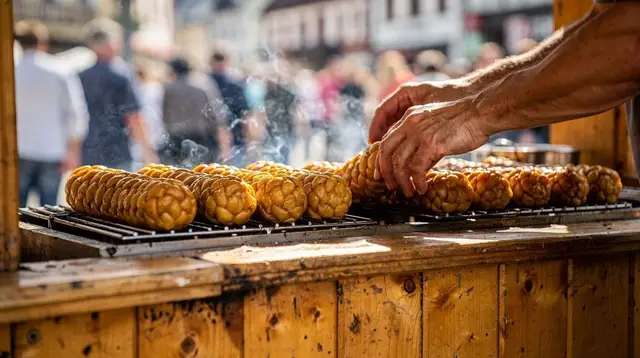
Walk the length of Krupówki on almost any day of the year and you will smell oscypek before you see it: a smoky, slightly sour note drifting from grills lined up along the pedestrian street. The cheese itself is easy to recognize once you know what to look for. It is spindle-shaped, tapered at both ends, with a hard golden-brown rind pressed into a repeating pattern from the wooden mould it was formed in. Inside, the paste is pale ivory, dense, and faintly elastic, closer in texture to a firm provolone than to a soft farmhouse cheese.
What sets real oscypek apart from the many smoked cheeses that resemble it is not the shape but the paperwork behind it. Since 2008, oscypek has held Protected Designation of Origin status in the European Union, the same category of protection that covers Parmigiano-Reggiano or Roquefort. That status is not decorative.
It legally restricts the name “oscypek” to cheese that meets three conditions at once: made from a minimum of 60% sheep’s milk, produced within a defined geographic area covering the Podhale, Tatra, and Pieniny highlands, and made during a fixed seasonal window. A cheese that is smoked, spindle-shaped, and sold in Zakopane can still fail all three tests and legally not be oscypek at all. Later in this guide is exactly how to tell the difference on a stall.
Understanding those three conditions is the whole point of this page. Oscypek is not just “smoked mountain cheese”, a description that fits several other regional products too. It is a specific, protected, seasonal food, and the single most useful fact a visitor can carry into Zakopane is the season itself.
The production window: May to September, and nothing outside it
Oscypek can only be legally produced between May and September. This is not a marketing choice by any single producer, it is written into the PDO specification, and it exists because it follows the biology of the animals rather than a calendar convenience. Highland sheep flocks in the Tatra foothills are moved up to mountain pastures, the halas, in spring once the grass is established, and stay there grazing through summer until they come back down in early autumn.
Milk taken from sheep grazing that mountain pasture, under the traditional shepherding system that has continued in the region for centuries, is the only milk the PDO rules allow into oscypek. Sheep kept in lowland barns over winter and fed on stored fodder do not produce milk that qualifies, even if a cheese made from it looked identical.
That means there are roughly five months of the year, May through September, when oscypek is actually being made in highland dairies, called bacówki, scattered above the Podhale villages and around Zakopane itself. Every other month, whatever is being grilled under that name on a stall has either been made and correctly stored from the last production season, or it is not oscypek at all.
Because this fact is so easy for a visitor to miss, and so central to eating honestly in the region, it is worth repeating it plainly: oscypek is a seasonal cheese, produced only from May to September, in the same way champagne is only from Champagne. A stall selling grilled cheese in a Zakopane December is not lying about the smoke or the shape. It may well be lying about the name.
How oscypek is actually made
The process starts with raw sheep’s milk, warmed and set with rennet into curds, which are then kneaded by hand while still warm, a step that gives the finished cheese its dense, slightly stringy texture rather than a crumbly one. The kneaded curd is pressed by hand into carved wooden moulds, oscypiorki, that stamp the surface with the geometric pattern every oscypek carries, and shaped into the tapered spindle that makes it recognizable at a glance from every other smoked cheese in Poland.
Once shaped, the cheese is soaked in brine, which both seasons it and begins to firm the rind, then hung to smoke over smouldering wood, traditionally in the rafters of the highland hut itself. Cold-smoking over several days dries the surface into the hard, golden-brown shell that lets a whole oscypek travel and keep without refrigeration for days, which is exactly why it became the portable protein of shepherds spending a season on the mountain, long before it became a tourist souvenir.
The PDO rules cap the non-sheep component: up to 40% of the milk can be cow’s milk from the same herds, but the sheep’s milk share can never drop below 60%. That ratio matters for flavour as much as for the label. Sheep’s milk brings a tangier, more mineral, slightly grassy character that cow’s milk alone does not replicate, which is part of why substitute cheeses made entirely from cow’s milk taste noticeably milder and flatter to anyone who has had the real thing.
Bundz and bryndza: the two cheeses that get confused with oscypek
Highland sheep dairies do not produce only oscypek, and two other cheeses from the same milk show up constantly on menus and market stalls around Zakopane, often confusing visitors who assume any sheep cheese on offer must be the famous one.
| Cheese | What it is | Texture | Typical use |
|---|---|---|---|
| Bundz | Fresh, unsalted sheep’s milk curd, eaten within days of making | Soft, moist, mild | Eaten on its own with bread, or as a base for other dishes |
| Bryndza | Bundz that has been salted and left to mature | Soft, spreadable, tangy, salty | Spread on bread, stirred into potato dishes, used in pierogi fillings |
| Oscypek | Salted, hand-shaped, and cold-smoked cheese | Firm, dense, smoky rind | Grilled and served with cranberry sauce, sliced, or shaved over dishes |
The three are, in effect, three stages of the same milk: fresh, matured, and smoked. None is a substitute for the others, and none is more “authentic” than the rest, they simply serve different meals. Bundz and bryndza are eaten fresh and do not keep for long, which is why you will not find them sold as souvenirs the way whole oscypek is. If a menu lists “smoked bryndza” or something similarly blended, it is worth asking what it actually contains, since the three names get used loosely outside their strict dairy meaning.
The street-stall reality: grilled oscypek with cranberry sauce
The single most common way to meet oscypek in Zakopane is standing up, on Krupówki, watching a slice sizzle on a small grill. This preparation, smacz oscypek, is simple: a thick slice of the cheese is grilled just long enough for the surface to blister and the inside to soften without fully melting (oscypek’s high salt and low moisture content mean it holds its shape far better on a grill than a soft cheese would), then handed over on a small plate or paper with a spoonful of żurawina, cranberry sauce, on the side.
The sharp, slightly bitter cranberry cuts through the smoke and salt of the cheese, and the combination has become the defining street food of the town, sold from stalls the entire length of the pedestrian street and around the base of the Gubałówka funicular.
It is worth eating slowly enough to notice what you are actually tasting: the smoke should be present but not overwhelming, the salt should be firm rather than sharp, and the texture should be dense and slightly chewy rather than rubbery. A cheese that tastes flat, faintly of nothing but smoke and salt, with none of the tangier sheep’s-milk character described above, is a reasonable sign that the milk behind it was not what the label implies.
The winter trap: gołka is not oscypek
This is the fact worth carrying into every stall visit outside the May-to-September window. Because oscypek’s shape, smoking method, and even its wooden mould pattern are simple enough to copy, a similar-looking cheese called gołka has become common on winter stalls in Zakopane, especially through the busy Christmas and February school-holiday weeks when demand for a hot smoked snack is highest and genuine oscypek stock from the last season is long gone or never existed in the first place.
Gołka is made from cow’s milk, smoked in a broadly similar way, and shaped to resemble oscypek closely enough that most visitors, and plenty of locals not looking closely, cannot tell the two apart by sight. It carries no PDO protection, because it is not the protected product, and there is nothing illegal about a stall selling it, as long as it is not being sold under the name “oscypek” itself, which does happen more often than the rules intend.
The practical rule for a visitor is straightforward: treat any “oscypek” bought in Zakopane between roughly October and April as very likely gołka, a perfectly enjoyable grilled cheese in its own right, but not the product this whole page describes. If a stallholder cannot say when the cheese was smoked, or the season it was made in, that uncertainty is itself the answer.
Where and how to taste real oscypek in season
Between May and September, oscypek made in that same season is genuinely being sold across Zakopane and the wider Podhale region, from the same Krupówki stalls, from market stands, and from small shops that also sell bryndza and other highland dairy. Buying whole rounds directly, rather than only the grilled slice, lets you see the mould pattern and rind colour clearly and compare a few before choosing, much as you would with any artisanal cheese.
For a more structured introduction, several tours pair a scenic outing with an actual tasting, which is useful if you want the cheese explained rather than just handed to you. A trip up to Gubałówka that combines the panoramic skywalk with an oscypek tasting puts the cheese in context, on the ridge where highland grazing is still visible on the slopes below.
A broader private food-tasting tour built around Polish highland traditions usually covers oscypek alongside kwaśnica, moskole, and other regional dishes described in the wider Podhale cuisine guide, giving a fuller sense of where the cheese fits on the table.
For a day that mixes an outdoor activity with food, a snowmobile outing that ends with a cheese tasting and a stop at the thermal baths is worth checking against the season note above: outside May-to-September, “cheese tasting” on a winter itinerary is very likely to mean gołka or bryndza rather than freshly made oscypek, which is not a flaw in the tour, just a fact worth knowing before you book it.
Beyond the grill: other ways oscypek appears on the table
Grilled with cranberry sauce is the dominant preparation, but it is far from the only one. Sliced thin and served cold, oscypek works as a sharp, salty addition to a cheese board alongside bryndza and cured meats. Shaved or grated, it turns up melted into scrambled eggs or stirred through potato dishes in some highland kitchens, where its smoke carries further than a raw slice would.
It also appears shredded over salads, giving a smoky, chewy contrast to greens that a soft cheese could not provide. None of these preparations are as visible to a passing visitor as the street grill, but they show up on menus around town, particularly in restaurants leaning into regional Podhale cooking rather than generic tourist fare, a distinction covered in the guide to eating well in Zakopane.
Buying oscypek to take home
Because it is cold-smoked and low in moisture, a whole oscypek is genuinely well suited to travel: it keeps for days at room temperature and considerably longer refrigerated, without the fragility of a fresh cheese. Whole cheeses are sold at market stalls, at shops along Krupówki, and at the Thursday and Saturday Nowy Targ market, which has traded highland produce since rights were granted to the town in 1487 and remains one of the more genuine places to buy dairy directly from producers rather than a tourist-facing stall.
The same seasonal rule applies to buying as to eating on the spot: a whole oscypek picked up in July was very likely made within the same season, while one bought in January was made months earlier at best, or is gołka at worst.
Oscypek season in the Zakopane calendar
| Period | What is actually available |
|---|---|
| May to September | Fresh oscypek production is running; bundz and bryndza are at their most available too |
| October | Last of the season’s stock is sold; new production has stopped |
| November to April | No fresh oscypek is being made; grilled “oscypek” on stalls is very likely gołka (cow’s milk, no PDO status) |
| Christmas and February school holidays | Peak demand for grilled cheese on Krupówki coincides exactly with the months when real oscypek cannot be produced |
Visiting in the height of summer, when the Tatra trails are busiest and the highland pastures are in full use, is the one guaranteed way to taste oscypek made in the same season you are eating it. A winter trip built around the ski jump World Cup or the Christmas market on Plac Niepodległości is still worth doing for everything else the town offers, just without the expectation of fresh oscypek on every grill.
Oscypek questions travellers ask in Zakopane
What is oscypek made from?
Oscypek is made from raw sheep’s milk, with a minimum of 60% sheep’s milk required under its PDO rules; the remaining share, up to 40%, can come from cow’s milk taken from the same highland herds. It is hand-kneaded, pressed into carved wooden moulds, brined, and cold-smoked over wood.
Why is oscypek only made from May to September?
The PDO specification ties production to the traditional highland grazing calendar. Only milk from sheep grazing mountain pasture during the spring-to-autumn grazing season, within the designated Podhale, Tatra, and Pieniny area, qualifies for cheese legally called oscypek.
What does PDO status mean for oscypek?
Protected Designation of Origin, granted to oscypek in 2008, legally reserves the name for cheese made in the defined region, from at least 60% sheep’s milk, by the traditional method, within the fixed May-to-September season. Cheese failing any one condition cannot legally use the name.
Is the oscypek sold in winter in Zakopane real?
Genuine oscypek is not being produced between roughly October and April, since highland sheep are not on mountain pasture then. What is commonly grilled on winter stalls under the same name is usually gołka, a similar-looking smoked cow’s-milk cheese without PDO protection.
What is the difference between oscypek, bundz, and bryndza?
All three come from the same sheep dairies but represent different stages of the milk: bundz is the fresh unsalted curd, bryndza is that curd salted and matured into a spreadable paste, and oscypek is the same milk shaped, salted, and cold-smoked into a firm, portable cheese.
How is oscypek usually served?
The most common preparation, sold along the length of Krupówki, is a slice grilled until the surface blisters, served hot with cranberry sauce spooned on top or alongside. It is also eaten cold, sliced thin, or shaved over regional dishes.
Can I take oscypek home with me?
Yes, a whole smoked oscypek travels well and keeps for days unrefrigerated, longer if chilled, making it a practical, non-perishable souvenir. Outside the May-to-September production window, what is being sold whole is more likely to be gołka than true PDO oscypek.
Where can I taste real oscypek in Zakopane?
Stalls and shops along Krupówki and around Gubałówka grill and sell it visibly through the production season; the reliable window is May to September. A guided tasting outing, such as the Gubałówka oscypek tasting trip or a broader Zakopane food-tasting tour, adds context to what you are eating alongside it.
Food tasting tours
Verified deep-linked GetYourGuide tours. Book through these links and we earn a small commission at no cost to you.
GetYourGuide does not provide a product photo for this activity — the image shows the meeting point, photographed by us.