Górale Culture: The Highlanders Behind Zakopane's Identity
Who are the Górale and what defines their culture?
The Górale are the highlander people of the Podhale region around Zakopane, with their own Polish dialect, a traditional costume built around parzenica embroidery and kierpce leather moccasins, and string-band music built on violin and double bass accompanying polyphonic singing. Their carpentry also shaped the Zakopane architectural style.
The people behind the wooden town
Everything a visitor notices in Zakopane in a single afternoon — the carved gables on Krupówki, the smell of grilled oscypek, a violin and double bass playing somewhere near a restaurant terrace — comes from one regional culture: the Górale, the highlanders of the Podhale, the foothill region wrapped around the base of the Tatras.
Górale is simply the Polish word for “highlanders,” and Podhale means “under the mountains.” The people who farmed, herded sheep and built timber houses on this land for centuries are not a separate nation or ethnicity; they are a distinct regional culture within Poland, with their own dialect, dress and music, and that culture is what gives Zakopane a personality no other Polish town has.
This page sets out what is actually documented about that culture: the dialect, the costume, the instruments and the transmission of the tradition. It leaves out invented names of specific troupes or craftspeople and specific event dates or workshop prices, because none of those were confirmed for this guide — treat any flyer or stall advertising a named group or a dated show as its own, separately verified, source.
A distinct dialect, not just an accent
The Górale of Podhale speak gwara podhalańska, a dialect of Polish rather than a different language, but one with enough of its own vocabulary, pronunciation and grammatical quirks that a standard Polish speaker from Warsaw or Kraków will notice it immediately. It developed over centuries of relatively isolated mountain pastoral life, shepherding routes, and contact with Slovak and Hungarian neighbours across the border.
Older residents of Podhale villages — around Kościelisko, Chochołów, Poronin and the hills toward Bukowina Tatrzańska — still use it daily, and it survives in local place names, in the lyrics of highlander songs, in shop signage written in dialect spelling, and in everyday speech alongside standard Polish. It is a living dialect, not a museum piece: children in Podhale schools grow up hearing both.
Visitors will not need the dialect to get by — standard Polish and, among younger staff on Krupówki, some English cover daily needs — but recognising that the sing-song, consonant-heavy speech overheard at a market stall or a sheep-cheese stand is a distinct regional form of Polish, not a mispronunciation, is part of understanding where you are.
The costume: parzenica and kierpce
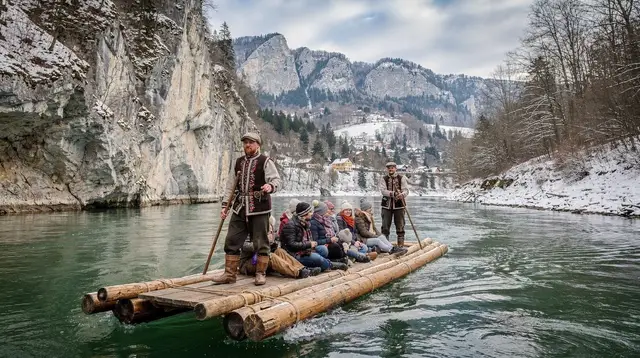
Traditional Góralski dress is built for mountain work and cold weather, and its best-known element is the parzenica: an embroidered motif sewn onto the front of men’s tight woollen trousers, usually in a curling, leaf-like pattern worked in coloured wool thread on pale cream or white cloth.
Parzenica motifs and colour choices vary from family to family and from village to village, and the embroidery is worked by hand rather than mass-produced, which is why two pairs of highlander trousers rarely look identical. The full men’s outfit typically pairs the embroidered trousers with a white linen shirt, a short wool waistcoat (often decorated with metal studs or shells), a wide leather belt, and a felt hat with a narrow brim, sometimes trimmed with shells or feathers.
Women’s traditional dress centres on a full skirt, an embroidered blouse, a fitted bodice or vest, and a floral headscarf or ribboned hairstyle, with an apron and coral-bead necklaces as common accessories — coral beads in particular were historically a sign of a family’s status.
On the feet, both men and women traditionally wore kierpce: soft moccasins made from a single piece of tanned leather, gathered and tied around the foot and ankle with leather laces, with no rigid sole. They were practical, inexpensive mountain footwear well suited to walking on rock and grass long before rubber-soled boots existed, and they remain part of the traditional outfit worn at highlander performances and folk festivals today, even though daily footwear in Podhale is now entirely modern.
None of this costume is everyday clothing any more — it is worn for performances, festivals, church holidays and family occasions — but it is not a fabricated tourist invention either: the garments, techniques and motifs are documented, inherited pieces of regional material culture, and collections of them are held at the Tatra Museum in Zakopane, founded in 1888, which remains the standard reference for anyone who wants to see the costume and its variations up close rather than only at a distance during a performance.
Music: string bands and polyphonic song
Górale musical tradition centres on small string ensembles, typically built around one or more violins and a three-string double bass, sometimes joined by a second violin playing a countermelody. The lead violin (prym) carries the tune while the other instruments provide rhythm and harmony underneath, producing a driving, dance-ready sound that is instantly recognisable once heard. These bands accompany both instrumental dance tunes and vocal singing.
The vocal side of the tradition is built on polyphonic singing — multiple voices singing different, interlocking lines rather than a single melody in unison — a style shared with other highland and shepherding cultures across the Carpathians. Songs cover themes of mountain life, shepherding, love and local history, sung in the Góralski dialect, and they are performed both at informal family or community gatherings and at organised public shows.
In Zakopane itself, visitors most commonly encounter this music at highlander evening events — often billed loosely as a “highlander feast” or “folk evening” — combining live string-band music, dancing in costume and a bonfire, typically paired with a regional meal. These evenings are a commercial format built for visitors, and any specific group name, showtime or price belongs on the listing of the operator running it rather than on this page; what can be said here is that the music and costume on display in that format draw directly on the same instruments, dance steps and dialect songs described above, not an invented “folk” style.
From highlander carpentry to the Zakopane style
The connection between Górale culture and the town’s architecture is direct and well documented. In the 1890s, the architect and writer Stanisław Witkiewicz studied the traditional timber building methods used by local Góral carpenters — log construction, steep shingled roofs, carved gables and decorative wood motifs drawn from folk art — and adapted them into a self-conscious architectural style, applied first to villas such as Koliba.
That style, since known as the Zakopane style, is what gives the town’s older wooden houses their distinctive look, and it turned a regional building craft into a recognised architectural movement. The full history of that style, and the specific buildings that show it best, is covered on its own page rather than here — see the guide to the Witkiewicz architecture for that detail — but the source of the style is worth stating plainly: it comes from Góral craftsmanship, not from an imported European fashion.
Where the culture is genuinely still practised
It is worth being precise about what is a living tradition and what is a performance staged for visitors, because both exist side by side in and around Zakopane and they are not the same thing.
Still practised day to day: the dialect, spoken across Podhale villages; costume-making skills such as parzenica embroidery, kept within families and small local workshops rather than factories; church and community events in some villages where traditional dress still appears outside of any tourist context; and sheep farming and cheese-making, which sustains oscypek production under its protected-origin rules from May to September.
Staged for visitors, but drawing on the same tradition: highlander evening shows with music, dancing and a bonfire; costumed photo opportunities on Krupówki; and folk-themed decoration in restaurants along the main streets. These are a commercial layer on top of the living culture, not a substitute for it, and treating them as the whole picture would undersell what is still practised away from the tourist strip.
A short walk through the older parts of town, past the wooden villas near Pęksowy Brzyzek and toward Chochołów, the best-preserved wooden village of the Podhale about 15 km from Zakopane, gives a quieter sense of the building tradition without any performance attached. A market day in Nowy Targ, held Thursday and Saturday mornings under rights granted in 1487, shows the region’s everyday commerce — sheepskin, leather goods, cheese — rather than a staged show.
Where to see it for yourself
| Where | What you see | Notes |
|---|---|---|
| Tatra Museum, Zakopane | Costume, instruments, tools, photographs | Founded 1888; the standard reference collection |
| Krupówki and nearby restaurants | Live string-band music, costumed staff or performers | Commercial, not a museum context |
| Highlander evening events | String band, polyphonic song, dance, bonfire, regional meal | Format is common; verify group, date and price with the specific operator |
| Chochołów village | Timber houses, carpentry that shaped the Zakopane style | About 50 listed log houses, no performance attached |
| Nowy Targ market | Everyday regional trade: sheepskin, leather, cheese | Thursday and Saturday mornings |
A guided walk through the old town is the easiest way to have this explained on the spot rather than pieced together from signage: a private walking tour of Zakopane’s old town or a broader private town tour typically covers the wooden villas, the church and cemetery, and the Krupówki area with a local guide who can point out costume and craft details a self-guided walk would miss.
For visitors based in Kraków who want the highlander town itself rather than only the mountains, a private Zakopane day tour with transportation from Kraków combines the transfer with the same kind of guided introduction. Those who want to pair the cultural side with the landscape that shaped it can add a guided hike into the Tatra foothills with pickup, since the pastoral life behind Górale culture happened on these same slopes.
Practical notes for visitors
Traditional dress is not something to buy as a cheap souvenir and expect to match what is displayed at a performance: genuine embroidered pieces are handmade and priced accordingly, and market stalls selling mass-produced “folk” items are a different, lower tier of product. If a specific costume, embroidery piece or kierpce pair matters to a visit, ask where and by whom it was made rather than assuming a stall item is equivalent to museum-quality work.
Highlander evening events vary widely in format, size and price depending on the operator, venue and season, and this guide deliberately does not quote a figure or name a specific troupe, since neither was verified for this page — check the listing of whichever event or restaurant is being considered. The same caution applies to festival dates: regional folk festivals and highlander gatherings do happen in and around Podhale through the year, but exact dates shift annually and should be checked against the event’s own current listing rather than assumed from a previous year.
For a first-time visitor short on time, the most efficient way to encounter Górale culture without committing to a full evening event is a walk down Krupówki at midday, when street food stalls grill oscypek and some restaurants have musicians playing informally, combined with an hour at the Tatra Museum for the historical grounding. Read more on planning the rest of a first visit in the guide to how many days to spend in Zakopane, and on avoiding the more commercialised traps of the main street in where to eat in Zakopane without the tourist markup.
Górale culture and costume: frequently asked questions
Are the Górale a separate ethnic group from Poles?
No. The Górale are Polish highlanders, a regional cultural and linguistic community within Poland, not a separate nationality. They are defined by the Podhale region, their dialect, dress, music and pastoral history rather than by ethnicity.
What is the Góralski dialect and is it still spoken?
Gwara podhalańska is a dialect of Polish with its own vocabulary, sounds and grammar, shaped by centuries of mountain pastoral life. It is still spoken by many residents of Podhale villages, especially older generations, and appears in local signage, songs and everyday conversation alongside standard Polish.
What is parzenica embroidery?
Parzenica is the traditional embroidered motif sewn onto the front of men’s Góralski trousers, typically in wool thread on white or cream fabric. Patterns and colours vary by family and village, and the craft is passed down rather than industrially produced.
What are kierpce?
Kierpce are soft leather moccasins, traditionally made from a single piece of hide tied around the foot with leather laces. They were the practical mountain footwear of the Podhale highlanders before modern boots and are still worn with traditional costume today.
Can visitors see Góralski music and costume in Zakopane?
Yes. String bands playing violin and double bass, and dancers in traditional costume, perform at highlander evening events, at some restaurants along and near Krupówki, and at seasonal events such as folk festivals. The Tatra Museum also holds costume and instrument collections for a calmer, year-round view.
Where does the Zakopane architectural style come from?
Stanisław Witkiewicz developed the Zakopane style in the 1890s by taking construction methods and decorative motifs from traditional Góral timber carpentry and applying them to villas such as Koliba. The link between highlander building craft and Zakopane’s wooden architecture is direct, though the architecture itself is covered on its own page.
Is the Górale culture still a living tradition or mostly performed for tourists?
Both are true at once. Dialect, costume-making and music are still practised within families and local associations in Podhale villages, while public performances in Zakopane for visitors are a separate, commercial layer built on top of that living tradition, not a replacement for it.
Where can I learn more about Górale history and objects in person?
The Tatra Museum in Zakopane, founded in 1888, holds costume, tool and instrument collections and is the standard reference point for a deeper, self-paced look at Podhale material culture.
Popular day trips
Verified deep-linked GetYourGuide tours. Book through these links and we earn a small commission at no cost to you.
GetYourGuide does not provide a product photo for this activity — the image shows the meeting point, photographed by us.