Highlander Fire and Music Evening in Zakopane
What actually happens at a highlander evening in Zakopane?
A commercial evening built around a wood fire, a live Podhale folk band in traditional dress, and a meal centred on grilled oscypek with cranberry sauce, kwaśnica soup, and local vodka or beer. It is a reconstructed spectacle staged for visitors, not a spontaneous village party, and both the music and the food vary in quality from one evening to the next.
What a Bonfire and Folk Music Evening Actually Is
Every evening in season, somewhere around Zakopane, a wood fire is lit, a small band tunes up, and a table fills with grilled cheese and sour cabbage soup. This is the highlander evening — sometimes called a górale feast, a bonfire evening, or simply “fire and music” in tour listings — and it is one of the most heavily sold evening activities in the whole Podhale region. Nearly every operator running sleigh rides, snowmobile trips or quad tours in the hills around town offers some version of it, either as a standalone booking or bolted onto an afternoon excursion.
The format is consistent enough that it is worth describing plainly before you book one: an open fire, usually outdoors under a wooden shelter or in a barn-style building with one open side; a live band in highlander dress playing fiddle, double bass and singing; and a set meal built around grilled oscypek with cranberry sauce and a bowl of kwaśnica. Vodka or Polish beer circulates, and the band often works the room, inviting guests to clap along or try a few steps of a simple dance later in the night. It is warm, loud, sociable, and squarely aimed at visitors rather than locals — which is not a criticism, just a fact worth knowing before you show up expecting a village party.
The Fire and the Setting
The fire itself is usually the visual centrepiece of the evening: a proper stack of logs, often built up over the course of the night rather than lit and left to burn down, throwing enough heat that guests can sit outdoors even on a cold Podhale evening. Some venues build the whole evening around an open-air fire pit with benches in a circle; others run the meal indoors, in a timber barn or lodge with the fire visible through an open wall or a large hearth at one end of the room.
Both versions exist across the operators working the Zakopane and Podhale valleys, and which one you get depends entirely on the specific evening you book — this page describes the format, not any single venue, since the setting, the exact site and the running order all vary by operator and by season.
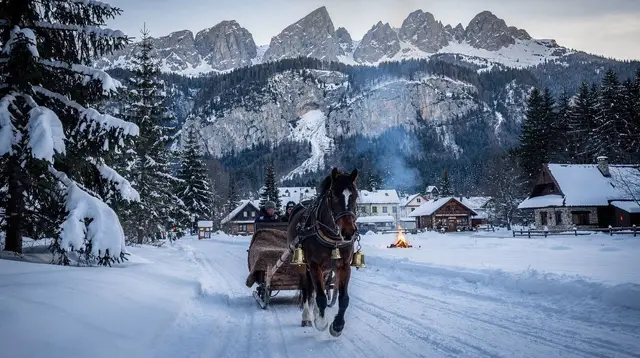
What stays constant is the pairing of fire and food: the grill sits at the edge of the fire, oscypek is often cooked to order over the coals, and the smoke and woodsmoke smell is part of the experience as much as the music. In winter, many of these evenings sit at the end of a sleigh ride through the snow, so guests arrive already cold and the fire does real, welcome work rather than being purely decorative.
The Music: Podhale Folk, Live
The band is a small ensemble in the Podhale style: one or two fiddles carrying the melody, a double bass keeping time, and singers who move between instrumental dance tunes and the close, unaccompanied vocal harmony that is characteristic of highlander singing in this part of Poland. It is a real regional tradition performed live, not a recording — the musicians play nightly through the season, which means the same tunes recur across evenings, but the delivery is genuinely live and the interaction with the room is spontaneous.
Expect the set to open with instrumental numbers, move into sung ballads, and often close with something more participatory — clapping, a simple circle dance, or an invitation for a few guests to join the musicians for a photograph. The mood is closer to a lively folk concert with dinner than a formal recital, and audience energy varies the evening as much as anything the band does: a full room that joins in gets a livelier set than a quiet one. The background of this music, and of Podhale singing more broadly, is a subject in its own right and is covered separately for readers who want the history rather than just the evening format.
The Costume: Parzenica and Kierpce
The band performs in highlander dress, and the details are worth knowing even if the full cultural context sits elsewhere. The men typically wear close-fitting white wool trousers with the parzenica — a curling, heart-shaped embroidery motif — stitched down the outer seam in bold thread, along with a wide leather belt set with metal studs and a short felt hat, often with a small feather or shell trim. On their feet, kierpce: soft, flat leather moccasins with no separate heel, tied around the ankle with a leather thong, designed originally for walking mountain terrain rather than performing in it. Women in the group, where the band includes them, typically wear an embroidered bodice over a white blouse and a full, patterned skirt.
None of this is invented for the show — it is the genuine Podhale highlander costume, still worn for real festivals and family occasions in the villages around Zakopane, and the same parzenica motif turns up on souvenirs sold the length of Krupówki. The fuller story of the costume, its symbolism and its place in górale identity is told in the dedicated guide to górale culture and dress — this one sticks to what a visitor actually sees at the table.
The Food: Oscypek, Kwaśnica, and What Comes With Them
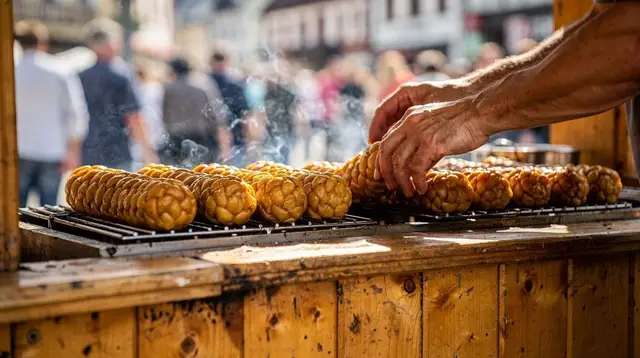
The meal is the other half of the evening, and it follows a recognisable pattern almost everywhere. Oscypek — the smoked, salted sheep’s-milk cheese made only between May and September under its protected status — is grilled until the outside blisters and served with cranberry sauce, the same combination sold from street stalls all along Krupówki, but here served warm and freshly grilled rather than from a cart.
Outside the cheese-making season, some venues substitute a similar smoked cheese or serve oscypek that was made and frozen earlier in the year; either way, it is worth knowing that “oscypek” on a winter menu is not always the same product as the summer original, a distinction covered in more depth in the full guide to oscypek.
Alongside the cheese, kwaśnica is close to a constant: a sour cabbage soup built on fermented cabbage and smoked pork, hearty enough to be a meal on its own on a cold night. Bread, pickled vegetables and grilled sausage commonly round out the plate, and drinks usually run to local vodka, Polish beer, or tea with raspberry syrup for anyone skipping alcohol.
Portions and exact menus differ by operator and by package, and neither the food nor the music is guaranteed to be excellent on any given night — quality genuinely varies, and a lukewarm plate or a subdued band is a real possibility rather than a rare exception. Readers who want a broader view of Podhale cooking, including dishes that rarely make it onto a tourist set menu, will find that covered in the guide to Podhale cuisine, alongside general advice on where to eat well around town.
Setting Expectations: A Show, Not a Village Party
The honest way to frame a highlander evening is as commercial entertainment built on real folk material, not as a spontaneous local gathering that visitors happen to be allowed into. These evenings are sold every night through the season, to groups of strangers who mostly do not know each other, by operators running the format as a business. That does not make the tradition behind it fake — the costume, the music and the dishes are all authentically Podhale — but the event itself is a reconstruction staged for paying guests, closer in spirit to a themed dinner show than to a village wedding or a saint’s-day feast.
Two consequences follow from that. First, do not expect a uniquely spontaneous or intimate evening — expect a well-rehearsed format that a professional band and kitchen run most nights of the week, for a room usually shared with several other travelling parties or tour groups. Second, do not expect consistency: a fire evening booked through one operator on one night can be markedly better, or worse, than the same booking made the week before, depending on the band on duty, the size of the group, and how the kitchen is running that evening. Reviews of any specific operator are worth reading close to your travel dates rather than relying on this page, which describes the format rather than endorsing any single provider.
How These Evenings Get Booked
Highlander evenings rarely stand entirely alone in the way an operator markets them — they are usually paired with a way of getting to the fire in the first place, which in season often means snow transport.
In winter, that pairing frequently takes the shape of a horse-drawn sleigh ride through the snow that ends at a bonfire supper with live folk music, or a similar run into one of the valleys such as a sleigh trip into the Chochołowska valley combined with a bonfire evening. Both only operate when there is snow on the ground for the sleighs, which in practice means roughly December to March, and neither is available or worth booking outside that window.
Outside the snow season, and sometimes alongside it, operators pair the same bonfire-and-music format with motorised excursions instead, such as a snowmobile or quad ride combined with a hosted bonfire feast.
Whichever transport option a package uses, the evening itself — fire, band, oscypek, kwaśnica — stays roughly the same; what differs is how you get there and back, and whether the group is large or kept small. None of these bookings guarantee a specific start time or a fixed price on this page deliberately, since both vary by season, by group size and by which operator is running a given evening — check the specific listing for current timing and cost before booking.
Practical Notes Before You Book
A few points are worth settling before committing to an evening. Confirm what is actually included — some packages cover only the meal and music, others bundle a return transfer from your accommodation, and a few combine the fire with a longer excursion earlier in the day. Ask about dietary options if you need them, since the default menu leans heavily on smoked meat and cheese. Dress warmer than you think you need to if the fire sits outdoors, even under a canopy, because Podhale evenings cool quickly once the sun is down, in every season but midsummer.
It is also worth deciding in advance how much of the evening you actually want: some travellers are happy with an hour of food and music before heading back, while others stay for the full two to three hours including any dancing. Most formats are relaxed about this, and nobody is likely to mind an early exit if the transfer allows it — worth confirming at booking rather than assuming.
For a wider sense of how an evening like this fits into a short Zakopane trip, and what else competes for the same evening slot, the two-day weekend itinerary and the broader things to do listing for this category are useful starting points, alongside general advice on avoiding the more obvious tourist traps around town.
Who This Suits, and Who It Does Not
A highlander evening works best for travellers who want an easy, sociable, warm evening without much planning, and who go in accepting it as staged entertainment rather than folklore in the wild. Families with children generally do well here — the fire, the music and the informality tend to hold younger visitors’ attention better than a formal restaurant meal would — and it pairs naturally with an active day out on snow or in the hills, since the format was built to follow exactly that kind of afternoon.
For a first Zakopane visit built around a short stay, it is a reasonable way to spend one evening among several options; the first-time visitor guide sets it in the context of everything else worth doing.
It suits people less well who are actively looking for an intimate, unstaged encounter with local life, or who have strong opinions about eating only in season-correct, small-scale settings — the honest comparison there is with the wider debate about Krupówki itself, which faces the same trade-off between convenience and authenticity.
Travellers who would rather eat in a proper Podhale kitchen than at a staged fire should look instead at general dining advice for the area, which points toward places serving the same dishes outside the evening-show format. Either choice is reasonable — the point of this page is simply to describe honestly what the fire-and-music evening actually is, so the decision to book one, or to skip it, is an informed one.
Highlander Evenings in Zakopane: Frequently Asked Questions
Is a highlander evening a real village celebration or a show for tourists?
It is a commercial format, staged every evening in season for visitors, not a spontaneous local celebration. The musicians are professionals who perform nightly, the menu is fixed, and the fire is lit for the group rather than a village occasion. That does not make the music or the costume fake — both draw directly on real Podhale traditions — but the event itself is reconstructed for paying guests.
What food is served at a Zakopane highlander evening?
The centrepiece is oscypek, the smoked sheep cheese, grilled and served with cranberry sauce, alongside kwaśnica, the sour cabbage soup with smoked meat that is a Podhale staple. Bread, pickles and grilled sausage often round out the plate, with local vodka or Polish beer to drink, and tea with raspberry syrup for those who prefer not to drink alcohol.
What do the musicians wear at these evenings?
The band typically wears the Podhale highlander costume: for the men, wool trousers with the parzenica embroidery running down the outer seam and kierpce, the soft leather moccasins tied with a thong, plus a felt hat and a wide leather belt studded with metal. Women’s dress, when part of the group, adds an embroidered bodice and a full skirt. The origins and meaning of the costume are covered separately.
Is the music live, and what kind of music is it?
Yes, the bands play live: a small string ensemble of fiddles and a double bass, plus unaccompanied vocal singing in the close, polyphonic style of the Podhale region. Sets usually mix instrumental dance tunes with sung ballads, and musicians often invite the room to clap or join a simple line dance later in the evening.
Do I need to book a highlander evening in advance?
Booking a day or two ahead is sensible in the winter and summer peaks, since operators sell out popular evenings, especially ones bundled with a sleigh ride or bonfire transfer. Outside peak weeks, same-day or next-day availability is common, but confirming a spot before arriving in Zakopane avoids a wasted evening.
Can vegetarians eat at a highlander evening?
Oscypek and bread cover a vegetarian diner reasonably well, but kwaśnica is built on smoked meat and most set menus are meat-centred by default. Anyone with dietary restrictions should ask the operator before booking rather than assume the kitchen will improvise on the night.
Is a highlander evening included with a sleigh ride or ATV tour?
Often, yes. Several operators combine a horse-drawn sleigh ride, a snowmobile or quad outing, or a valley excursion with a bonfire supper as a single booking, which is usually better value than arranging the meal and the transport separately. The sleigh option only runs when there is snow on the ground, typically December to March.
How long does a typical highlander evening last?
Most run two to three hours once the food, music and any dancing are accounted for, though exact timing depends on the operator and on how the fire and the set combine with any transfer or sleigh ride bolted onto the package. Groups are free to leave once they have eaten if they do not want to stay for the full set.
Highlander feast nights
Verified deep-linked GetYourGuide tours. Book through these links and we earn a small commission at no cost to you.
GetYourGuide does not provide a product photo for this activity — the image shows the meeting point, photographed by us.