For most people, Zakopane does not start at Zakopane. It starts at a gate roughly 110 km to the north: Kraków, the city with the airport, the train station, and the bus platforms that feed the Tatras all day, every day. Understanding this leg — how long it really takes, which option to pick, and what belongs to Kraków rather than to the mountains — matters more than almost any other logistics question on this trip, because getting it wrong costs hours, not minutes.
Why Kraków is the gateway, not a detour
Zakopane has no airport, no major train hub of its own beyond a modest regional station, and no direct international bus network. Nearly every visitor — Polish or foreign, flying or driving — passes through Kraków first. That makes Kraków less an optional add-on and more the functional front door of this whole region: the Kraków leg of the trip is not a detour from Zakopane, it is the way in.
The number worth remembering is 110 km by road. That is short on a map and deceptive in practice, because the entire route funnels through a single corridor, the Zakopianka (national road 47/E77 for stretches), which behaves very differently depending on the day and the hour.
How far is it, and how long does it actually take
| Mode | Typical duration | Frequency / notes |
|---|---|---|
| Bus | 2-2.5 hours | More than 50 departures a day |
| Train | 2-3.5 hours | Varies by service (regional vs. express) |
| Car, off-peak | About 1.5 hours | Single road, the Zakopianka |
| Car, peak times | Up to 3+ hours | Friday evenings, Sunday afternoons, holidays, snowy weekends |
| KRK Airport direct bus | 2-2.75 hours | Covers the extra ~5 km to the airport |
Three numbers, three very different experiences of the same 110 km. It is worth taking each one seriously before picking.
By bus: the easiest way, and usually the smartest one
The bus is the default choice for good reason. More than 50 services a day run the Kraków-Zakopane corridor, spread from early morning to late evening, which means there is rarely a wait longer than 20-30 minutes at busy times. The ride itself takes 2 to 2.5 hours, and modern coaches run air-conditioned, with luggage space and usually a toilet on board.
Buses leave from the main Kraków bus station area near the main train station, and arrive at Zakopane’s own bus station in the town centre, a short walk from Krupówki. For anyone who wants to compare this against the other two options in detail, the dedicated guide on bus, train and car between Kraków and Zakopane breaks down operators, ticket booking windows and seat reservations.
The bus’s real advantage over the car is that it does not care about the Zakopianka’s mood. A driver stuck behind a queue of holiday traffic loses an hour of their trip; a bus passenger loses nothing more than a slightly later arrival, because the schedule already assumes some slack. For a first Zakopane trip, or for anyone without a rental car, the bus is the answer worth defaulting to.
By train: comfortable, but check the timetable
The train covers the same distance in 2 to 3.5 hours, a wider range than the bus because service quality varies: some connections run direct and relatively fast, others involve a change or take a slower regional routing through the Podhale. Trains are generally more comfortable for a longer sit — proper seats, more legroom, a chance to work or read — and they avoid road traffic entirely, which matters most in bad weather.
The trade-off is frequency and flexibility: there are far fewer trains than buses in a given day, so a missed connection costs more time to recover from. For travellers whose schedule is fixed around a specific train, or who simply prefer rail, it remains a solid option; for anyone who wants the shortest gap between “I want to leave” and “I am on my way,” the bus usually wins. The background on the differences between train, bus and car covers this trade-off in more depth, including why the same 110 km produces three different answers depending on the mode.
By car: fastest off-peak, a trap at the wrong hour
Driving is the quickest option on paper: about 1.5 hours outside peak periods, door to door, with no schedule to match and full flexibility about stops along the way — Wadowice, the Ojców area, or a village market. That flexibility is real, and for a group with luggage, kids, or a plan to explore the Podhale villages independently, a car earns its keep.
But the road tells only one story once a bottleneck forms. The Zakopianka is a single main corridor for a huge share of southern Poland’s weekend and holiday traffic, and it jams predictably: Friday evenings as the weekend crowd heads south, Sunday afternoons as it heads back north, public holidays, and snowy weekends in winter when conditions slow everything further.
On any of those, the 1.5-hour drive can become 2.5 to 3 hours or more, with no way to opt out once committed to the road. Winter driving adds its own risk — snow chains, ice, and reduced visibility on mountain approaches — covered in the guide to driving to Zakopane, the Zakopianka and parking. The practical rule: drive if the timing avoids the danger windows above, take the bus if it does not.
Once in Zakopane, a car mostly becomes a liability rather than an asset: Kuźnice is closed to private vehicles, Morskie Oko’s car park needs an online reservation, and most valley trailheads are better served by the local minibuses to the valleys and Kuźnice than by hunting for parking.
Landing at Kraków Airport — there is no airport in Zakopane
Nearly every international visitor arrives through Kraków Airport (KRK), roughly 115 km from Zakopane — a few kilometres beyond the city-to-city distance, since the airport sits outside central Kraków. This is worth stating plainly because it surprises some first-time visitors: Zakopane has no airport of its own. Anyone flying in is landing at KRK and then making the same Kraków-Zakopane transfer described above, just starting a little further out.
Direct airport buses cover this route in about 2 to 2.75 hours, running straight from the arrivals area to Zakopane without a change in central Kraków — convenient for landing after a flight with luggage in tow. Private transfers and taxis cover the same ground in similar time off-peak, at a higher price but with door-to-door convenience and no schedule to match. The full breakdown of these options, including how to book ahead in high season, is in the guide to the transfer from Kraków Airport to Zakopane.
For travellers with a short layover mentality — land, transfer, mountains by evening — this number matters: budget the better part of three hours from touchdown to Zakopane, not the 90 minutes the road distance alone might suggest.
Day trips sold from Kraków: why some people skip the drive twice
Because so many travellers base themselves in Kraków rather than Zakopane, a whole industry of day trips runs south from the city and back in a single day. A full day to Zakopane and the Tatra mountains sold from Kraków typically combines a scenic ride on the Zakopianka with a few hours in town — Krupówki, maybe the Gubałówka funicular paired with a cheese and vodka tasting — before heading back the same evening.
It is a reasonable way to see Zakopane’s town centre without changing hotels, though it inevitably compresses time on the ground: the guide to whether a Zakopane day trip from Kraków is worth it weighs that trade-off against staying overnight.
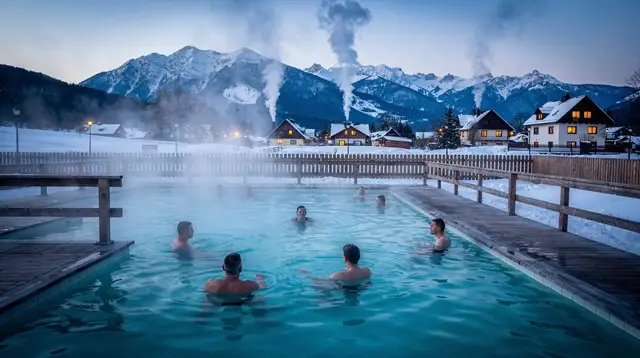
The same logic extends to the thermal baths in the surrounding villages, which sit closer to Kraków’s day-trip range than Zakopane’s proper mountain attractions do. A full day from Kraków covering Zakopane and the Tatra foothills is one route; a soak-focused alternative such as a day tour from Kraków built around Zakopane’s hot springs skips the high mountains entirely in favour of the Podhale’s geothermal pools, useful in winter when trail access is limited anyway.
None of these day trips replace a proper stay in the mountains — Morskie Oko, Kasprowy Wierch and the deeper valleys need more than a few compressed hours — but for a traveller whose base is fixed in Kraków, they are a legitimate way to get a taste of the Tatras without packing a bag.
Two side trips that belong to Kraków, not Zakopane
Two of Poland’s best-known sites are frequently confused for Zakopane-area attractions. They are not. Both are Kraków excursions, geographically and logistically, and treating them as Zakopane day trips wastes a large part of a mountain holiday.
Wieliczka salt mine sits about 15 km from Kraków — a short, easy half-day trip from the city. It is not near Zakopane at all; reaching it from the mountains means first covering the same 110 km back to Kraków, then the extra 15 km to Wieliczka, which turns a half-day outing into the better part of a full day. If the plan includes Wieliczka, it belongs to time spent in Kraków, not to a Zakopane itinerary.
Auschwitz-Birkenau is roughly a 2.5 to 3 hour drive from Zakopane in the other direction, and it demands an advance online reservation — entry itself is free, guided tours are paid, and both need booking ahead, sometimes well ahead in high season. This is a memorial, not an attraction, and it deserves to be treated as one: a full, unhurried day, not a stop squeezed between mountain activities. From Kraków, the distance is far shorter, which is why the overwhelming majority of visits are organised from the city rather than from Zakopane. Anyone weighing whether to add it to a mountain-based trip should read it as a serious, separate commitment, not a box to tick alongside Krupówki and the funicular.
For a broader sense of what else sits within reach of Kraków but outside the mountains — the Wadowice birthplace of Pope John Paul II, the Ojców valley — see other day trips from Wadowice and Ojców.
Kraków itself: worth a day before or after the mountains
It is easy to treat Kraków purely as a transit point, but the city rewards a day or two of its own: the medieval Main Square, Wawel Castle, the former Jewish quarter of Kazimierz, and a restaurant scene that outclasses anything in the mountains. Most itineraries that pair the two places do one of two things — spend a day or two in Kraków on arrival before heading to Zakopane, or reverse the order and unwind in the city after several days of hiking, before flying home from KRK.
Either sequence uses the same bus and train links described above, so the choice is really about pacing rather than logistics. A short Zakopane weekend of two days bolted onto a longer Kraków stay works well for a first trip to Poland; a one-day Zakopane excursion from Kraków suits a traveller whose main base is firmly the city. Either way, budgeting for the transfer — 2 to 2.5 hours each way at minimum — keeps the rest of the schedule realistic, and the guide to first-time Zakopane planning is a useful next stop for working out how many days the mountains themselves deserve.
Before booking anything precise — TPN park tickets, the Morskie Oko car park, a Kasprowy Wierch cable car slot — it is worth reading the guide to booking Morskie Oko, Kasprowy and TPN tickets, since several of these sell out days in advance in July and August, regardless of how smoothly the Kraków-Zakopane leg goes. Travellers on a tighter budget should also check the Zakopane budget and złoty guide before pricing the trip end to end, since Poland’s currency and price levels differ from the eurozone destinations many visitors compare it to.
Getting from Kraków to Zakopane: FAQ
How far is Kraków from Zakopane?
About 110 km by road. That distance takes 2 to 2.5 hours by bus, 2 to 3.5 hours by train depending on the service, or around 1.5 hours by car outside peak times.
What is the fastest way to get from Kraków to Zakopane?
A car off-peak is fastest at about 1.5 hours, but the single road can double that in traffic. For predictable timing, the bus at 2 to 2.5 hours, with more than 50 departures a day, is usually the better bet.
Is there an airport in Zakopane?
No. Zakopane has no airport. Kraków Airport (KRK), about 115 km from Zakopane, is the nearest one, and direct airport buses to Zakopane take 2 to 2.75 hours.
How long does it take from Kraków Airport to Zakopane?
Direct airport buses take roughly 2 to 2.75 hours. A transfer or taxi covers the same distance in a similar time off-peak, longer if it crosses a Friday evening or a snowy weekend.
Can Wieliczka salt mine be visited from Zakopane?
Not as a short trip. Wieliczka is about 15 km from Kraków, not from Zakopane, so it is a Kraków-based excursion. Reaching it from Zakopane means routing through Kraków first.
Is Auschwitz-Birkenau close to Zakopane?
No. It is roughly a 2.5 to 3 hour drive from Zakopane, and it requires a free advance online reservation. It should be planned as a long day from Kraków, or from Zakopane only with a full day set aside, and treated as a memorial, not a tourist attraction.
When does the Kraków-Zakopane road get congested?
The Zakopianka is busiest on Friday evenings, Sunday afternoons, public holidays and snowy winter weekends, when the normal 1.5-hour drive can stretch toward 3 hours.
Should I spend time in Kraków before or after Zakopane?
Either works. Many travellers land at KRK, spend a day or two in Kraków, then head to Zakopane; others do the mountains first and unwind in the city before flying out. Both directions use the same bus and train links.