Minibuses to the Valleys and Kuźnice
How do I get from Zakopane to Kuźnice or the valley trailheads without a car?
Private minibuses leave from the bus station area and Kościuszki street for Kuźnice, Kiry, Siwa Polana, Palenica Białczańska, Wierch Poroniec and the thermal baths. They run informally through the day rather than on a fixed timetable, and for most visitors they remove any need to rent a car.
A private, informal network, not a public bus line
Ask a Zakopane local how to reach Kuźnice or the Kościeliska valley without a car, and the answer is rarely “the bus.” It is “a minibus.” These small, privately run vehicles are the backbone of local transport around Zakopane: dozens of them shuttle between the town centre and the trailheads of the Tatra National Park all day, every day, in every season.
They are not part of the municipal transit system, they do not follow a printed timetable, and no single company runs them all. What they share is a route pattern that every regular visitor learns quickly: they leave from one part of town and head for one of a handful of well-known destinations — Kuźnice, Kiry, Siwa Polana, Palenica Białczańska, Wierch Poroniec, or one of the thermal baths in the villages around Zakopane.
For a first-time visitor arriving by bus or train from Kraków, the minibus network can look chaotic: minivans idling with hand-written destination cards in the windscreen, drivers calling out valley names, small groups forming and dissolving as vehicles fill and leave. It is not chaos, though — it is simply demand-driven rather than schedule-driven. Once you know where to stand and which name to listen for, it becomes the easiest way to reach almost every trailhead this guide covers, and for a great many visitors it is the single biggest reason a rental car turns out to be unnecessary.
Where to catch a minibus in Zakopane
Two areas anchor the network. The first is the zone around Zakopane’s bus station, on the eastern side of town near where long-distance coaches from Kraków and elsewhere pull in. This is a natural hub: travellers get off a Kraków bus and, within a few steps, find minibuses heading onward to the valleys. The second is Kościuszki street, the road that runs from the town centre down toward the station area — a stretch lined with small stands, ticket windows for various local operators, and drivers who position themselves by destination.
Neither location works like a conventional bus stop with numbered bays and posted departures. Instead, expect a loose cluster of vehicles, each marked for a specific destination by a card in the window or a driver’s call: “Kuźnice, Kuźnice,” “Morskie Oko,” “Kościelisko, Kiry.” If you are unsure where to stand, walking slowly along Kościuszki street or around the station forecourt and reading the destination cards is usually enough to find the right minibus within a couple of minutes. Staff at your accommodation can also point newcomers to the current departure spot for a specific valley, since the exact corner used by any one route can shift slightly from season to season.
Kuźnice: closed to private cars, and why that matters
The single most important practical fact about getting to Kuźnice — the base station of the Kasprowy Wierch cable car and the starting point for several major hikes — is that it is closed to private vehicles. You cannot simply drive there, park near the cable car, and walk to the ticket window. That single restriction shapes how almost every visitor plans their day, and it leaves exactly three options.
Walk from the centre. Kuźnice sits about 30 to 40 minutes on foot from central Zakopane, along a road that is pleasant enough on a dry morning but far less appealing after a long hiking day, in the rain, or with children in tow. It is a genuine option, especially for visitors staying near Krupówki who want to warm up their legs before a mountain day.
Take a minibus. This is what most visitors actually do. Minibuses marked for Kuźnice run from the bus station area and Kościuszki street throughout the day, and the ride itself takes only a few minutes. For anyone heading up on the cable car, coming down from Giewont via Kondratowa, or simply visiting the Tatra National Park gateway, the minibus removes the walk without requiring a car that could not be parked there anyway.
Travellers who would rather lock in both the ride and a cable car slot at once can also book a Zakopane: Kasprowy Wierch Cable Car Ticket Transfer instead of joining the minibus queue and buying the cable car ticket separately.
Park at Rondo Kuźnickie. For visitors who do have a car — whether a rental or their own — the practical compromise is to drive as far as the Rondo Kuźnickie roundabout and park there, then continue to the cable car base on foot for the final stretch. This is useful if you are combining a Kuźnice visit with driving onward elsewhere the same day, but it does not save the walk entirely, and parking space at the roundabout is limited on busy mornings.
None of these three options is inherently wrong, but the minibus is the one that most visitors settle on after trying the walk once with a full day pack, or after failing to find parking near the roundabout on a sunny Saturday. It costs no more effort than waiting a few minutes for a seat, and it delivers you directly to the cable car ticket area rather than to its outskirts.
Reaching the valley trailheads
Beyond Kuźnice, the same minibus logic applies to the other major entrances of the Tatra National Park, each served by its own set of vehicles departing from the same general area of town.
Kiry, the entrance to the paved and gentle Kościeliska valley, sits about 8 km west of Zakopane. Minibuses to Kiry are a natural choice for families or for anyone planning the easy walk described in the Kościeliska valley family hike guide — a route flat enough for prams that does not call for a car at either end.
Siwa Polana, the starting point for the long Chochołowska valley, is reached the same way. This matters especially during the short window each April when the valley’s floor turns white with crocuses — visitors converge on Siwa Polana for the crocus bloom, and a minibus avoids both the parking search and the walk back to a car park at the end of a long day.
Palenica Białczańska, the trailhead for Morskie Oko, works differently from the others because its car park must be reserved online in advance, and can sell out days ahead in summer. A minibus sidesteps that reservation system entirely: there is no need to book a parking slot if you are not driving there yourself.
Given how central Morskie Oko is to a Zakopane trip, it is worth reading the Morskie Oko visitor guide and the guide to booking Morskie Oko, Kasprowy and TPN tickets before deciding how to combine the minibus ride with the park entry ticket, which is required regardless of how you arrive. A Zakopane: Morskie Oko Trailhead Transfer Tatra Park Ticket bundles that transfer with the entry fee, which spares a summer morning the extra stop at the ticket booth.
Wierch Poroniec, the starting point for the meadow walk to Rusinowa Polana, is a shorter and quieter route than the others, closer to Poronin and Murzasichle than to central Zakopane. It sees less minibus traffic than Kuźnice or Palenica Białczańska simply because fewer visitors go there, but the same principle holds: a minibus reaches the trailhead without a car.
Minibuses to the thermal baths
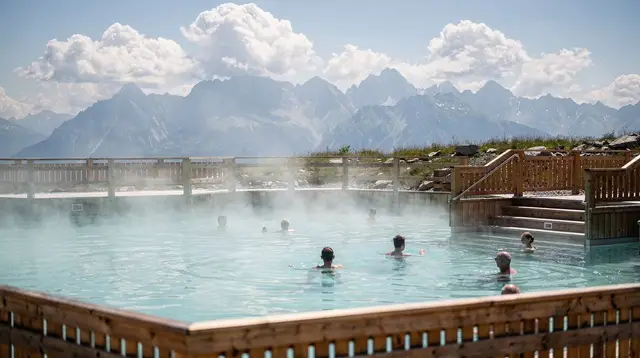
The same network extends past the trail entrances to the thermal baths scattered through the Podhale villages. Minibuses run to Chochołów, home to Termy Chochołowskie, and to Białka Tatrzańska for Terma Bania, as well as toward Bukowina Tatrzańska and Szaflary for their own pools. Since Chochołów the village and the separate Chochołowska valley are easy to confuse — they sit on different roads roughly 10 km apart — it is worth double-checking the destination card on the minibus rather than assuming “Chochołów” always means the crocus valley.
For an evening soak after a day in the mountains, a thermal-baths minibus is arguably even more convenient than for a hiking trailhead: nobody wants to drive after a long soak in warm water, and the vehicles run into the evening, when the baths themselves are often quieter and cheaper to visit than during the day.
Minibus vs. rental car for a normal stay
The practical question most visitors eventually ask is whether any of this adds up to “I don’t need a car.” For a typical multi-day Zakopane stay built around the town centre, the valleys, and the surrounding villages, the honest answer is usually yes.
| Destination | Reached by minibus | Car alternative |
|---|---|---|
| Kuźnice (Kasprowy Wierch cable car) | Yes, direct | Not possible — closed to private cars; park at Rondo Kuźnickie and walk |
| Kiry (Kościeliska valley) | Yes, direct | Small car park at the entrance, fills up in season |
| Siwa Polana (Chochołowska valley) | Yes, direct | Car park at the entrance, busy during crocus season |
| Palenica Białczańska (Morskie Oko) | Yes, direct | Requires an advance online car park reservation |
| Wierch Poroniec (Rusinowa Polana) | Yes, less frequent | Roadside parking near the trailhead |
| Thermal baths (Chochołów, Białka Tatrzańska, others) | Yes, direct | Car parks generally available, but driving after an evening soak is unappealing |
A rental car still has its uses — reaching the Slovak Tatras independently, stringing together several villages in one day, or simply preferring the freedom of your own schedule. But for the core loop of Zakopane, its valleys and its trailheads, a car adds the cost of the rental itself, the hassle of parking where private vehicles are actively discouraged, and none of the convenience that the minibus network already provides.
Anyone weighing the two options in more depth can compare notes in the guide on driving to Zakopane, the Zakopianka and parking in snow, and in the guide on getting from Kraków to Zakopane by bus, train or car, which covers the longer journey that precedes all of this local movement.
What to expect on board
Minibuses to the valleys and Kuźnice are informal by design, and knowing that in advance makes the experience far less confusing. There is no printed timetable to check the night before, no app to consult, and no single fare desk. Instead, vehicles depart once they have enough passengers, cycling back and forth through the day — more frequently during busy morning hours when hikers are heading out, and less frequently early in the morning or later in the evening. On a clear summer weekend, a Kuźnice or Palenica Białczańska minibus might leave every few minutes; on a quiet Tuesday in November, the wait can stretch out, and walking or driving to Rondo Kuźnickie may be the more sensible choice.
Seating is first-come, and on the busiest routes more than one operator works the same destination, so if one vehicle fills up, another is very often already waiting or arriving behind it. Luggage space is limited, which matters more for a day pack than for a wheeled suitcase — most passengers are hikers heading out for the day, not travellers moving between accommodations. Drivers generally know the route well enough to point out where to get off for a specific trail junction if you ask, which is useful the first time you head for a less obvious entrance like Wierch Poroniec.
Minibuses and Kuźnice, in context
Everything in this guide comes back to one restriction: Kuźnice does not admit private cars, and that single fact reshapes how a large share of Zakopane’s visitors move through their day. The minibus network exists precisely to answer that restriction, and it happens to answer the same question for the other valley entrances and the thermal baths as well.
Walking from the centre remains a fine option for the fit and unhurried, and parking at Rondo Kuźnickie suits drivers who are continuing elsewhere afterward — but for most visitors planning a normal stay around Zakopane, hopping on a minibus from the bus station area or Kościuszki street is simply the path of least resistance, and it is one of the clearest reasons a rental car is rarely necessary here.
Getting to Kuźnice and the valleys: frequently asked questions
Where do the minibuses to the valleys and Kuźnice leave from?
From the area around Zakopane’s bus station and from Kościuszki street, the road that runs from the centre down toward the station. Touts and small stands mark each departure point by destination, and drivers often call out the valley or trailhead name as people pass.
Can I drive to Kuźnice myself?
No. Kuźnice is closed to private cars. You can walk 30 to 40 minutes from the centre, take a minibus, or drive to Rondo Kuźnickie and continue on foot from there.
Do minibuses run on a fixed schedule?
No published timetable governs them. They are private, informal services that fill up and leave once enough passengers are aboard, then repeat through the day, more often at busy times and less often early or late.
Do I need to book a minibus in advance?
No. You simply go to the departure area and look for the sign or the driver calling your destination. Advance booking applies to the Palenica Białczańska car park and to Kasprowy Wierch cable car tickets, not to the minibuses themselves.
Is a rental car necessary for a normal stay in Zakopane?
For most itineraries, no. The minibus network covers the main trailheads, the villages and the thermal baths, and Kuźnice and Palenica Białczańska restrict private cars anyway, which removes much of the usual case for driving.
Which trailheads and valleys can I reach by minibus?
The main ones are Kuźnice for the Kasprowy Wierch cable car, Kiry for the Kościeliska valley, Siwa Polana for the Chochołowska valley, Palenica Białczańska for Morskie Oko, and Wierch Poroniec for Rusinowa Polana. Minibuses also run to the thermal baths in the surrounding villages.
What happens if a minibus is full when I arrive?
Another one usually follows, since more than one vehicle and more than one operator serve busy routes. On the most popular runs, in peak morning hours, a short wait is normal rather than exceptional.
Transfers and tickets
Verified deep-linked GetYourGuide tours. Book through these links and we earn a small commission at no cost to you.
GetYourGuide does not provide a product photo for this activity — the image shows the meeting point, photographed by us.