What Kościeliska Valley actually is
Every year a few families arrive at the Kiry entrance expecting something closer to the walk up to Giewont or the trail to Morskie Oko, and every year the valley disappoints them for the wrong reason. Kościeliska Valley is not a mountain hike. It has no chains, no summit, no view that opens up above the treeline.
What it has instead is 9 km of paved, gently rising forest track that a stroller can manage, two show caves a few minutes off the main path, a working mountain hut with hot food at the far end, and a side trail to a quiet forest pond. That is the whole offer, and for a family with a five-year-old and a pram it is very often the best day the Tatras have to give.
This page treats Kościeliska Valley for what it is: the easiest, flattest, most stroller-friendly valley walk that the Tatra National Park runs, and the right answer to “where do we go with the kids” rather than to “where do we get above 2,000 metres.” If you are looking for a summit, this is not your valley — read about Kasprowy Wierch or the hike up Giewont instead. If you are looking for a walk your whole family can finish without anyone crying, keep reading.
Getting to the entrance at Kiry
Kościeliska Valley starts at Kiry, a hamlet about 8 km west of Zakopane, reached in 20 to 25 minutes by minibus from the town centre or by car. The minibuses that serve Kiry leave regularly from the bus station area and from Kościuszki street in Zakopane — there is no need to reserve a car park in advance the way Morskie Oko requires, which is one of the reasons this valley works well as a same-morning decision. A car park exists at Kiry itself for drivers, with space that fills up on the busiest July and August mornings but rarely turns anyone away the way Palenica Białczańska does.
At the entrance booth you buy the compulsory Tatra National Park ticket — 11 PLN standard, 5.50 PLN reduced, or 55 PLN for seven days if you plan several park visits (2026 prices). This is not optional and not specific to “attractions”: every marked trail inside the park, including this flat valley floor, requires the ticket, checked at random by park rangers. Buy it at the booth or in advance online at tpn.gov.pl if you want to skip the queue on a busy Saturday.
The 9 km of paved track: what actually works with a stroller
From the Kiry booth, the track runs almost dead flat for the first couple of kilometres, then climbs gently — around 200 m of total ascent over the full 9 km to Ornak hut, spread out so gradually that most of it is barely noticeable. The surface is paved tarmac the whole way, wide enough for two prams to pass, and shared with the horse carriages and small electric carts that service the hut.
This is the detail that separates Kościeliska from every other valley in this guide: you do not need hiking boots, and a standard three-wheel stroller will get a toddler all the way to the cave turn-offs without trouble. A full guide to which Tatra trails handle a stroller and which don’t is at stroller-friendly trails around Zakopane; this valley tops that list.
That said, “stroller-friendly” has a limit here too. The final stretch up to Ornak hut narrows and steepens slightly, enough that a jogging stroller manages better than a lightweight umbrella one, and after rain the unpaved cave side-paths turn muddy fast. Families who want the shortest version of the day can treat Mroźna cave, about 3 km in, as the natural turnaround — an hour there and back, flat the entire way, with the payoff of an actual cave instead of just forest.
| Segment | Distance from Kiry | Surface | Suits a stroller? |
|---|---|---|---|
| Kiry to Mroźna cave turn-off | ~3 km | Paved | Yes, all the way |
| Mroźna cave interior | 15-minute loop | Lit walkway, steps | No — carry the child |
| Kiry to Raptawicka cave turn-off | ~5 km | Paved | Yes to the turn-off |
| Kiry to Ornak hut | 9 km | Paved, gentle climb | Yes, with a sturdier stroller |
| Ornak hut to Smreczyński Pond | +2.5 km one-way | Unpaved forest path | No |
The two show caves: Mroźna and Raptawicka
Kościeliska Valley is riddled with limestone caves, and two of them are developed for visitors. Jaskinia Mroźna (“Cold Cave”), about 3 km from Kiry, is a short lit loop through chambers of stalactites and underground streams — 15 to 20 minutes inside, no scrambling required, though the floor is uneven and a child needs to be carried or walked by hand. Jaskinia Raptawicka (“Raptawicka Cave”), a little further up the valley, is similar in scale and equally easy.
Neither cave needs advance booking; both open seasonally (roughly May to October, weather and water levels permitting) and charge a small separate entry fee at the cave mouth, on top of the park ticket. Caves are the single best reason this valley beats a plain forest walk for children — a physical, tangible destination halfway through the day, not just “more trees.”
Smreczyński Pond: the detour that is not for everyone
Past Ornak hut, a side trail climbs to Smreczyński Staw, a small dark forest pond framed by spruce, about 2.5 km each way on unpaved, sometimes root-crossed ground. This is where the family day stops being stroller territory: carry a toddler, or leave this stretch for a future trip when the youngest walker is a few years older. For adults or older children with energy left after the main valley, it is a genuinely peaceful add-on with almost no crowds, since most day visitors turn back at Ornak. For everyone else, Ornak hut is the sensible end point.
Ornak hut: food, a terrace, and the turnaround point
Schronisko na Ornaku, at the head of the paved section, is a working mountain hut — not a restaurant built for tourists, but a real refuge that also serves hot food: pierogi, soup, kwaśnica, tea with raspberry syrup, cake. It has toilets, a covered terrace, and in season enough tables for a valley’s worth of walkers to eat at once, though it gets genuinely full around midday in July and August. For most families, Ornak is where the outbound walk ends: eat, let the kids run around the meadow in front of the hut, then walk back the same paved 9 km to Kiry. Paths beyond Ornak head into proper mountain terrain — passes, ridges, longer huts — and belong to a different kind of day than the one this page is describing.
What is banned here — and it matters more in this valley than most
The Tatra National Park’s rules apply on every trail, but two of them come up constantly for families planning Kościeliska specifically:
- No dogs. Dogs are allowed in only two places in the whole park: the Chochołowska valley up to its hut, and the Droga pod Reglami path. Kościeliska is not one of them — leave the dog in Zakopane or choose Chochołowska instead if the dog is coming.
- No drones, no wild camping or bivouac, marked trails only. Overnight stays happen only in the park’s mountain huts, Ornak included, and only if booked. A ranger checking tickets at the Kiry booth is also checking for these rules being broken further up the valley.
None of this is unique to Kościeliska — it is park-wide — but because this valley draws the most casual, first-time visitors of any trail in the Tatras, it is also where these rules get broken most innocently. Bring the ticket, leave the dog and the drone behind, and stay on the paved track.
How Kościeliska compares to the other easy valleys
Three valleys get recommended for families in and around Zakopane, and they are not interchangeable. The table below is the short version; the long version, with more on stroller range and timing, is in the Kościeliska Valley family hike guide.
| Valley | Terrain | Distance (one-way) | Dogs allowed? | Standout feature |
|---|---|---|---|---|
| Kościeliska | Flat, paved | 9 km to Ornak | No | Two show caves |
| Chochołowska | Flat, paved, longer | 9 km to the hut | Yes, to the hut | April crocus bloom |
| Rusinowa Polana | Short, one climb | 3.2 km | No | Closest High Tatra panorama |
Chochołowska is the valley to pick if a dog is part of the trip, or if you are visiting during the two-week crocus bloom in early April. Kościeliska wins on the caves and on being marginally shorter to the turnaround point at Ornak. Neither valley is a substitute for an actual mountain hike — for that, see the guide to first-time visitors deciding how many days to spend in Zakopane, which separates “easy valley day” from “mountain day” honestly.
When to go
The valley is at its best from late May, once the last snow patches near Ornak clear, through September, while both caves and the hut are open on their full seasonal hours. July and August bring the most people — Ornak’s terrace can be genuinely crowded at lunchtime — but the paved track absorbs crowds better than any chained ridge trail, so this remains a good midsummer choice even on a day when Morskie Oko or Kasprowy Wierch are impossibly busy.
Winter turns the valley into a quiet snowshoe or packed-snow walk for those equipped for it, though the caves close and the hut keeps shorter hours. Spring brings mud on the unpaved side-paths even while the main track stays walkable.
Rounding out the day
A morning in Kościeliska Valley leaves most of the afternoon free. A well-reviewed half-day option that covers Zakopane’s centre and a walk into the park in one guided trip is the Zakopane and the Tatra Mountains tour, useful for a first visit if you would rather not work out the minibus timetable yourself.
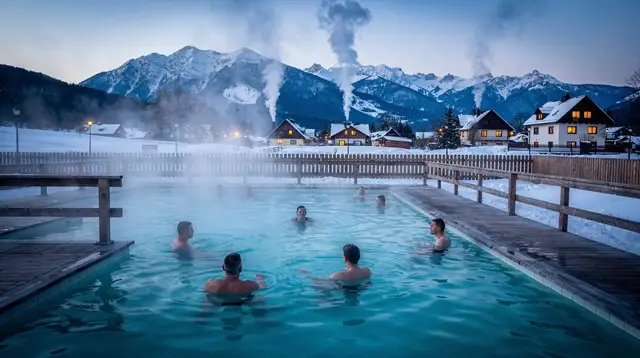
Families who want to spend the warm-down hours in water rather than on a trail often head to the thermal baths in Chochołów village, a short drive from Kiry — book the entry ticket for Chochołowskie thermal baths ahead of an evening visit, since the largest pool complex in Poland gets busy after 5pm. Children who still have energy left after the valley walk sometimes do better at the rope park at the top of Gubałówka, reachable by funicular straight from Krupówki in town.
For where to sleep near this side of the Tatras, and for a broader sense of what a family itinerary in the area looks like across two or three days, see where to stay near Zakopane, Kościelisko and Białka and the three-day family itinerary. If accessibility for a wheelchair rather than a stroller is the question, the dedicated Tatra accessibility guide covers exactly how far the paved section of Kościeliska goes before the surface changes.
Kościeliska Valley: frequently asked questions
Is Kościeliska Valley suitable for strollers and small children?
Yes, for most of its length. The 9 km from Kiry to Ornak hut is fully paved and gently graded, manageable with a sturdier stroller; the final approach to the hut narrows slightly. The side paths to Smreczyński Pond and inside the caves are not stroller terrain — carry younger children there.
Do I need a Tatra National Park ticket to walk in Kościeliska?
Yes. The compulsory park ticket applies to every marked trail, including this flat valley floor, not only to named attractions. Buy it at the Kiry entrance booth or online in advance at tpn.gov.pl; standard price is 11 PLN, reduced 5.50 PLN (2026).
Can I bring my dog to Kościeliska Valley?
No. Dogs are permitted in only two places in the Tatra National Park: the Chochołowska valley up to its mountain hut, and the Droga pod Reglami path. Kościeliska is not one of them.
How long does the walk to Ornak hut take?
Budget 2 to 2.5 hours each way at a family pace, so 4 to 5 hours round trip including a stop for food at the hut. Families who only go as far as Mroźna cave and back can do the whole outing in about 1.5 hours.
Which caves can I visit in Kościeliska Valley, and do I need to book?
Mroźna and Raptawicka are both show caves open seasonally, roughly May to October depending on weather and water levels. Neither requires advance booking — pay the small entry fee at the cave mouth, on top of the park ticket.
Is Kościeliska Valley the same as Chochołowska Valley?
No, they are two different valleys about 10 km apart on different access roads, though both are flat, paved, family-friendly walks with a mountain hut at the far end. Chochołowska is the one that allows dogs and hosts the April crocus bloom; Kościeliska has the two show caves.
Can I reach a mountain summit from Kościeliska Valley?
Not on the walk described here. The paved valley floor ends at Ornak hut; trails beyond it lead into genuine mountain terrain requiring proper hiking gear and experience, a different kind of day from the flat family walk to Ornak and back.
Is Kościeliska Valley open in winter?
Yes, as a packed-snow or snowshoe walk from Kiry, though the show caves close for the season and Ornak hut runs shorter hours. The park ticket is still required, and daylight hours are shorter, so plan an earlier start.