Ask ten people in Zakopane when the crocuses bloom in Chochołowska Valley and you will get ten different answers, all of them roughly right and none of them exact. That uncertainty is the honest starting point for this valley: it is Poland’s longest Tatra valley, it hosts one of the country’s best-known natural spectacles every spring, and almost everything else about visiting it is straightforward. This page covers the timing question properly, then the practical walk, the rules, and the one mix-up that trips up more visitors than any trail junction — confusing this valley with the village that shares its name.
The Crocus Bloom: A Window, Not a Date
Crocus scepusiensis grows across the open meadows of Chochołowska Valley in numbers that genuinely run into the millions. When the bloom is at its peak, entire slopes turn pale lilac-white, and the sight has become one of the most photographed events in the Tatra National Park. It usually opens in the first days of April and holds for around two weeks before fading.
That word “usually” matters. The crocus does not follow a calendar; it follows the snow. Chochołowska sits at a relatively low, gentle valley floor, so it clears earlier than most of the park — but “earlier” still depends on how much snow fell that winter and how quickly it melts. A mild winter with an early thaw can bring the bloom forward into late March. A heavy, late winter can push it past mid-April. Some years the window narrows to ten days; in an unusual year it can stretch closer to three weeks.
No page, including this one, can hand you a fixed date months in advance. What you can do is build flexibility into the trip: plan a Tatras visit for the last week of March through mid-April, check recent local reports in the days beforehand, and treat the bloom as a bonus you time as closely as the season allows rather than a date you book against. Our dedicated guide to Tatra spring and crocus timing tracks the pattern year by year in more depth, and the Chochołowska crocus season guide goes further into where the densest patches tend to appear within the valley.
If the crocuses are not the priority, none of this matters: outside the two-week window, Chochołowska is simply the longest, gentlest big valley in the Polish Tatras, walkable from June through September without a flower in sight but with the same wide meadows and the same mountain wall closing the horizon.
Two Different Places: Valley and Village
This is the point worth getting right before anything else, because the names invite the mistake. Chochołów is a village — the best-preserved wooden village of the Podhale, scrubbed pale every spring, with its own thermal baths on its outskirts. Chochołowska Valley is a hiking valley inside Tatra National Park, entered several kilometres away at a car park called Siwa Polana. They share a name root because both sit in the same corner of the Podhale, near the Slovak border, but they are about 10 km apart on different roads, and nothing links them beyond geography.
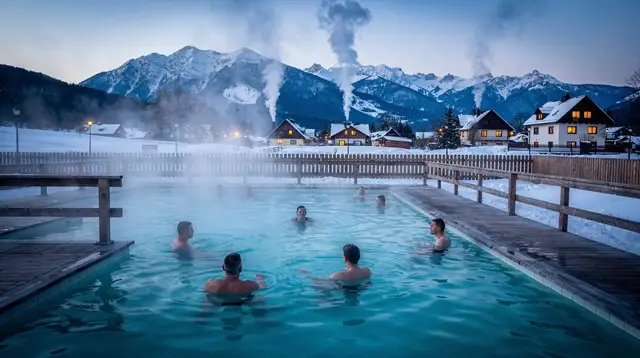
A visitor who books an evening at the thermal baths expecting a mountain valley, or who drives to the wooden village expecting a crocus meadow, will find neither. If your plan includes both — a highland village walk and a valley hike, or a soak after a walk — treat them as two separate stops on the same day, not one. The village and its baths get their own coverage on the Chochołów destination page and in the Termy Chochołowskie guide; this page stays with the valley.
a day trip from Kraków that pairs the Chochołowska thermal baths with time in Zakopane is a sensible way to fit the baths in if the valley walk itself is not on your list that day — just don’t expect the bus to drop you at the trailhead.
Getting to Siwa Polana
The valley starts at Siwa Polana, a paid car park and trailhead about 20-25 minutes from central Zakopane by minibus or car. Minibuses to the valleys leave regularly from the bus station area and Kościuszki street in Zakopane; our minibus and Kuźnice guide covers how that network works if you have not used it before. Driving is equally simple outside peak times, though the same Zakopianka traffic and parking cautions that apply everywhere in the region apply here: on a fine crocus weekend or a sunny July Saturday, the Siwa Polana car park fills, and a late arrival means a longer walk from an overflow spot on the roadside.
There is no way to drive further into the valley itself. Like every major valley inside Tatra National Park, private vehicles stop at the entrance, and everything beyond Siwa Polana is on foot, by bicycle, or by the small road train described below.
Walking the Longest Valley in the Polish Tatras
Chochołowska is the longest valley in the Polish Tatras, and its lower section is also one of the gentlest. From Siwa Polana, a wide, mostly flat gravel track runs for several kilometres along the valley floor, following the Chochołowski Potok stream through open meadows and larch forest. This first stretch is easy enough for a family outing, a pushchair on a dry day, or a first proper valley walk for a visitor with limited time — a comparison with the similarly gentle Kościeliska valley is worth reading if you are choosing between the two, in the Kościeliska family hike guide.
Beyond the flat opening section, the valley narrows and climbs gradually toward the Chochołowska mountain hut (Schronisko na Polanie Chochołowskiej), a working hut that serves food and drink and marks the natural turning point for a half-day visit. Reaching the hut and returning to Siwa Polana makes a satisfying half-day out, mostly flat, with real mountain scenery for relatively little climbing effort.
For a full day, the valley continues past the hut toward its head, where side valleys and connecting ridge paths lead toward the Slovak border and, for well-prepared hikers, onward toward other parts of the high Tatras. That upper section demands more — proper boots, a full day’s food and water, and the same weather caution that applies to every high Tatra route: our TOPR mountain safety guide is worth reading before any full-day plan here, particularly on the afternoon thunderstorm risk that builds through July and August.
Cycling and the Road Train
The lower, flat stretch of the valley is also open to two easier ways of covering ground. A small road train runs from the Siwa Polana entrance partway up the valley for visitors who want the meadows and the mountain air without the walking, and bicycles can be hired near the trailhead to cover the same flat section faster and further. Neither option continues past where the valley starts to climb — beyond that point, it is on foot only, same as any other high trail in the park.
Rules: Ticket, Dogs, and What Is Different Here
A Tatra National Park entry ticket is required to walk into Chochołowska Valley, exactly as on every marked trail in the park — the flat opening stretch included, not only the higher sections. Tickets are bought online at tpn.gov.pl or at the booth near the entrance; our TPN ticket booking guide covers prices and how far ahead to buy in season.
What makes Chochołowska genuinely unusual among the park’s valleys is its dog policy. Dogs on a lead are permitted as far as the Chochołowska hut, and also along the separate Droga pod Reglami path that traces the edge of the park below the peaks. This is one of only two places in the entire national park where a dog is allowed at all — every other trail, including neighbouring Kościeliska, is dog-free. If you are travelling with a dog and want a real Tatra valley walk, this is effectively the only option, and it is worth reading why the rest of the park is closed to dogs in our dog ban explainer before assuming the same applies here.
Beyond the ticket and the dog rule, the usual park conditions hold: marked trails only, no drones, no wild camping, daylight hours only. None of that changes because the terrain is gentler than Giewont or the Orla Perć.
Chochołowska Table: The Essentials
| What | Detail |
|---|---|
| Entrance | Siwa Polana car park, ~20-25 min from Zakopane |
| Park ticket | Required for the whole trail, buy online or at the booth |
| Terrain, lower section | Wide, flat gravel track, several kilometres, easy for families |
| Terrain, upper section | Gradual climb to the hut, then steeper side valleys beyond |
| Dogs | Allowed on a lead as far as the hut, and on Droga pod Reglami |
| Crocus season | Roughly first two weeks of April, exact date depends on snow |
| Road train / bike hire | Covers the flat lower section only |
| Distinct from | Chochołów village and its thermal baths, about 10 km away |
Beyond Crocus Season
Outside the two-week spring window, Chochołowska remains a good choice for exactly the reasons it works in April: it is gentle, it is long, and it rewards a relaxed pace rather than a race to a summit. In June and July the same meadows that carried crocuses fill with other wildflowers and grazing sheep further up the valley. By September the larches along the lower track turn gold, and the crowds that fill Morskie Oko and Kasprowy Wierch in midsummer rarely make it this far west — a point worth weighing against the Five Lakes Valley or Morskie Oko if you are choosing a valley specifically to get away from queues.
Winter is a different matter: this is one of the areas where organised snowmobile and quad routes run through the Podhale valleys when snow allows, well outside the walking season the rest of this page describes. a guided quad bike tour through the Tatra foothill valleys covers that kind of route if you are visiting outside the spring or summer walking window and want to see the wider Podhale landscape from a different kind of vehicle.
Where Chochołowska Fits in a Longer Trip
Because it sits toward the western edge of the park, Chochołowska is easy to treat as a half-day addition rather than the centrepiece of a Tatras trip. Visitors focused on the park’s best-known sights — a day trip that combines Zakopane with the walk to Morskie Oko covers that other, very different valley, with its lake rather than its meadows — sometimes skip Chochołowska entirely for lack of time, which is reasonable outside crocus season but a genuine loss during it.
If your stay is short, our Zakopane weekend itinerary shows how a half-day here can slot beside Krupówki and Gubałówka without crowding a two-day trip; a longer three-day Tatras classic route has room for both Chochołowska and one of the park’s higher-profile valleys. For visitors who want an easier family day without mountain elevation gain, pairing Chochołowska’s flat lower section with a stop at a rope park is a reasonable substitute for a harder trail — the rope park above Gubałówka works well as that second, less strenuous stop on the same day.
For anyone still deciding when to come specifically for the bloom, our general best time to visit tool and the April crocus window explainer go into the year-by-year pattern in more detail than a single valley page can hold — because, as with everything about this particular two weeks, the honest answer is a range, not a date.
Chochołowska Valley and Crocus Season: Frequently Asked Questions
When exactly do the crocuses bloom in Chochołowska Valley?
Usually in the first days of April, for about two weeks, but the date depends entirely on how much snow is still melting that year. A mild winter can bring the bloom forward; a heavy one can push it into mid-April. Check recent reports before planning a special trip around it.
Is Chochołowska Valley the same place as Chochołów village?
No. Chochołów is a wooden village with its own thermal baths, about 10 km away by road. Chochołowska Valley is a hiking valley inside Tatra National Park, entered from the Siwa Polana car park. They share a name root but nothing else, and they are not walking distance apart.
Do I need a park ticket to walk into Chochołowska Valley?
Yes. A Tatra National Park ticket is required on this trail exactly as on every other trail in the park, bought online at tpn.gov.pl or at the booth near Siwa Polana. There is no free or ticket-exempt section of the valley.
Can I bring my dog into Chochołowska Valley?
Yes, on a lead, as far as the Chochołowska hut, and also on the separate Droga pod Reglami path that runs along the edge of the park. This is one of the very few places in the Tatras where dogs are allowed at all.
How do I get to the start of the valley at Siwa Polana?
By minibus from Zakopane’s bus station area, or by car, about 20-25 minutes. There is a paid car park at Siwa Polana; it fills on sunny spring weekends and during the crocus bloom, so arrive early.
Can I cycle or take a road train instead of walking?
Yes, for the first flat section. A small road train runs from Siwa Polana partway up the valley, and bicycles can be hired near the entrance. Beyond that first stretch, the valley continues as a walking trail only.
How long is the walk through Chochołowska Valley?
It is the longest valley in the Polish Tatras. Reaching the Chochołowska hut and back is a half-day outing on flat ground; continuing to the side valleys or the ridge above makes it a full day with real climbing.