Why Dogs Are Banned in the Tatra National Park
The email arrived three weeks before we left. A reader who’d found our Zakopane guide wanted to know which trails she could walk with her spaniel. I had to write back and tell her: almost none of them. Not “keep him on a lead.” Not “check the local rules.” None.
I’d assumed the same thing she had, the first time I planned a Tatra trip. I’d hiked with dogs across the Alps, the Pyrenees, the Scottish Highlands — always a lead, sometimes a muzzle near livestock, never an outright ban. So when I read, buried in the Tatra National Park’s visitor rules, that dogs are not permitted on the trails at all, I assumed it was one of those over-cautious signs nobody actually enforces. It isn’t. It’s checked, it’s fined, and once I understood why, I stopped being annoyed by it.
It isn’t about the dog’s behaviour
That’s the part that took me longest to accept. In most of the places I’d hiked with dogs before, the rule was really a proxy for behaviour: keep the animal under control, don’t let it chase sheep, and you’re generally fine. The Tatras don’t work that way. The ban applies to the perfectly trained mountain dog exactly as it applies to the yappy terrier on a retractable lead. It isn’t a judgment on the animal. It’s a judgment on what a dog’s scent and presence do to a landscape, regardless of how it behaves.
Tatra National Park covers 211.6 km² and was created in 1954 specifically to protect what lives inside it — not to give people a nice place to walk. The trails you’ll use, from the paved track into the Kościeliska valley to the climb up Giewont, all sit inside that protected area. A dog doesn’t need to bark, lunge or leave the path to have an effect. Its scent alone changes how the resident wildlife behaves for hours after it’s passed.
What’s actually up there
The number that changed my mind was 180. That’s roughly how many brown bears live across the Polish and Slovak Tatras combined — not a symbolic population, a real one, moving through the same valleys the trails cross. I’d read plenty about mountain safety in the Tatras before the trip, mostly thinking about storms and chains near summits. I hadn’t thought about the fact that a bear encountering unfamiliar dog scent, or a dog itself, can respond defensively — not out of aggression, but because it reads as a threat to be met head-on rather than avoided, which is exactly the opposite of what you want from a bear on a narrow trail.
Then there’s the Tatra chamois, picking its way along slopes I could barely stand on, and the Tatra marmot — a species down to around 800 individuals here, protected since 1868, which means Poland was already trying to save this animal before it had a national park to protect it in. Marmots whistle an alarm call and bolt underground at the first hint of a predator. A dog trotting along, lead or no lead, reads as exactly that.
Multiply that disturbance by the thousands of hikers who pass through in a single July week and the marmots simply stop coming out during daylight, which defeats the point of them being there for anyone to see. Add golden eagles and lynx, both of which need undisturbed nesting and hunting ground, and a dog stops being a private matter between owner and animal. It becomes something the whole ecosystem has to react to.
I found this easier to accept once I stopped comparing the Tatras to the trails I already knew. This park isn’t managed as a recreation ground with wildlife living in it. It’s managed as wildlife habitat that happens to allow people through, on a leash of rules rather than the dog’s.
The two exceptions, and why they’re where they are
There are exactly two places dogs are allowed, and both say something about the logic behind the rest of the ban. The first is the Chochołowska valley, as far as the mountain hut — a long, wide, mostly flat valley where trails run along a single obvious track rather than fanning across open terrain. The second is the Droga pod Reglami, a lower path that skirts the edge of the park rather than climbing into the high country where the chamois and marmots live. Neither route pushes into the terrain the ban exists to protect. That’s not a loophole; it’s the same logic applied consistently — where the impact is smaller, the rule bends slightly.
Everywhere else, no. Not the paved approach to Morskie Oko, even though it looks more like a country lane than a wilderness trail. Not the Kościeliska valley, gentle enough for a pram. Not the climb to Giewont’s cross, and not the boardwalks through the Five Lakes valley. If you’re used to a park drawing its rules around difficulty or danger, this is the adjustment: the Tatras draw theirs around habitat, and a paved path through prime chamois ground is treated the same as a scramble through it.
What I did instead
We didn’t have a dog with us, which made this easier to write about than to actually live through. But talking to other travellers in Zakopane that week, the pattern was consistent: people who’d brought a dog on the trip ended up leaving it at their accommodation for the mountain days and building the rest of the itinerary around it instead.
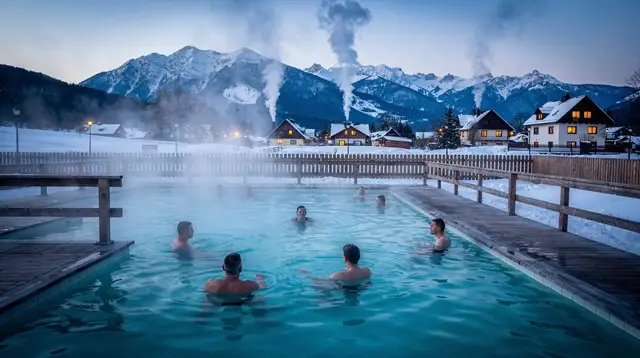
One family split their days — the adults took a guided day trip to Morskie Oko and Zakopane while someone stayed back with their dog, then everyone met up in the evening for an evening session at the Zakopane thermal baths, which don’t allow dogs either but at least don’t ask you to leave one alone all day to enjoy them.
If you’re travelling with a dog and want everyone included, the smarter move is to build the trip around what’s actually dog-friendly rather than trying to smuggle a walk in anyway: the town itself, Krupówki, the wooden villages, and — if a hot soak sounds better than a hike that day — a sauna and spa day trip to the Chochołowska baths that nobody in the group needs to sit out.
I’ll admit the rule still felt heavy-handed on the first morning, watching other hikers double back at a TPN checkpoint because a ranger had spotted a lead poking out of a rucksack. By the third day, after we’d stood twenty metres from grazing chamois that didn’t so much as look up, I understood what that silence was worth, and why nobody in this park is willing to trade it for a walk.
Dogs in the Tatra National Park: frequently asked questions
Are dogs allowed anywhere in the Tatra National Park?
Yes, in exactly two places: the Chochołowska valley up to the mountain hut, and the Droga pod Reglami path. Every other marked trail in the park, including the approach to Morskie Oko and the Kościeliska valley, is closed to dogs regardless of how they’re controlled.
Does it matter if my dog is well-trained or small?
No. The rule isn’t based on behaviour, size or training. It’s based on the effect a dog’s scent and presence has on wildlife, which is the same whether the dog is calm on a short lead or excitable off one.
What happens if a ranger finds me hiking with a dog?
Park rangers do check, especially at trailhead checkpoints, and dogs found on closed trails result in a fine. It isn’t a rule that exists only on paper.
Why does a leashed dog still cause a problem?
A lead controls the dog’s movement, not its scent or the sound and sight of it. Wildlife like the Tatra marmot reacts to the presence of a dog at a distance, well before it could physically reach the animal, so a lead doesn’t remove the disturbance.
Is the ban connected to the bears specifically?
Partly. With around 180 brown bears across the Polish and Slovak Tatras, a dog encountering one can trigger a defensive reaction rather than the avoidance a bear would normally show a human alone, which is a risk for the hiker as much as for the wildlife.
Can I leave my dog in the car at a trailhead like Palenica Białczańska?
It isn’t recommended and isn’t really practical either — the Morskie Oko car park must be booked in advance and sits some distance from the trail, and cars can heat up quickly even at altitude. Most owners arrange dog-sitting at their accommodation instead.
Are assistance dogs exempt from the ban?
Guide dogs and other assistance animals are generally permitted where required for the handler’s needs; if this applies to you, contact TPN directly before your visit to confirm current arrangements for your specific route.
Is the rule the same on the Slovak side of the Tatras?
The Slovak High Tatras, managed by TANAP, apply similarly strict rules on most high-mountain trails, so crossing the border for a day trip to somewhere like Štrbské Pleso doesn’t change the situation for a dog.
tours.Explainer
Verified deep-linked GetYourGuide tours. Book through these links and we earn a small commission at no cost to you.
GetYourGuide does not provide a product photo for this activity — the image shows the meeting point, photographed by us.