The Valley of Five Polish Lakes and the Siklawa Waterfall
What is the hike to the Valley of Five Polish Lakes and Siklawa waterfall?
It is a full-day walk from the Palenica Białczańska car park through Wodogrzmoty Mickiewicza and up the Roztoka valley to Siklawa, Poland's highest waterfall at about 70 m, and on to the five tarns. The trail has no chains, a Tatra National Park ticket is required, and it is best walked between June and September.
Ask anyone leaving the Palenica Białczańska car park where they’re headed and nearly everyone answers the same way: Morskie Oko. That’s understandable — it’s the best-known lake in the Tatras, and the paved road makes it feel like the obvious choice. What most visitors miss is that the very same car park is also the starting point for a completely different valley, one that gets a fraction of the foot traffic and rewards the walk with a genuine waterfall, five mountain tarns, and long stretches where the only sound is water and wind.
Same car park, a different valley
The Valley of Five Polish Lakes and the Morskie Oko basin share a trailhead but nothing else. Where the Morskie Oko path is a wide, paved service road built for horse carriages and crowds, the route toward the Five Lakes branches off onto a narrower forest trail that climbs steadily through spruce woods before opening onto rock and alpine meadow.
The contrast is deliberate on the part of the park’s trail network: two very different days out, starting from the same reserved parking area, described separately because they deserve to be planned separately. If your plan is Morskie Oko, read the complete visitor guide to that lake and the note on carriage versus walking instead — this page is about the other valley.
Both routes require the same starting point, which means the same practical constraint applies before you even lace up your boots: the Palenica Białczańska car park has to be reserved online in advance, often days ahead in July and August. Arrive without a reservation in high season and you won’t be parking here at all, whichever valley you’re aiming for.
Wodogrzmoty Mickiewicza and the turn into the Roztoka valley
The first landmark on the way to the Five Lakes is Wodogrzmoty Mickiewicza — literally “Mickiewicz’s Thunders of Water” — a set of cascades where the Roztoka stream tumbles over granite in a series of drops audible before they’re visible through the trees. It’s a natural resting point and, for many casual walkers who only wander this far from the car park, the turnaround for a shorter outing.
Continue past Wodogrzmoty Mickiewicza and the trail leaves the crowd behind almost immediately. This is the point where the route commits to the Roztoka valley proper, climbing gradually alongside the stream through forest that thins as elevation increases. It’s here that the difference from the Morskie Oko side becomes obvious on the ground, not just on the map: fewer voices, fewer horse carriages passing, and a trail surface that shifts from smooth path to rockier mountain terrain. Walkers heading up toward Rysy from the Morskie Oko side are on an entirely separate trail system by this point — the two routes diverge early and don’t reconnect until much higher, near the ridge.
The climb through the Roztoka valley is steady rather than technical. There’s no scrambling, no chains, and none of the exposure that defines routes like Giewont’s summit approach. What it does demand is sustained effort: this is a genuine mountain valley, gaining real elevation over a real distance, and it should be approached as a full day in the hills rather than a short stroll from the car park. Good boots, layers, and enough water for a long day matter more here than on the paved Morskie Oko road.
Siklawa: the highest waterfall in Poland
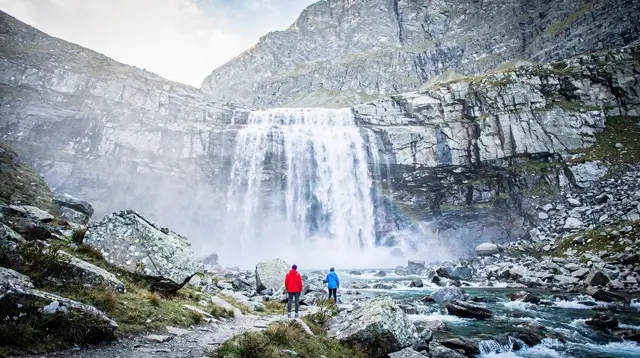
The reward for the climb is Siklawa, a waterfall of around 70 m that drops from the upper basin of the Five Lakes valley down into the Roztoka gorge below — the highest waterfall in the country. Unlike Wodogrzmoty Mickiewicza lower down, Siklawa isn’t a roadside curiosity; reaching it is the point of the hike, and the trail passes close enough to feel the spray on a windy day without any need to leave the marked path.
Above Siklawa, the trail switches character again as it climbs the final rocky section into the upper valley itself, where the terrain opens into the high basin that gives the valley its name.
The five tarns
The Valley of Five Polish Lakes takes its name from a chain of tarns sitting in a glacial basin well above the treeline, ringed by bare granite peaks. This upper section is where the hike’s character shifts from forest ascent to genuinely alpine landscape: open rock, cold clear water, and views back down the Roztoka valley toward the lowlands. There is a mountain hut in the basin, a welcome stop for tea or a hot meal before the walk back down, and a natural place to pause before deciding whether conditions and daylight allow for continuing further along the ridge trails that lead deeper into the park’s high country — routes for a different, more demanding day, not an extension to attempt casually at the end of a long first outing.
Compared with the crowds around Morskie Oko — where boardwalks and viewpoints fill with visitors from morning until evening in July and August — the Five Lakes basin feels genuinely remote, even though it sits within the same national park and shares the same trailhead. The effort of the climb through the Roztoka valley does the filtering: it thins out everyone unwilling to commit to a full day on foot.
Why this side stays quiet
| Morskie Oko route | Five Lakes Valley route | |
|---|---|---|
| Surface | Paved service road | Forest and mountain trail |
| Chains or exposure | None | None |
| Typical crowd | Heavy, all day in summer | Thin past Wodogrzmoty Mickiewicza |
| Horse carriage option | Yes, to Włosienica | No |
| Starting point | Palenica Białczańska | Palenica Białczańska |
| Winter feasibility | Not recommended | Not recommended; high trails close seasonally |
The two routes are close enough on the map that some visitors assume they can combine both in a single day. In practice, each demands a full day on its own terms — the Five Lakes valley for its sustained climb, Morskie Oko for the sheer distance of the access road plus the extension to Czarny Staw. Trying to string them together usually means rushing one or missing the other before dark, which is worth planning around rather than discovering on the trail. For a longer stay, an itinerary built around several days of Tatra hiking can give each valley its own day.
The Tatra National Park ticket, and when to buy it
Every marked trail inside Tatra National Park requires a paid entry ticket, and the trail to the Five Lakes valley and Siklawa is no exception — the ticket is not just for the “attractions” like the lake itself, it’s checked at the entrance near Palenica Białczańska and applies to the whole day’s walking. Buying it online ahead of a summer visit avoids a queue at the booth, and it’s worth doing at the same time as reserving the car park, since both can sell out on the busiest days of July and August. The full mechanics of ticketing and parking reservations for this trailhead are covered in the guide to booking Morskie Oko, Kasprowy and TPN tickets.
Afternoon storms, and the trails that close for winter
Summer in the Tatras follows a pattern that catches unprepared walkers every year: clear mornings give way to building cloud by early afternoon, and July and August in particular bring frequent thunderstorms that roll in with little warning once the peaks start to heat up. On an open, exposed trail like the climb into the Five Lakes basin, that means starting early and keeping an eye on the sky rather than pushing on toward the tarns once thunder starts to build.
The general pattern of Tatra storms, and how to plan a hiking day around them, is covered in the guide to Zakopane’s summer thunderstorms; the safety fundamentals for a day like this one are in the Tatra mountain safety guide, including when to turn back and how to reach TOPR mountain rescue.
The same high terrain that makes this hike worthwhile in summer is exactly why it isn’t a winter option. Several of the high-altitude trails in this part of the national park close from around the start of November until roughly mid-June because of avalanche risk, and the Five Lakes valley sits well within that closed zone for most of the cold season. This is not a hike to attempt outside the marked season, whatever the snow conditions look like from the valley floor — the closures exist because conditions higher up are genuinely dangerous, not as a formality.
Getting there and getting around
There’s no need for a rental car to reach the trailhead. Minibuses run from Zakopane to the valley trailheads, including Palenica Białczańska, and they’re the normal way locals and visitors alike get there — private cars aren’t allowed past the car park in any case, so a minibus or taxi to the entrance is often more convenient than driving yourself. For visitors basing themselves in Kraków rather than Zakopane, this is a long day rather than an easy add-on; it works better as part of a multi-night stay near the mountains than as a single day trip from the city.
If this is your first visit to the region and you’re still deciding how many days to give the Tatras, the guide to how many days a first Zakopane visit needs is worth reading before committing a full day to this valley alone, and the rundown of common Zakopane mistakes covers a few planning errors — like underestimating the Palenica Białczańska reservation system — that apply just as much here as at Morskie Oko.
Guided alternatives
Walking the Five Lakes valley independently is entirely possible — the trail is well marked and doesn’t require technical skill — but for visitors who would rather not navigate the ticketing, transport and timing on their own, a guided hiking day from Kraków covers the logistics.
A guided Tatra Mountains hike with hotel pickup from Kraków takes care of transport to the trailhead and back, which removes the minibus planning entirely. For a longer day dedicated purely to walking, a full-day Tatra Mountains hiking tour from Kraków gives more time on the trail than a rushed self-drive day would allow.
Visitors who’d rather combine a look at Morskie Oko with a guided walk elsewhere in the park, on a different day from this one, can compare that option through the guided hike to Kasprowy Wierch, which climbs a different, cable-car-served part of the range entirely — useful context for splitting a multi-day Tatra visit between valleys rather than trying to see everything from one trailhead in a single outing.
Questions about the Five Lakes Valley and Siklawa waterfall
Do I need a ticket for the Valley of Five Polish Lakes?
Yes. A Tatra National Park entry ticket is required on this trail, as on every marked trail in the park, and it’s checked at Palenica Białczańska and sometimes along the way.
Is this the same trail as Morskie Oko?
No. Both routes start from the Palenica Białczańska car park, but Morskie Oko follows the paved road east, while the Five Lakes route turns off through Wodogrzmoty Mickiewicza and climbs the Roztoka valley to the west. They are two separate destinations, not two ways of reaching the same lake.
Are there chains or exposed sections?
No. The route to Siklawa waterfall and the tarns is a marked walking trail without chains or exposed scrambling, unlike Giewont or the Orla Perć ridge.
When is the best time to go?
From June to September, once the high trails have reopened for the season and the snow has cleared from the upper valley. July and August bring frequent afternoon thunderstorms, so an early start matters more than the calendar.
Can this hike be done in winter?
No. Several high-altitude trails in this part of the park close from around the start of November to about mid-June for avalanche risk, and this route should not be treated as a winter walk.
Why do the crowds disappear on this route?
Most day visitors who reserve a slot at the Palenica Białczańska car park are heading straight for Morskie Oko along the paved road. Far fewer continue past Wodogrzmoty Mickiewicza into the Roztoka valley, so the Five Lakes side empties out once you leave the main access road.
Guided hikes
Verified deep-linked GetYourGuide tours. Book through these links and we earn a small commission at no cost to you.
GetYourGuide does not provide a product photo for this activity — the image shows the meeting point, photographed by us.