Tatras Classic in 3 Days: Lake, Cable Car and Baths
Does three days actually cover the Tatras?
Not the whole range, no — three days covers the three things most visitors actually came for: the lake, the cable car, and a soak afterwards. Anyone who tries to fold in Giewont’s chains, the Chochołowska crocuses or a Slovak border crossing on top of this is not adding a fourth stop to a three-day trip, they are planning a five-day trip and hoping it fits. This itinerary is deliberately narrow.
It gives Morskie Oko a full half-day, Kasprowy Wierch a full morning, and Chochołów’s thermal water a full afternoon, because each of those three needs exactly that much room once the minibus rides, the queues and the reservations are counted honestly. If three days is genuinely all you have, this order — town first, lake second, cable car and baths third — is the version that survives contact with reality. Anyone who can add a day should look at the four-day car-free version instead, which spreads the same three stops out and adds a fourth.
The rule this page will not break: Morskie Oko and Kasprowy Wierch never share a day. Both require advance booking — a reserved car park for one, a dated cable car ticket for the other — and both eat a genuine half-day once travel is included. Scheduling them together sounds efficient on a spreadsheet and fails constantly in practice, usually because one booking window closes before the other trip is finished.
Before you leave home: what to book, and when
Two reservations decide whether this itinerary works at all, and neither can be bought on the spot in July or August.
| What | Where to book | How far ahead in peak season |
|---|---|---|
| Palenica Białczańska car park (day 2) | tpn.gov.pl, or your accommodation if arriving by minibus | Several days ahead in July–September |
| Kasprowy Wierch cable car ticket (day 3) | PKL online booking, dated and timed | As soon as the date is fixed; slots can sell out by the evening before |
| TPN entry ticket (day 2, and day 3 if walking the ridge) | tpn.gov.pl or the trailhead booth | A day or two ahead is usually enough, but online quotas run out first |
If you are travelling without a car, none of this changes — minibuses run to both trailheads regardless — but the online reservation for the Palenica car park and the cable car ticket still has to exist before you arrive, because both are capped independently of how you get there. See the full booking checklist for Morskie Oko, Kasprowy Wierch and TPN tickets before you fix your dates.
Day 1: settling into Zakopane, Krupówki and Gubałówka
Day 1 is arrival and orientation, not a mountain day — treat it that way and the rest of the trip runs smoother. Check in, then walk the length of Krupówki, the town’s one pedestrian street, about 1.1 km of wooden villas, oscypek stalls and highlander music spilling out of restaurant doorways. This is also the afternoon to buy whatever the season calls for — a warm layer, proper boots — since Krupówki has every outdoor shop Zakopane owns.
Mid-afternoon, ride the Gubałówka funicular from the top of Krupówki: three to four minutes, 300 m of climb, and the first full view of the High Tatras chain laid out south of town. At the top, the ridge walk toward Butorowy Wierch takes 30 to 45 minutes each way and is worth it for anyone not already tired from travelling; families with energy to spare can add the rope park at the top of Gubałówka — a treetop course right at the funicular’s upper station — before the funicular back down.
Finish the day early. Day 2 starts with a drive or minibus ride before the crowds, and a late night on Krupówki is the easiest way to arrive at Palenica Białczańska after the best carriage queue positions and the quietest trail conditions are gone.
Day 1 at a glance
| Time | What |
|---|---|
| Arrival | Check in, orient yourself on Krupówki |
| Afternoon | Gubałówka funicular, panorama, optional ridge walk or rope park |
| Evening | Early dinner, early night — day 2 starts before the crowds |
Day 2: Morskie Oko, and nothing else
Give this day entirely to the lake. Morskie Oko sits 25 km from Zakopane by road, but the road itself only reaches Palenica Białczańska — no car, taxi or bus goes further, and the car park there must already be reserved online, ideally booked several days ahead in summer. From Zakopane, a minibus to the Palenica Białczańska trailhead is the simplest option and needs no separate parking booking of your own.
From Palenica, it is 9 km of paved, gently climbing road to the lake — 2 to 3 hours on foot, about 400 m of total climb, no technical difficulty and a TPN entry ticket required at the gate. A horse-drawn carriage (fasiąg) covers most of that distance to Włosienica, roughly 1.5 km below the lake, for about 80 to 100 PLN uphill and less on the way down; queues for carriages form early and the wait can rival the walking time on a busy morning. Compare both approaches properly in the carriage versus walking guide before deciding — walkers see more of the valley, carriage riders save their legs for the return.
At the lake, allow real time before turning back: Morskie Oko is the largest tarn in the Tatras, framed by peaks on three sides, and it earns unhurried time rather than a five-minute photo stop. Fit walkers with an hour to spare can continue 50 minutes further to Czarny Staw, the smaller, higher lake below Rysy, for a quieter view with far fewer people. The full route, timings and what to expect at each stage are in the complete Morskie Oko visitor guide; anyone tempted by Rysy itself should read the Czarny Staw and Rysy route from Morskie Oko first — it is a long, chained day for fit, experienced walkers, not an extension of this one.
For travellers who would rather have the reservation, the minibus and the walk bundled into one booking rather than arranging each piece separately, a guided option covers all of it: a day trip built entirely around the lake, transport included. It removes the car-park reservation problem entirely, since the operator holds the slot.
Budget the whole day for this — minibus out, walk or carriage both ways, time at the lake, minibus back. Anyone who returns to Zakopane by mid-afternoon has almost certainly rushed the lake itself, which defeats the point of coming.
| Stage | Distance / time |
|---|---|
| Zakopane to Palenica Białczańska | 25 km by minibus, about 40–50 min |
| Palenica to Morskie Oko on foot | 9 km, 2–3 hours, 400 m climb |
| Palenica to Włosienica by carriage | About 1.5 km short of the lake, roughly 20 min walk remaining |
| Optional extension to Czarny Staw | 50 minutes further, one-way |
Day 3: Kasprowy Wierch in the morning, Chochołowskie in the afternoon
Start early — this is the day the two dated bookings both land, and neither waits. Take the minibus or walk the 30 to 40 minutes to Kuźnice, which is closed to private cars, and board the Kasprowy Wierch cable car at your reserved time slot: about 20 minutes with a change at Myślenickie Turnie, arriving at the 1,959 m top station.
From there, the panorama takes in the Polish and Slovak Tatra chains together, and a short walk along the ridge — ten or fifteen minutes in either direction — clears you of the crowd immediately around the station. Fit walkers with more time can continue toward Kopa Kondracka, but that only works if the morning schedule has slack, which this one, by design, barely does.
Come back down on the cable car by late morning and head to lunch in Zakopane or Kościelisko before the afternoon’s second half. Compare Kasprowy against Gubałówka honestly in the cable car versus funicular guide if you are wondering why day 1 got the gentle funicular and day 3 gets the high-mountain one — the short answer is that Kasprowy needs a clear morning and a fresh reservation, and Gubałówka needs neither.
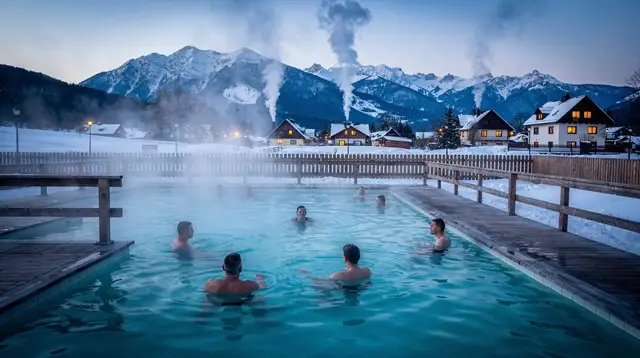
In the afternoon, head to Termy Chochołowskie in the village of Chochołów — not to be confused with the separate Chochołowska valley 10 km away on a different road. Termy Chochołowskie is the largest thermal complex in Poland, roughly 30 pools between 32 and 38°C, and it is exactly the right register for legs that spent the morning on cable cars and ridge paths: no more walking required, just warm water for as long as you want it.
A shared transfer from town removes the need to arrange your own minibus back and forth: a return trip to the springs with time in the pools included. Before leaving, a short walk through Chochołów village itself — about 50 preserved log houses, scrubbed pale every spring — makes a good bookend to the baths if there is an hour left before the return transfer.
Day 3 at a glance
| Time | What |
|---|---|
| Early morning | Minibus or walk to Kuźnice, reserved cable car slot to Kasprowy Wierch |
| Late morning | Ridge views, cable car back down, lunch |
| Afternoon | Termy Chochołowskie, optional walk through Chochołów village |
| Early evening | Return transfer to Zakopane |
Why Morskie Oko and Kasprowy Wierch never share a day
It is tempting to look at the map and think both fit in one long day — the lake in the morning, the cable car in the afternoon. In practice, the two bookings work against each other. The Palenica car park reservation and the Kasprowy Wierch ticket are both dated, both capped, and both tend to get taken for the same popular mid-morning windows in high season, which forces a choice between an early lake visit and a late cable car slot, or the reverse — and either choice compresses one of the two experiences into something rushed.
Add the fact that Morskie Oko alone runs 4 to 6 hours door to door including the walk, and the arithmetic for combining both in a single day stops working for anyone who actually wants to enjoy either. Keeping them on separate days, as this itinerary does, means each one gets a real reservation window and a real amount of time, with no risk that a late return from the lake causes a missed cable car slot the same afternoon.
What this itinerary leaves out, on purpose
No Giewont: the chains near the summit and the risk of afternoon lightning make it a trip that needs its own early-start day, not an add-on to an already full one. No Chochołowska valley crocuses, no Kościeliska caves, no Slovak border crossing — all genuinely worth a visit, none of them fit inside three days that are already committed to the lake, the cable car and the baths.
Anyone drawn to those should look at the four-day car-free itinerary or the five-day hiking itinerary, both of which give the extra stops the half-day or full day they actually need rather than squeezing them into this one. First-timers unsure how many days to commit to the region at all should start with the how many days in Zakopane guide.
Common mistakes on this itinerary
The most common failure mode is booking nothing until arrival, then finding the Kasprowy Wierch ticket sold out for the only free morning and the Palenica car park full for the only free day at the lake. The second most common mistake is trying to walk to Rysy or onto Orla Perć as a spontaneous extension of day 2 or day 3 — both are long, chained, experienced-hikers-only routes that need their own dedicated day and are covered separately in the Czarny Staw and Rysy guide, not folded into a lake visit already running to a return minibus.
A general list of avoidable errors, beyond this itinerary specifically, is in Zakopane mistakes and tourist traps to avoid. Anyone leaning on mountain rescue as a backup plan for underpreparedness should read the TOPR safety guide first — rescue in Poland is free, but that is not the same as routine.
Frequently asked questions about the classic 3-day Tatras itinerary
Can I visit Morskie Oko and Kasprowy Wierch on the same day?
It is possible on paper but rarely works in practice. Morskie Oko takes a half-day round trip once the minibus, the 9 km walk or carriage, and the return are added up, and Kasprowy Wierch tickets are sold in dated, timed slots that can sell out by mid-morning. Splitting them across two separate days removes the risk of missing one booking because of the other.
Do I need a rental car for this itinerary?
No. Minibuses run from Zakopane to Palenica Białczańska for Morskie Oko and to Kuźnice for the Kasprowy Wierch cable car, and to Chochołów for the baths. A car adds the Zakopianka traffic and the fact that no private vehicle is allowed past Palenica or into Kuźnice itself.
How far ahead should I book the Palenica Białczańska car park and the Kasprowy Wierch cable car?
In July and August, book the Palenica car park several days ahead and the Kasprowy Wierch ticket the moment your date is fixed, since online slots can sell out by the previous evening. In shoulder season a day or two ahead is usually enough for both, but neither should be left to the morning of the visit.
What if the Kasprowy Wierch cable car is closed by wind or maintenance?
The cable car stops in strong wind and during the halny föhn wind at any season, and it closes for scheduled maintenance in late October to early November and part of spring. Check the status the evening before and have Gubałówka or the Chochołowska valley as a fallback for that morning.
Is it better to walk to Morskie Oko or take the horse carriage?
Walking the paved 9 km takes 2 to 3 hours each way with 400 m of climb and costs nothing beyond the park ticket. The horse carriage covers most of that distance to Włosienica, about 1.5 km below the lake, for roughly 80 to 100 PLN uphill, and suits anyone short on time or mobility rather than anyone looking for speed, since queues form early.
Should I visit the thermal baths before or after Kasprowy Wierch?
After. Termy Chochołowskie is built for tired legs, and an afternoon soak is the natural way to close a morning spent walking through Kuźnice, changing cable cars at Myślenickie Turnie and exploring the ridge at the top station.
Does this itinerary need a Tatra National Park ticket?
Yes, on day 2 for Morskie Oko and on part of day 3 if you walk beyond the Kasprowy Wierch top station onto the ridge. The ticket is compulsory on every marked trail inside TPN, not only at the lake itself, and is bought online or at the trailhead booth.
Can this itinerary be done in winter?
The lake, the cable car and the baths all run in winter, but the balance shifts: Kasprowy Wierch becomes a skiing and viewing trip rather than a ridge walk, Morskie Oko is a snowy walk rather than a summer stroll, and the baths become the warmest, most obvious afternoon choice. Book the cable car and the Palenica car park just as far ahead, since Christmas and the February school holidays are the busiest weeks of the year.
tours.3 days
Verified deep-linked GetYourGuide tours. Book through these links and we earn a small commission at no cost to you.
GetYourGuide does not provide a product photo for this activity — the image shows the meeting point, photographed by us.