Chochołów: A Walk Through Poland's Best-Preserved Wooden Village
What is there to see on a walk through Chochołów village?
Chochołów is the best-preserved wooden village of the Podhale, with about fifty log houses listed as historic monuments in 1970 and whitewashed with a soap-and-lime wash every spring to keep the timber pale. A walk along the village's main row of houses takes well under an hour on foot, and can be combined with a soak at the nearby Termy Chochołowskie, the largest thermal baths in Poland.
Two places share a name, and only one has the wooden houses
Before anything else: if you have heard of “Chochołów” because someone mentioned April crocuses, you are thinking of the Chochołowska valley, not the village this guide is about. They share a name because the valley takes its name from the village at its mouth, but they are two separate places, roughly 10 km apart, reached by two different roads. The village is a settlement on flat ground in the Podhale, lined with wooden houses. The valley is the longest glacial valley of the Tatra National Park, entered through the Siwa Polana trailhead, ticketed like every other trail inside the park, and known above all for the carpet of crocuses that opens in early April.
If your plan for the day is a hike among snow-fed streams and, in spring, flowering meadows, you want the valley and the guide to its crocus season. If your plan is a walk past a row of historic log houses, a look at Podhale vernacular carpentry, and maybe a soak afterwards, you want the village — and that is what this page covers.
What makes Chochołów village worth the detour
Of all the wooden villages scattered across the Podhale, Chochołów is generally reckoned the best preserved. About fifty log houses form its historic core, standing in a continuous row rather than as isolated survivors among newer buildings, which is what gives the walk its particular character: you are looking at a stretch of village as it more or less looked generations ago, not at a single restored showpiece surrounded by concrete.
That survival is not an accident. The row of houses was entered onto the register of protected monuments in 1970, which fixed their footprint, their materials, and their appearance in place at a point when many Podhale villages were losing their wooden building stock to brick and render. Elsewhere in the region, log houses tend to survive as scattered individual buildings — a farmstead here, a barn there. In Chochołów, a whole run of them stands together, which is rarer and is the reason the village draws a specific kind of visitor: people who want to see the building tradition itself, not just a museum piece of it.
The other detail that makes the row feel alive rather than preserved-in-amber is upkeep. Every spring, the log walls are scrubbed down with a soap-based wash, a maintenance ritual repeated on a fixed yearly cycle. That is why the timber along the row reads as pale rather than the silvery grey that untreated wood usually turns outdoors after a few seasons of weather. It is a small, recurring piece of work, done by the people who live in the houses, and it is arguably as much what you are looking at on a walk through Chochołów as the carpentry itself: a village that keeps its own appearance up, year after year, rather than one frozen by a museum board.
Walking the row of houses
The walk itself does not require planning beyond arriving. There is no ticket, no marked trail, and no national park boundary to cross — Chochołów village sits outside the Tatra National Park, so none of the entry-ticket or trail rules that govern Morskie Oko or the Chochołowska valley apply here. You simply walk the village’s main row on foot.
A sensible approach is to treat it as a there-and-back stroll rather than a loop: start at one end of the row of historic houses, walk its length taking in the building line, then either retrace your steps or continue on to whatever comes next on your Podhale day — Termy Chochołowskie, a different village, or the road back toward Zakopane. Because the houses stand close together along one stretch, the core of the walk covers ground quickly; this is a short, flat, low-effort visit rather than a hike, and it slots easily into a half-day that also includes something else in the Podhale.
What you are looking at as you walk is the shared vocabulary of Podhale log building: horizontal timber walls built up course by course, steep roofs suited to heavy snow load, and the whitewashed finish described above running the length of the row. This is the same vernacular carpentry tradition that, a few decades after these houses were built, fed directly into the more ornamented Zakopane style that Stanisław Witkiewicz developed in the 1890s for the villas of Zakopane itself — a design language the town is still known for.
Chochołów is where you see the building tradition in its plainer, working form, before it became a consciously designed architectural style; the guide to the Zakopane style and Witkiewicz’s villas covers where that later, more decorated version of the same carpentry shows up in town.
Because the houses are private homes and working farm buildings rather than a museum installation, this guide deliberately does not describe their interiors — what is or is not open to visitors, and what any particular house contains, is not something to state without having verified it on site, and it can change from one season to the next. Treat the walk as an exterior one: the row of buildings, their proportions, their materials, and their upkeep, seen from the street.
The village beyond the row of houses
Chochołów is a working Podhale village, not a preserved district cut off from ordinary life, and that shows once you look past the historic row. Newer houses stand alongside the old ones further along the same roads, farms operate as they do throughout the Podhale, and the rhythms of the Górale highlander culture — dress, dialect, music — that shape the wider region are as present here as anywhere else in it.
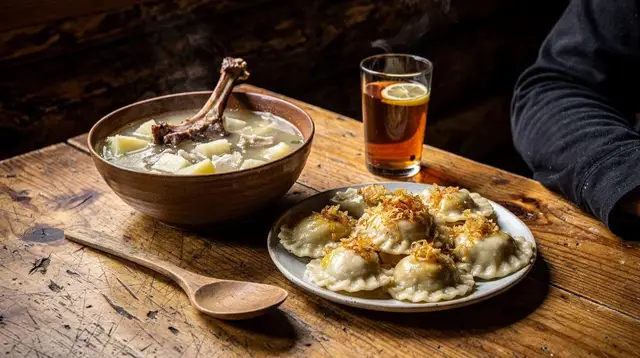
If your interest runs to that culture more broadly, from highlander dress and embroidery to the food traditions of the Podhale, the guides to Górale culture and to Podhale cuisine — kwaśnica, pierogi, and the sheep’s-milk cheeses of the region — are the places to follow that up; this page stays with the walk itself.
A village visit like this one pairs naturally with the rest of a Podhale day rather than standing entirely alone. Several of the other Podhale villages covered on this site — Kościelisko, Szaflary, Poronin and Murzasichle — sit within a similar band west and north of Zakopane, and travellers doing a loop of the villages often fold Chochołów’s wooden row into a wider circuit rather than making a single dedicated trip for it.
Termy Chochołowskie: the obvious stop afterwards
Chochołów’s other claim to attention is practical rather than historic: it is home to Termy Chochołowskie, the largest thermal baths complex in Poland, with pools spread across the site in a temperature range of roughly 32 to 38 degrees. For a lot of visitors, this is what turns a short village walk into a half-day plan — see the wooden row on foot, then spend the rest of the afternoon in the pools.
This guide is not the place to quote opening hours or admission prices for the baths, since both change between seasons and years and are worth checking directly before you go; the dedicated Termy Chochołowskie guide and the operator’s own current information are the right places for that. What is worth flagging here is simply that the baths sit in the village, not in the valley — one more reason to keep the two Chochołów place names straight before you set off, since arriving at the wrong one means driving back out and starting over.
If you would rather have the walk and the baths bundled with transport and a guide, both are sold as a single outing from Zakopane and Kraków. One option pairs the village and pools with a tasting:
a half-day trip from Zakopane that combines the Chochołów spring pools with a local tasting.
A similar version run from Kraków adds a cable-car ride to the day:
a Kraków day trip to the Chochołów thermal baths that folds in a tasting and a cable-car ride.
If you already have your own transport and only need the pools sorted, a standalone entry ticket is also bookable in advance:
a pre-booked entry ticket for the Chochołowskie thermal baths.
Chochołów village versus the Chochołowska valley, side by side
Because the naming overlap trips up even people who have read about the area beforehand, it is worth laying the two out next to each other rather than trusting the names alone to keep them apart.
| Chochołów village | Chochołowska valley | |
|---|---|---|
| What it is | A Podhale settlement with roughly fifty listed log houses | The longest valley in the Polish Tatras, inside Tatra National Park |
| Access | Its own road, separate from the valley trailhead | Entered via the Siwa Polana car park |
| National park rules | None — sits outside the park | TPN entry ticket required, marked-trail rules apply |
| Signature feature | The whitewashed row of historic wooden houses | April crocus bloom across the valley floor |
| Nearby thermal baths | Termy Chochołowskie, on site | None |
| Typical visit length | Well under an hour on foot for the row itself | A half day or more, as a proper valley walk |
If you are trying to fit both into one trip, treat them as two separate stops on the same day rather than one continuous visit — there is no path that connects the village row directly to the valley trailhead, and the roads to each are not the same road.
Getting there and planning the visit
Chochołów sits among the cluster of Podhale villages west of Zakopane, reachable by the minibuses that serve the villages from the Zakopane bus station area, by car, or as part of an organised day trip that bundles the village with the thermal baths, as described above. However you arrive, double-check that the road you are on leads to the village and not to Siwa Polana and the valley entrance — the fork between the two is exactly the kind of thing a GPS destination named “Chochołów” can get wrong if you have not specified which one you mean.
There is no season in which the village walk itself is closed off — it is an ordinary stretch of village street, walkable in winter as much as summer, and it does not depend on cable cars, ski lifts, or trail closures the way so much of the wider Tatra region does between November and mid-June. That makes it a reliable half-day option even in the shoulder seasons when higher trails in the national park are shut. What does vary by season is the thermal baths next door and the crowds drawn by the crocuses in the valley 10 km away — neither of which affects the row of houses itself, which looks much the same across the calendar aside from its fresh spring whitewash.
If you are building a longer Podhale day around Chochołów, consider adding one or two of the other activities sold from the same base. A snowmobile run paired with the thermal baths is one option in winter:
a winter snowmobile excursion from Kraków that ends at the thermal baths.
For a more active version of the same combination in the warmer months, pontoon rafting and quad biking can be paired with a soak on the same outing:
a day trip from Kraków combining pontoon rafting, quad bikes, and the thermal baths.
A note on what this guide leaves out
Two things are deliberately absent from this page. First, exact opening hours and admission prices for Termy Chochołowskie — both are set by the baths’ operator, they change between seasons, and quoting a figure here risks being wrong by the time you read it; check current pricing directly before you plan around it. Second, a description of what is inside any individual house along the historic row — these are private homes and working farm buildings, not a museum circuit with a fixed, verifiable visiting arrangement, so this guide sticks to what can be seen and confirmed from the street: the row itself, its materials, its 1970 listing, and its yearly whitewash.
For everything else in the Podhale, the destination pages for the villages, and the wider guides to the region’s thermal baths and to avoiding the area’s more obvious tourist traps, fill in the rest of the planning.
Frequently asked questions about walking Chochołów’s wooden village
Is Chochołów village the same place as the Chochołowska valley?
No, and this is the single most common mix-up in the area. Chochołów is a village of wooden houses on flat ground in the Podhale, while the Chochołowska valley is the longest valley of the Tatra National Park, entered from a separate trailhead at Siwa Polana. The two are roughly 10 km apart and reached by different roads.
How do I get to Chochołów village from Zakopane?
Chochołów lies to the west of Zakopane in the Podhale, on its own road that does not pass through Siwa Polana. Minibuses and private transfers serving the Podhale villages run there; if you are driving to the Chochołowska valley instead, you will turn off onto a different road entirely, so check your destination before setting out.
How many wooden houses does the village have, and how old are they?
Around fifty log houses form the historic core of Chochołów, and the ensemble was entered onto the register of protected monuments in 1970. That listing is what has kept the row intact rather than replaced house by house over the decades.
Why are the houses whitewashed every spring?
Villagers scrub the log walls with a soap-based wash each spring, which is why the timber stays pale rather than greying the way untreated wood normally does outdoors. It is a maintenance ritual as much as a cosmetic one, repeated on a fixed yearly cycle rather than as a one-off restoration.
Can I visit the Termy Chochołowskie on the same trip as the village walk?
Yes, the two sit close together, and pairing a walk through the log houses with a soak at Termy Chochołowskie, the largest thermal baths complex in Poland with pools in the 32 to 38 degree range, is a natural way to spend a half day. Check current opening times and admission before you go, since this guide does not fix a price.
Is the walk through Chochołów suitable for a short visit or with children?
Yes. The village is flat, the row of houses is compact, and there are no trails, tickets, or climbs involved the way there are in the national park valleys. It works well as a short stop for families or as part of a wider day among the Podhale villages.
Do I need a Tatra National Park ticket to walk through Chochołów?
No. Chochołów village sits outside the national park boundary, so none of the TPN entry rules, tickets, or trail restrictions that apply to Morskie Oko or the Chochołowska valley apply here. It is an open village street, walkable at any time.
Zakopane walking tours
Verified deep-linked GetYourGuide tours. Book through these links and we earn a small commission at no cost to you.
GetYourGuide does not provide a product photo for this activity — the image shows the meeting point, photographed by us.