A village that shares its name with two valleys, and not much else
Kościelisko causes more confusion than it deserves, mostly because of its name. Say “Kościelisko” to someone planning a Tatra trip and they will often assume you mean the Kościeliska valley — the long, paved glacial valley inside Tatra National Park whose entrance is actually 8 km further west, at a place called Kiry. Kościelisko the village is a separate thing: a small Podhale community about 3 km from central Zakopane, with houses, a parish church, a handful of guesthouses, and no single attraction that this guide can point to and call a reason to come on its own.
That is not a criticism of the place. It is a correction of an assumption a lot of first-time visitors carry into their planning. Kościelisko’s honest role in a Zakopane trip is as a point of passage — the corridor you go through, or near, on the way to two much more interesting valleys, and the landing point for one of the ridge walks off Gubałówka. This page treats it that way, because treating it as a day-trip destination with a programme of its own would mean inventing sights that the source material for this site simply does not document.
The naming problem, spelled out
Three different places share overlapping names in this small stretch of the Podhale, and mixing them up is the single most common planning mistake in the area:
| Place | What it is | Where its entrance actually is |
|---|---|---|
| Kościelisko | A Podhale village | About 3 km from central Zakopane, on the road toward Kiry |
| Kościeliska valley | A glacial valley inside Tatra National Park | Kiry, about 8 km west of Zakopane |
| Chochołowska valley | The longest valley of the Polish Tatras | Siwa Polana, near Kościelisko |
| Chochołów | A separate wooden village, 10 km away | Its own road, not the Chochołowska valley entrance |
If you remember only one thing from this table, make it this: the village and the valley that shares its first half are not the same walk, and the valley entrance is further out than the village. A minibus or car heading from Zakopane to “Kościeliska” for a day’s hiking needs to continue past Kościelisko village to Kiry — stopping at the village itself does not put you at the trailhead.
Kościeliska valley: the entrance is at Kiry, past the village
The Kościeliska valley is the more visited of the two valleys that flank Kościelisko, and for good reason: its floor is a 9 km paved track with barely any climb, which makes it one of the few Tatra valleys that genuinely suits prams, small children and anyone who wants scenery without technical walking. The entrance is at Kiry, roughly 8 km west of Zakopane, reachable by private minibus from the bus station area and Kościuszki street, or by the limited parking at the trailhead itself.
Along the paved floor you pass two show caves — Mroźna and Raptawicka — and a side trail to the Smreczyński pond, before the valley narrows toward the Ornak mountain hut. Because the track is paved and largely flat, it absorbs crowds well even in July and August, and it is the valley this site recommends first for families; the fuller walk-through is in the Kościeliska valley family hike guide. A Tatra National Park entry ticket is required here exactly as it is everywhere else in the park — the paved surface does not exempt it from the rule.
Chochołowska valley: the entrance is at Siwa Polana
The second valley, and the longer of the two, starts at Siwa Polana, a separate trailhead closer to Kościelisko than Kiry is. The Chochołowska valley is the longest valley in the Polish Tatras, and its flat opening section is served by a small road train and bike hire, which makes the first stretch an easy outing even for visitors who have no intention of walking all the way to the high ridges at its head.
The one thing that draws a specific, time-limited crowd here is the crocus bloom: from about the first days of April, for roughly two weeks depending on how the snow has lain that year, millions of Crocus scepusiensis flower across the valley meadows. It is a genuinely striking sight and worth timing a spring visit around, covered in detail in the Chochołowska valley crocus season guide. Outside that short window, the valley functions as a long, quiet walking valley rather than an event.
One more distinction worth holding onto: the Chochołowska valley, entered at Siwa Polana, is not the same place as the village of Chochołów, which sits about 10 km away on an entirely different road and is known for its wooden houses rather than for any hiking trail. It is easy to book a stay near “Chochołów” expecting the valley entrance to be a short walk away, and be wrong. The Chochołów wooden village walk guide covers that village on its own terms.
Getting from Zakopane through Kościelisko to either valley
There is no need to rent a car for this stretch of the Podhale. The same private minibus network that serves Kuźnice and Palenica Białczańska also runs out toward Kiry and Siwa Polana from the bus station area and Kościuszki street in central Zakopane, passing through or close to Kościelisko village on the way.
| Route | Approximate distance from Zakopane | How to get there |
|---|---|---|
| Zakopane to Kościelisko village | About 3 km | Minibus or short taxi ride |
| Zakopane to Kiry (Kościeliska valley) | About 8 km | Minibus; limited parking at the trailhead |
| Zakopane to Siwa Polana (Chochołowska valley) | Similar range, slightly closer than Kiry | Minibus; small car park |
| Zakopane to Chochołów village | About 10 km, separate road | Minibus or car |
A car is not a liability here the way it can be at Kuźnice or Palenica Białczańska — both trailheads have some parking — but it also buys little, since the minibuses run frequently in season and neither valley entrance allows vehicles onto the trail itself beyond the car park.
The Gubałówka connection: a chairlift down to Kościelisko’s side
Kościelisko also has a quieter link to the town centre, from above rather than along the road. The funicular from the top of Krupówki carries visitors up to Gubałówka (1,126 m) for the panorama of the whole Tatra chain. From the top station, a ridge walk of 30 to 45 minutes leads along to Butorowy Wierch (1,160 m), where a chairlift runs back down — on the Kościelisko side of the hill, not back toward Krupówki.
It is a pleasant way to link a Gubałówka visit with a descent that avoids backtracking through the funicular queue, and it is covered in more detail in the Gubałówka funicular panorama guide and the Butorowy Wierch and Nosal chairlifts guide. It is not, however, a lift that starts or finishes in the middle of Kościelisko village — it lands you on its outskirts, from where a short onward transfer back to Zakopane or on to one of the valleys is still needed.
Thermal baths nearby, and the temptation to conflate them too
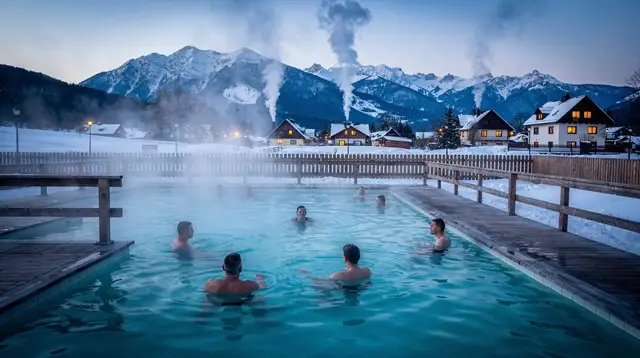
Because Kościelisko sits close to both Chochołów, home to the large Termy Chochołowskie complex, and to the thermal-bath belt that also includes Białka Tatrzańska and Bukowina Tatrzańska further east, it is often used as a loose shorthand for “the thermal bath area” in trip-planning conversations. That shorthand is useful only if you keep the actual distances straight: Termy Chochołowskie is in Chochołów village, a separate 10 km drive from Kościelisko, not a walk from it.
an entry ticket to the Chochołowskie thermal baths, the largest thermal complex in Poland with around 30 pools is the most direct way to combine a Kościeliska or Chochołowska valley walk with an evening soak, since evening sessions tend to be cheaper and quieter than a midday visit. If you would rather compare the whole cluster of baths before choosing one, the which thermal baths to choose guide lays out the differences between Termy Chochołowskie, Terma Bania and Terma Bukovina.
For travellers based in Kraków who want the valleys, the baths and the transfer bundled into one trip without arranging minibuses themselves, a full-day tour from Kraków covering Zakopane and a thermal bath stop removes the logistics of stringing Kiry, Siwa Polana and Chochołów together independently.
What Kościelisko is not, and why that matters for planning
It is worth being blunt about this, because the name invites a wrong assumption: Kościelisko is not a village with an old town, a market square, a museum circuit or a single must-see building the way Chochołów or central Zakopane are. Building a day around “seeing Kościelisko” on its own would mean padding an itinerary with a drive-through and calling it a stop. The honest way to use it is as a waypoint: the last settlement before Kiry, the closest village to Siwa Polana, and the landing side of the Butorowy Wierch chairlift.
That framing changes how a day should actually be built. Instead of “morning in Kościelisko, afternoon free,” the workable version looks like “morning on the paved Kościeliska valley track from Kiry, lunch back near the village, afternoon thermal bath in Chochołów” — or the Chochołowska equivalent, or a crocus-season version in early April.
Travellers who want more structured ways to combine the valleys with an experienced local can also look at guided options: for the higher Tatra terrain beyond Kościelisko’s reach, such as the walk up to Morskie Oko, a private guided hike covering the Tatra Mountains and Morskie Oko is built for people who want a guide rather than self-navigation, and for a faster, motorised way to see the valleys and forest roads around Kościelisko and Chochołów, a guided quad bike and buggy tour of the Tatra Mountains covers similar ground on wheels rather than on foot.
Practical notes that apply whichever valley you choose from here
A Tatra National Park entry ticket is compulsory on both the Kościeliska and Chochołowska valley trails, exactly as on every other marked path in the park — buying one only at the more famous sites like Morskie Oko is a common and costly mistake. Dogs are banned across most of the park, with the Chochołowska valley one of the very few exceptions where dogs are allowed as far as the mountain hut. Both valleys close some of their higher connecting trails from around 1 November to mid-June, so a winter or early-spring visit should stick to the flat, paved lower sections near Kiry and Siwa Polana rather than assuming the whole valley is open.
Neither valley entrance has a village-style amenity base of its own — no real restaurant street, no shops beyond a kiosk or two — so plan meals either in Zakopane before setting out, or around the thermal bath stop afterwards. If your route from Kraków already includes Zakopane and a thermal bath, it is worth checking the first-time Zakopane, how many days guide or the Zakopane weekend, two days itinerary to see where a Kościeliska or Chochołowska valley half-day actually fits against Morskie Oko, Kasprowy Wierch and the town itself, rather than trying to add it as an extra on top of an already full weekend.
Travellers coming from Nowy Targ or the Szaflary thermal cluster will find Kościelisko sits roughly between them and Zakopane geographically, which can make it a sensible midpoint stop on a day that links a market visit, a soak and a valley walk — but again, only as a waypoint on that longer route, not as the anchor of the day.
Kościelisko in a Podhale destination, not a Kraków day trip
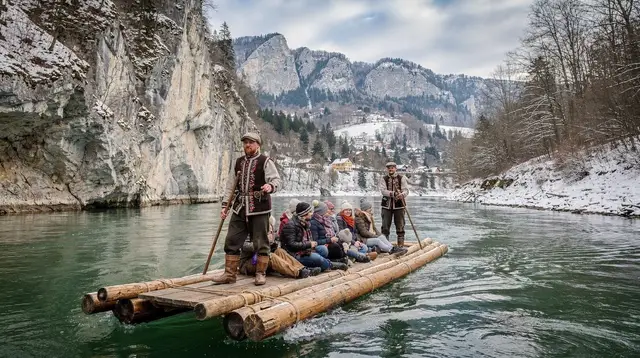
Kościelisko is not somewhere to include in a single day trip out of Kraków that also tries to cover the Dunajec gorge or Auschwitz — the driving math does not leave enough time to also do justice to a valley walk here. It belongs to a Zakopane-based stay, where the extra 15 to 20 minutes to Kiry or Siwa Polana beyond the village is a minor addition to a day already built around the mountains.
Travellers weighing whether to base themselves in central Zakopane, in Kościelisko, or further out in Białka Tatrzańska or Bukowina Tatrzańska should treat Kościelisko’s proximity to two valley entrances as its main selling point over a central-Zakopane base, and weigh that against the thinner choice of restaurants and evening life away from Krupówki.
Kościelisko, questions answered
Is there anything to see in Kościelisko village itself?
Not much that this guide can document as a stand-alone attraction. Kościelisko is a working Podhale village with houses, a church and a few guesthouses, but it has no museum, no old town street and no single sight that justifies a special trip. Its value is location, not content.
What is the difference between Kościelisko and the Kościeliska valley?
They share a name but not a place. Kościelisko is the village, about 3 km from Zakopane. The Kościeliska valley is a separate glacial valley inside Tatra National Park whose entrance is at Kiry, roughly 8 km west of Zakopane and a few kilometres past the village.
How do I get from Zakopane to the Kościeliska valley entrance at Kiry?
Private minibuses run from the bus station area and Kościuszki street in Zakopane out to Kiry, passing through or near Kościelisko on the way. There is limited parking at Kiry itself, so the minibus is usually the easier choice in season.
Is Kościelisko the same as Chochołów?
No. Chochołów is a separate wooden village about 10 km away on a different road, known for its preserved log houses and for the Termy Chochołowskie thermal baths. The Chochołowska valley, which is yet another place, has its own entrance at Siwa Polana, closer to Kościelisko than to Chochołów village.
Can I combine Kościelisko with the Chochołowska valley in one day?
Yes — the Siwa Polana entrance to the Chochołowska valley is a short ride from Kościelisko, and the flat first section of the valley suits a half-day walk. Pairing it with an evening session at a nearby thermal bath is the common way locals and repeat visitors use the area.
Does the Butorowy Wierch chairlift from Gubałówka end in Kościelisko?
It lands on the Kościelisko side of the ridge, after a 30-to-45-minute walk along the top from the Gubałówka funicular station. It is a way of descending toward Kościelisko rather than a lift that starts or ends in the village centre itself.
Is Kościelisko a good base to stay overnight?
It can work for travellers who want to be closer to the Kościeliska and Chochołowska valley entrances than central Zakopane is, and who don’t mind a short transfer back into town for restaurants and Krupówki. It is quieter than Zakopane, with fewer services.
Do I need a Tatra National Park ticket to walk from Kościelisko into the valleys?
Yes. The Tatra National Park entry ticket is required on every marked trail, including the paved walk through the Kościeliska valley from Kiry — it is not only checked at the more famous sites like Morskie Oko.