Zakopane with Kids: A Chain-Free 3-Day Family Itinerary
Not every trip to the Tatras has to end on a chained ridge or a 400-metre climb. This three-day plan was built around one constraint: nothing that a stroller, a nervous seven-year-old, or a grandparent with bad knees cannot handle. Every kilometre covered here is either paved, on wheels, or step-free, and every stop is confirmed as accessible without a mountain permit skill set.
Why this plan skips the chains, the summits and the horse-carriage queue
Zakopane’s most photographed sights are not built for small children. Giewont, the “Sleeping Knight” with its iron cross, needs about three hours up from Kuźnice and finishes on 100-200 m of chains over polished limestone — the kind of terrain where a sudden afternoon storm has turned fatal before. Rysy, Poland’s highest point at 2,499 m, is a long day even for fit adults, snow-free only from around July. And Morskie Oko, the lake everyone wants to see, means a reserved car park, then 9 km each way on foot or a slow horse-carriage queue to a point still short of the water.
None of that belongs in a family itinerary with young children, so this one deliberately stops at the edge of what is genuinely flat: the Kościeliska valley. Nothing here goes further into the park, and nothing here touches a chain, a scramble, or an unmarked route.
| Day | Where | How you move | Elevation gain |
|---|---|---|---|
| 1 | Zakopane town + Gubałówka | On foot on Krupówki, then funicular | None uphill |
| 2 | Kościeliska valley, from Kiry | Paved track on foot or by pram | Flat |
| 3 | Chochołów baths + Ždiar, Slovakia | Car, then step-free treetop platform | None |
Day 1: Krupówki on foot, Gubałówka by funicular
Start on Krupówki, Zakopane’s 1.1 km pedestrian street, closed to cars and easy to cover in short bursts with plenty of benches, ice-cream stalls and grilled oscypek along the way (the real, PDO-protected sheep cheese is only made May to September; a winter stall selling “oscypek” is usually cow’s-milk gołka, worth knowing before a child asks why it tastes different). A relaxed loop of central Zakopane takes an easy morning — see the half-day walk along Krupówki for a stop-by-stop order that keeps a stroller on smooth pavement the whole way.
After lunch, walk to the top of Krupówki and take the Gubałówka funicular: three to four minutes each way, about 300 m of climb done entirely sitting down, return tickets roughly 37-49 PLN (2026). At 1,126 m, the summit platform opens onto the whole Tatra chain at once — the best panorama in the area for zero physical effort — plus souvenir stalls, a summer toboggan run, and space for children to run around flat, open ground. The Gubałówka funicular guide covers queue times and the best photo spots.
Families travelling with older kids who want one active hour without leaving town can add the ropes course above the funicular station — a supervised rope park on the top of Gubałówka — with courses graded by height and confidence, a five-minute walk from where the funicular drops you off. It is entirely optional and easy to skip if nap time is closer than the queue. For a broader read on what else in town works well with young children, see the Zakopane with kids guide.
Day 2: the flat, paved Kościeliska valley
This is the day built entirely around one number: 9 km of paved, near-flat track, gentle enough that it is the standard recommendation for prams in the whole Tatra range.
Take a minibus from central Zakopane to Kiry, about 8 km west of town — this is the official entrance to the Kościeliska valley, inside Tatra National Park. A TPN entry ticket is required here exactly as it is at Morskie Oko: 11 PLN standard, 5.50 PLN reduced, free under 7 (2026 prices), bought online at tpn.gov.pl or at the booth. Dogs are not permitted on this trail — it sits inside the park, and Kościeliska is not one of the two exceptions (only the Chochołowska valley up to its hut, and the Droga pod Reglami path, allow dogs).
From the entrance the track runs almost dead flat along the valley floor, wide enough for two prams side by side, with limestone walls rising on either side. Two show caves, Mroźna and Raptawicka, sit just off the main path as a short detour — worth a stop to let legs move differently for ten minutes, though the caves themselves involve a few steps inside, so leave the stroller on the main track while one adult goes in.
The Ornak mountain hut, about two-thirds of the way up, is a natural turnaround point with food and drink if the group is tiring, or a lunch stop before heading back the same way. There is no obligation to reach the end: this is a valley you can shorten at will, in either direction, without losing the point of the day.
The full route notes, printable trail profile and stroller checkpoints are in the Kościeliska valley family hike guide; for a wider comparison of which Tatra paths actually suit a pram, see stroller-friendly easy trails around Zakopane. This is also the natural point in a trip to stop and note what this itinerary is not: it does not continue past Kościeliska into the park’s higher, unpaved trails, and it does not attempt the Valley of Five Polish Lakes or any route requiring a full day’s climb.
Day 3: thermal pools at Chochołów, then Slovakia’s step-free treetop walk
The last day needs a car, because both stops sit outside town with no direct public transport link that keeps to a family schedule.
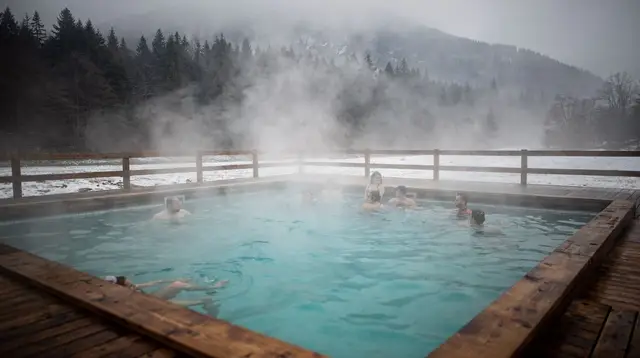
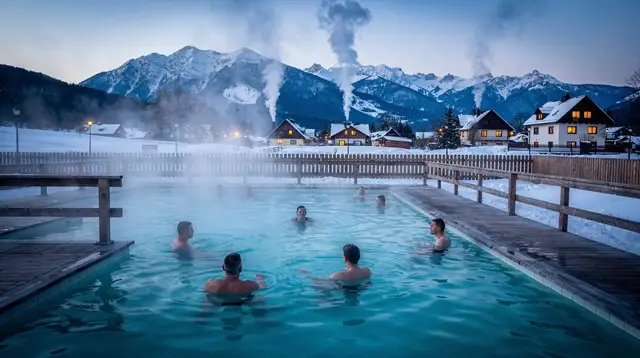
Morning — Termy Chochołowskie. Drive to Chochołów, about 15 km from Zakopane, home to the largest thermal baths complex in Poland: roughly 30 pools at 32-38 °C, including dedicated shallow pools for small children. Two to three hours here in the late morning works well — warm water, zero walking, and a change of pace after a valley day.
A combined visit with tasting is bookable as a Chochołów spring pools visit that pairs the baths with a local tasting for families who want the outing organised rather than self-driven, or an entry-only ticket for those keeping their own car and schedule. The Termy Chochołowskie guide covers pool depths, changing rooms and the best entry time to avoid the midday rush; for context on how it compares with the other regional baths, see which thermal baths to choose in the Tatras.
Afternoon — Bachledka treetop walk, Ždiar, Slovakia. From Chochołów it is roughly 40-50 km to Ždiar on the Slovak side, crossing an open Schengen border with no checkpoint — carry an ID card or passport regardless, and switch to euros, since Slovakia is not on the złoty.
The Bachledka treetop walk is 1,234 m long, reaching up to 24 m above the forest floor with a 32 m viewing tower, and — the detail that matters most for this itinerary — it is entirely step-free, built as a ramped walkway rather than a staircase trail. A 60 m spiral slide at the tower gives older children a reason to do a second lap. Pets are not allowed on the walkway, so this is not a stop for a dog travelling with the family, whatever a search engine might suggest.
A guided day trip covering the Bachledka treetop walk together with Štrbské Pleso is the simplest way to do this leg without self-driving the Slovak roads, and it removes the need to navigate an unfamiliar mountain road with tired children in the back seat. Full step counts, ramp gradients and photo spots are in the Bachledka treetop walk guide; if comparing it against Poland’s own treetop walk at Murzasichle before deciding which to prioritise, see treetop walks in Poland vs Slovakia compared.
Practical notes for travelling with children
| Detail | What to know |
|---|---|
| TPN ticket (day 2) | Compulsory on the Kościeliska track; 11 PLN standard, 5.50 PLN reduced, free under 7 |
| Dogs | Banned in Tatra National Park and at the Bachledka treetop walk |
| Currency | Złoty in Poland, euro in Slovakia — carry both or a card that handles either |
| Border crossing | Open Schengen border, no checkpoint, ID or passport still required |
| Car | Not needed days 1-2 (minibuses cover Kiry); required day 3 for Chochołów and Ždiar |
| Rescue | TOPR (985 or +48 601 100 300) covers the Polish side; free of charge |
A few honest caveats: the Zakopianka road out of town can be slow on Friday evenings, Sunday afternoons and any snowy weekend, so build slack into the day-three drive rather than timing it tightly against the treetop walk’s closing hour. Termy Chochołowskie gets busy from midday in high season — an early slot avoids the worst of it. And if the group would rather skip the car altogether, the 4-day Tatras without a car itinerary swaps the Slovak leg for an extra Polish-side day using only minibuses.
Family Zakopane in 3 Days: Frequently Asked Questions
Is this itinerary suitable for a stroller or a toddler who cannot walk far?
Yes. Every step covered here is either a ride — the funicular, a car, the treetop walkway — or a paved, flat track. The Kościeliska valley on day two is 9 km of level asphalt used daily by prams, and the Bachledka treetop walk on day three is fully step-free.
Do we need a car for this trip?
Not for day one or two, which run on minibuses from central Zakopane. Day three does need a car, because Termy Chochołowskie and the Bachledka treetop walk at Ždiar both sit outside town and the Slovak leg has no direct public transport link that fits a family schedule.
Can we take our dog to the Bachledka treetop walk or into the Tatra National Park?
No. Dogs are banned inside Tatra National Park, which covers the Kościeliska valley, and the Bachledka treetop walk in Ždiar does not allow pets either. Plan a kennel or a pet-sitter for these three days.
Does this itinerary include Giewont, Rysy or Morskie Oko?
No, deliberately. Giewont’s summit involves chains over polished rock and a real lightning risk; Rysy is a long, technical day even for fit adults; and Morskie Oko means 9 km each way on foot or a horse-carriage queue. None of that suits young children, so this plan stays inside the flat Kościeliska valley and skips every chained or high-altitude trail.
Do we need a Tatra National Park ticket for the Kościeliska valley?
Yes. A TPN entry ticket is compulsory on every marked trail in the park, including the paved Kościeliska valley, not only at named attractions. Buy it online at tpn.gov.pl or at the booth in Kiry; standard price is 11 PLN, reduced 5.50 PLN, free under 7 (2026 rates).
What do we need to cross into Slovakia for day three?
Poland and Slovakia are both in the Schengen area, so there is no border checkpoint, but carry an ID card or passport anyway. Slovakia uses the euro, not the złoty, so bring euros or a card for the treetop walk entry and any food stop in Ždiar.
How much walking is actually involved across the three days?
Almost none by mountain standards. The longest continuous stretch is the Kościeliska valley, and even that is flat and can be shortened at any point by turning back to Kiry. Nothing in this itinerary climbs, and nothing requires scrambling or chains.
Family-friendly activities
Verified deep-linked GetYourGuide tours. Book through these links and we earn a small commission at no cost to you.
GetYourGuide does not provide a product photo for this activity — the image shows the meeting point, photographed by us.