Bachledka Treetop Walk at Ždiar: A Slovak Day Trip from Zakopane
What is the Bachledka treetop walk at Ždiar, and how do I get there from Zakopane?
Bachledka is a treetop walkway above Ždiar, a Górale village at 895 m in the Slovak Tatras: 1,234 m long, up to 24 m above the ground, with a 32 m viewing tower and a 60 m spiral slide, and step-free access throughout. Ždiar sits 30-60 km from Zakopane across an open Schengen border, reachable with just an ID card, and the euro is the currency once you cross, not the złoty.
Ždiar and the Bachledka treetop walk: what’s actually there
Cross the border south of Zakopane and the mountains keep going, but the village names change, the money changes, and the wooden houses take on a different shape. Ždiar sits at 895 m in the Slovak Tatras, a Górale (highlander) village whose timber houses still face the road the traditional way, one of the last places where that building style survives almost intact.
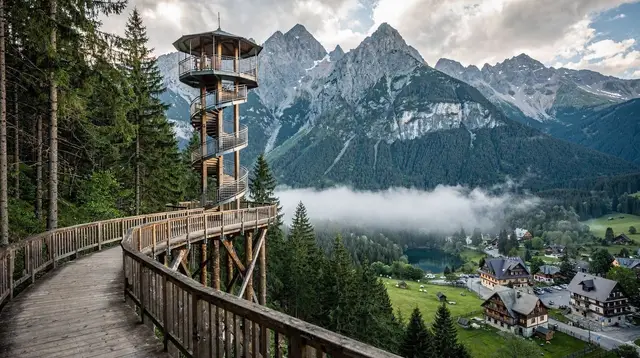
Above the village, cut into the forest on the lower slopes of the Bachledova dolina, runs the Bachledka treetop walk: a raised timber and steel walkway that climbs through the canopy for 1,234 m, reaching as much as 24 m above the forest floor at its highest points, with a 32 m viewing tower standing over the trees and a 60 m spiral slide built into the descent for anyone who wants to skip the last stretch of walking. The whole course is step-free, which is rare enough among Tatra attractions to be worth saying twice: a pram rolls the entire length of it, and so does a wheelchair, without a lift, a detour, or a staff member carrying anything.
This page describes what the site actually is and how to reach it from Zakopane, not what it costs or when it opens — ticket prices and opening hours move from one season to the next, and the only place to check them before a visit is the operator’s own page on the day you plan to go. What follows are the numbers that don’t change: the length of the walkway, the height of the tower, the distance across the border, and the currency you’ll need once you’re on the other side.
A Górale village on the other side of the ridge
Ždiar is not a resort built around one attraction. It is a working village that happens to sit directly below one of the more striking stretches of the Slovak Tatras, and the treetop walk is the reason most visitors from Poland now stop there, but not the only reason to slow down.
The wooden houses along the main road carry the same highlander building tradition you’ll recognise from Chochołów or the older streets of Zakopane — steep roofs, timber façades, painted decoration around the windows — a reminder that the Górale culture straddles the border rather than stopping at it. If a highlander evening with live music and a bonfire appealed to you in Zakopane, the same Górale traditions are visible here in daily life rather than performance, in the houses and in the older generation’s dress on market days.
The village sits in a valley between two better-known Slovak landmarks: the lake resort of Štrbské Pleso to the west and the cable-car town of Tatranská Lomnica to the east. That position is what makes Ždiar a natural stop on a loop rather than a destination in itself for most travellers based in Zakopane — you pass through or near it on the way to either.
The course itself: length, height, tower, slide
| Element | Figure |
|---|---|
| Total length of the walkway | 1,234 m |
| Maximum height above ground | 24 m |
| Viewing tower | 32 m |
| Spiral slide (descent) | 60 m |
| Access | Step-free throughout |
| Village elevation | 895 m |
| Pets | Not permitted |
The walk climbs gradually through spruce and beech forest on a wide timber deck wide enough for two prams to pass, with side platforms and interpretive stops along the way before it reaches the main tower. From the top of the 32 m tower, the view opens south toward the higher Slovak peaks and north back toward the ridge that separates this valley from Poland — the same mountain chain seen from the other side at Kasprowy Wierch, just from a lower, gentler vantage point.
The descent can be done on foot back down the walkway, or by the 60 m spiral slide, a fast, enclosed chute that drops visitors back toward the base station — popular with children and with anyone who walked up and would rather not walk back down the same way.
Nothing about the course requires technical footwear or fitness: it is engineered access, not a mountain trail, and that is precisely what sets it apart from almost everything else described on this site. Compare it with the closer option on the Polish side, the Murzasichle treetop walk near Poronin, and the differences and similarities between the two are laid out directly in our comparison of treetop walks in Poland and Slovakia.
Access without a step: strollers, wheelchairs, and no dogs
Two access facts are worth stating plainly because they cut against what most Tatra attractions offer.
First, the entire walkway is step-free. That single design choice makes Bachledka one of the very few sites in this guide’s coverage area that a wheelchair user or a parent with a pram can visit without planning around stairs, gravel switchbacks, or a staff member’s help. Most of what sits on the Polish side of the border — the paths to Morskie Oko, the climb to Giewont, even the funicular platform at Gubałówka — involves at least some uneven ground. Bachledka does not.
Second, pets are not allowed on the treetop walk. If you’re travelling with a dog, this is one of the days it stays behind, whether that means leaving it in Zakopane accommodation or splitting the group for the day. It’s a small detail, but one that trips up visitors who assume a forest walkway is dog-friendly by default; it isn’t here.
Crossing from Zakopane: Schengen, distance, currency
The border between Poland and Slovakia in this stretch of the Tatras has no checkpoint and no passport control. Both countries sit inside the Schengen area, so the crossing is a road sign, not a barrier: an identity card is enough documentation, there is nothing to stamp, and there is no queue to plan for. This is worth knowing if you’ve only crossed borders outside Schengen before — there is genuinely nothing to do at the line itself.
The distance from Zakopane to Ždiar runs roughly 30 to 60 km, depending on the exact route and which part of Zakopane you start from — shorter than the run to Kraków and on quieter roads than the Zakopianka, the single road that jams badly on weekends in high season. Because this is a different country, not a regional excursion, the one change that trips up first-time visitors is money: Poland uses the złoty, and Slovakia uses the euro.
Bring euros, or a card that works without issue abroad — do not expect to pay in złoty on the Slovak side, and do not try to convert prices between the two currencies in your head against a fixed rate, since it moves. Card acceptance is broadly reliable at the main sites, but a small amount of cash in euros is worth carrying for parking, kiosks, or a coffee in the village.
Getting there: how visitors actually reach Bachledka
Most visitors based in Zakopane reach Ždiar in one of two ways: driving themselves across the open border, or taking an organised day trip that handles the crossing, the driving, and usually a second stop in the same day. Given the distance and the fact that this is an international trip rather than a local one, a guided option removes the friction of navigating unfamiliar roads and finding parking near the treetop walk’s base station, and it typically pairs the visit with another Slovak landmark so the day isn’t built around a single stop.
One straightforward option is a guided day trip from Zakopane that combines the Bachledka treetop walk with the lakeside village of Štrbské Pleso, which covers both sides of the valley in a single outing. Travellers who want to go further into Slovakia on the same trip, rather than stay close to Ždiar, sometimes choose a full-day excursion to Orava castle and the Demänovská ice cave instead, which trades the treetop walk for two different Slovak landmarks further from the border.
For a longer stay on the Slovak side, a two-day tour through the High Tatras that also visits Spiš castle covers more ground than a single day allows, useful if the border crossing has convinced you it’s worth more than an afternoon. And for a more flexible pace, a private transfer and tour from Poprad to the walled town of Levoča works well for travellers who would rather set their own schedule than join a fixed itinerary.
Combining Bachledka with Štrbské Pleso or Tatranská Lomnica
Because Ždiar sits roughly between the two, most itineraries that include the treetop walk add one more stop rather than trying to fit in both.
Štrbské Pleso, a lake resort at 1,346 m, is the closer and gentler pairing: a walk around the lake, mountain views, and a slower pace that suits a day that already includes a forest walkway. Tatranská Lomnica, further east, is the pairing for travellers who want to add height to the day — its cable car climbs toward Lomnický štít, the high point of the Slovak High Tatras, a contrast to the low-elevation, step-free nature of Bachledka itself.
| Pairing from Ždiar | Character of the day |
|---|---|
| Štrbské Pleso | Lake, gentle walking, closer distance |
| Tatranská Lomnica | Cable car, higher elevation, longer day |
| Orava castle | Further west, a full day on its own |
| Poprad / Kežmarok | Towns, a slower, less scenic day |
Either pairing keeps the day inside Slovakia after the crossing rather than shuttling back and forth across the border, which is the more efficient way to use the drive.
Other stops nearby worth knowing about
A handful of other Slovak landmarks sit within reach of the same border crossing, useful context even on a day built mainly around Bachledka. Belianska cave and Orava castle sit further west and typically anchor their own day rather than an add-on. The towns of Poprad and Kežmarok are quieter stops, useful for a coffee or a walk through an old town square rather than a headline attraction. None of these compete with Bachledka for a first Slovak day trip from Zakopane, but they’re worth knowing about if one visit across the border turns into two.
For a broader sense of how the Slovak side compares to staying on the Polish side of the Tatras — crowds, prices, pace — see our comparison of Zakopane and the Slovak Tatras, and for the practical case for crossing at all, why the Slovak side is often cheaper and less crowded lays out the reasoning in more detail.
If two days across the border appeals more than one, our Slovak side two-day itinerary builds a fuller loop around Ždiar, Štrbské Pleso, and Tatranská Lomnica. And for the full range of things to do on this side of the border, the Slovak High Tatras category page collects the rest of what’s covered on this site.
What to bring and what to expect
Pack for a forest walk at moderate elevation rather than a high mountain outing: the walkway itself asks nothing technical of visitors, but the village sits at 895 m and the weather can shift the way it does anywhere in the Tatras — a layer for wind at the tower, and rain gear if the forecast is uncertain. Bring euros rather than złoty once you’re across the border, an identification card rather than a passport, and leave the dog at home for this particular stop.
If you’re travelling with a pram or need step-free access, this is one of the most dependable attractions in the whole region for that — plan the rest of a Slovak day around it rather than the other way round, since Štrbské Pleso and much of Tatranská Lomnica’s base area are equally manageable, while a high-mountain target like Lomnický štít itself is a cable-car ride rather than a walk.
Bachledka treetop walk at Ždiar: frequently asked questions
How long is the Bachledka treetop walk and how high does it go?
The course runs 1,234 m through the forest canopy above Ždiar, climbing to as much as 24 m off the ground at its highest sections, with a 32 m viewing tower along the route.
Is the Bachledka treetop walk suitable for strollers and wheelchairs?
Yes. The walkway is step-free from the entrance to the tower, which makes it one of the few Tatra attractions that works for a pram or a wheelchair without a workaround.
Can I bring my dog to Bachledka?
No. Pets are not allowed on the treetop walk, so plan for someone to stay behind with the dog or leave it in Zakopane for the day.
Do I need a passport to cross from Poland to Slovakia for Ždiar?
No passport control exists at this border: both countries are in the Schengen area, so an identity card is enough and there is no stamping or checkpoint to plan around.
Which currency do I need at Bachledka, złoty or euro?
Euro. Poland uses the złoty, but Slovakia is in the eurozone, so bring euros or a card that works abroad once you cross the border.
How far is Ždiar from Zakopane, and how long does the drive take?
Ždiar is roughly 30-60 km from Zakopane depending on the route and the exact starting point in town, an open-border drive that is shorter than the Kraków run and does not involve the Zakopianka traffic.
Can I combine Bachledka with Štrbské Pleso or Tatranská Lomnica in one day?
Yes, and it is the common way to see it: Ždiar sits between both, so a single day trip across the border can pair the treetop walk with the lake at Štrbské Pleso or the cable car at Tatranská Lomnica.
Slovak Tatras day trips
Verified deep-linked GetYourGuide tours. Book through these links and we earn a small commission at no cost to you.
GetYourGuide does not provide a product photo for this activity — the image shows the meeting point, photographed by us.