Štrbské Pleso: The Glacial Lake of the Slovak High Tatras
What is Štrbské Pleso and how do you get there from Zakopane?
Štrbské Pleso is a glacial lake at 1,346 m in the Slovak High Tatras, frozen roughly 155 days a year and reached by a cog railway from the town of Štrba below it. From Zakopane it is 30 to 60 km across an open Schengen border, needing only an ID card or passport and euros rather than złoty.
A lake on the other side of the border
Cross the ridgeline that separates Zakopane’s valley from the next one south and the mountains do not change character so much as change passport. The peaks are still the High Tatras, the rock is still the same granite, but the currency in your pocket needs to be euros instead of złoty, and the villages read their names with a different set of diacritics. Štrbské Pleso, a glacial lake at 1,346 m, sits well inside this Slovak half of the range, and it is one of the more straightforward reasons to make the crossing for a day.
The lake itself is small and can be walked around in well under an hour, but its setting does the work: a mirror of water backed by a wall of peaks, a scattering of hotels built during the resort’s decades as a winter-sports base, and — the detail that separates it from a simple viewpoint — a cog railway that climbs to it from the town of Štrba below, on the main railway line that runs along the foot of the Tatras. That rack-and- pinion approach is part of why Štrbské Pleso has been reachable without a car for over a century, long before minibuses linked every trailhead on the Polish side.
None of what follows invents a timetable or a ticket price for that railway, or for anything else at the lake: those numbers shift by season and operator, and a guide that prints a fare in September and gets read in January is a guide that misleads. What this page fixes are the three things that do not shift — the altitude, the freeze pattern, and the fact that the railway exists as the historic way up — and it builds the practical picture of getting there from Zakopane around them.
The three facts worth anchoring on
Before the logistics, the numbers that matter and that will not go stale:
| Fact | Detail |
|---|---|
| Altitude | 1,346 m above sea level |
| Ice season | Frozen roughly 155 days of a typical year |
| Historic access | A cog (rack) railway climbs from Štrba, on the valley line below, up to the lake |
| Location | Slovak High Tatras, across the Schengen border from Zakopane |
| Distance from Zakopane | Roughly 30 to 60 km depending on route |
At 1,346 m, Štrbské Pleso sits noticeably higher than Zakopane town (830-1,000 m) but below the cable-car stations at Kasprowy Wierch (1,987 m) on the Polish side. That altitude is enough for the lake to freeze for a large part of the year — around 155 days by the recorded figure — which is why Štrbské Pleso built its reputation as a winter destination as much as a summer one, with the frozen surface historically used for skating and, in its resort heyday, ski-jumping events on the slopes above it.
The cog railway is the detail that explains why this particular lake, among the dozens of tarns scattered through the Tatras, became a resort rather than staying a hiker’s reward at the end of a trail. A rack railway needs infrastructure, a station, and a reason to build it — and Štrbské Pleso got one, connecting it to the standard rail network at Štrba and, by extension, to Poprad and the rest of Slovakia, well before Tatranská Lomnica’s cable car existed in anything like its current form.
Crossing from Zakopane: the border that isn’t one
The single most useful fact for a traveller based in Zakopane is that the Slovak Tatras are not really “abroad” in the way a flight would make them abroad. Poland and Slovakia are both in the Schengen area, so the frontier between them carries no border control post — no queue, no stamp, no barrier to stop at. A car, a minibus, or a hiker on a cross-border trail simply continues from one country into the next.
That does not mean the border is irrelevant, only that it works differently than a traveller might expect:
- Carry ID. Schengen removes routine checks, not the requirement to hold a valid ID card or passport — spot checks do happen, and a day trip without ID is a bad idea regardless of how relaxed the crossing looks.
- Currency changes. Poland uses the złoty; Slovakia uses the euro. A day that starts in Zakopane and ends at Štrbské Pleso or Tatranská Lomnica means either carrying euros, using a card (widely accepted in the resort areas), or budgeting for a currency exchange somewhere along the way.
- Distance is short. Depending on the exact route and which part of the Slovak Tatras is the target, the figure runs roughly 30 to 60 km from Zakopane — closer to a long morning drive than an international trip in the way most people picture one.
For context on what an organised crossing looks like without renting a car, see Zakopane vs. the Slovak side, which lays out the practical differences between staying on the Polish side and adding a Slovak day.
Getting to Štrbské Pleso
There are, broadly, two ways travellers reach Štrbské Pleso from the Zakopane side of the range, and they suit different trips.
By road. A car or organised minibus crosses the open border and follows the roads that skirt the southern foot of the Tatras toward the resort area around Štrbské Pleso, Tatranská Lomnica and Poprad. This is the route used by day tours that bundle several Slovak sites into one outing, since it allows stops along the way that a train timetable would not.
By rail, via Štrba. The historic approach is the cog railway climbing from the town of Štrba, which itself sits on Slovakia’s main line connecting to Poprad — the largest town at the foot of the Slovak Tatras and a transport hub in its own right (see Poprad and Kežmarok). A traveller arriving by regular train to Štrba changes onto the rack railway for the climb up to the lake. This is the option worth knowing about even for a driver, because it is the reason Štrbské Pleso became a resort rather than a remote tarn: rail access predates most of the road infrastructure that now also reaches it.
Neither approach is complicated, but neither is instant either. Treat a Štrbské Pleso day from Zakopane the way you would treat a trip to Morskie Oko on the Polish side: a full outing, not a two-hour detour, once the crossing, the drive or train connection, and time at the lake itself are all added up.
What Štrbské Pleso is like once you’re there
The lake is compact — a loop path circles it in well under an hour at an easy pace — and the resort around it has the layout of a place that was built for winter sport and later adapted for a broader kind of tourism: hotels along the shoreline, a promenade, and the peaks of the High Tatras rising directly behind, without the lower foothill buffer that softens the view from Zakopane town.
Because the lake sits at 1,346 m, the character of a visit changes hard by season:
- In the ice months (roughly 155 days of the year, so a large stretch of late autumn through winter and into spring), the frozen surface has historically been used for skating, and the resort leans into a winter identity — snow on the peaks above, a still, white lake below.
- In the ice-free months, the same lake becomes a mirror for the surrounding ridge, a quieter counterpart to the more dramatic, higher-altitude scenery around Tatranská Lomnica’s cable car toward the Lomnický štít.
One rule carries over from the Polish side of the range without any adjustment: lifts, cable cars and mountain infrastructure across the whole Tatra chain, Slovak stations included, can close in strong wind or poor weather. The Kasprowy Wierch cable car on the Polish side stops in high wind for exactly the same reason the Slovak lifts near Štrbské Pleso and Tatranská Lomnica do — this is mountain weather, not a national quirk, and it is worth building slack into any day that depends on a lift running.
Pairing Štrbské Pleso with the rest of the Slovak Tatras
Štrbské Pleso rarely works as a destination entirely on its own for a traveller coming from Zakopane — the crossing itself is easy enough that most visitors build it into a wider Slovak day or two-day trip. The natural pairings, all drawn from the same stretch of the Slovak High Tatras:
- Tatranská Lomnica, a short distance along the same resort corridor, where a cable car climbs toward the Lomnický štít. Combining the two gives a single day both a lakeside walk and a high-altitude cable-car leg — see the Tatranská Lomnica and Lomnický štít cable car guide for how that side works.
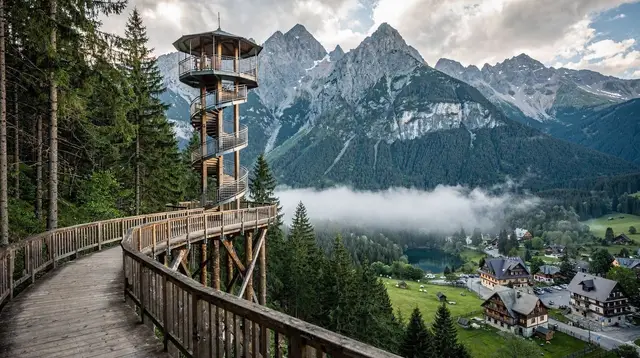
- Ždiar and the Bachledka treetop walk, a step-free attraction further east that pairs well with a lake visit for a day that mixes an easy nature walk with a family-friendly structure — detailed in the Bachledka treetop walk guide.
- Poprad and Kežmarok, the transport and market towns below the resort belt, useful as a base for the rail approach via Štrba (see Poprad-Kežmarok).
- Orava Castle, further west, which anchors a different kind of Slovak day trip built around castles rather than lakes — the Orava Castle and Belianska Cave guide covers that combination.
For a full two-day structure that uses Štrbské Pleso as one anchor among several Slovak stops, see the Slovak side, 2 days itinerary.
Booking a day that includes Štrbské Pleso
Because the border adds a genuine logistical step — currency, and coordinating a road or rail connection that starts in a different country from where most Zakopane visitors are staying — an organised day tour is the option most travellers use rather than self-driving or piecing together Slovak trains from a Polish base.
a day trip from Zakopane that pairs the Bachledka treetop walk with a visit to Štrbské Pleso covers the most direct route to the lake alongside one of the Slovak side’s other signature stops, without requiring a car or a Slovak rail ticket to be arranged separately.
For a longer look at the Slovak High Tatras that folds in more of the region’s built heritage, a two-day High Tatras and Spiš Castle tour extends beyond a single-day scope and adds the Spiš Castle area, which sits further from Zakopane than a standard day allows for comfortably.
Travellers whose interest leans toward castles and caves rather than the lake itself can instead look at a day trip from Zakopane to Orava Castle and Demänovská Cave, which covers a different pocket of Slovakia west of the High Tatras resort belt.
And for a smaller-group, flexible option based from the Slovak side rather than Zakopane, a private tour from Poprad to Levoča works well for travellers who are already staying on the Slovak side of the range, perhaps having used the rail connection through Štrba, and want a guided day from there.
Building a Štrbské Pleso day from Zakopane, step by step
- Decide road or rail. A self-driven or organised-minibus road crossing suits a day that also stops at Tatranská Lomnica or Ždiar; the rail route via Štrba suits travellers who prefer not to drive and who value the historic cog-railway ascent.
- Carry ID and euros. No checkpoint will stop the car or train, but ID should still be on hand, and euros (or a card) will be needed once inside Slovakia — złoty is not accepted there.
- Check the season. In the roughly 155 days a year the lake is frozen, expect a winter scene rather than open water; outside that window, the lake reflects the ridge above it in the more familiar way.
- Build in weather slack. Any lift or cable car near Štrbské Pleso or at Tatranská Lomnica can close in strong wind, exactly as the Polish cable cars do — treat a lift ride as a bonus, not a guarantee, when planning the day’s schedule.
- Pair it with a neighbour. Štrbské Pleso alone is a short visit; combining it with Tatranská Lomnica, Bachledka, or a castle stop further west turns the crossing into a full and worthwhile day rather than a lake seen for twenty minutes.
Štrbské Pleso and the Slovak Tatras: your questions answered
How far is Štrbské Pleso from Zakopane?
Roughly 30 to 60 km depending on the route taken, all within the Schengen area, so there is no border checkpoint to cross, only a change of currency from the Polish złoty to the euro.
Do I need a passport to cross into Slovakia?
The border is open under the Schengen agreement, with no control post, but travellers are still expected to carry a valid ID card or passport, since spot checks can happen.
Is Štrbské Pleso frozen in winter?
Yes. The lake sits at 1,346 m and is recorded as frozen for around 155 days of a typical year, which places its ice season across most of the winter and into spring.
How do you reach Štrbské Pleso by train?
A cog railway (rack railway) climbs from the town of Štrba, on the main line below the Tatras, up to the lake at Štrbské Pleso — the classic way to arrive without a car.
Can Štrbské Pleso be combined with Tatranská Lomnica in one day?
The two sites sit in the same stretch of the Slovak High Tatras and are commonly paired on a single day out from Zakopane, with Tatranská Lomnica adding its own cable car toward the Lomnický štít.
What currency is used at Štrbské Pleso?
The euro. Poland uses the złoty, so a day trip that crosses from Zakopane into the Slovak Tatras means carrying or accessing euros for anything paid in cash on the Slovak side.
Does bad weather affect a visit to Štrbské Pleso?
Infrastructure across both the Polish and Slovak Tatras, including lifts and cable cars near Štrbské Pleso and along the Slovak side, can close in strong wind or poor weather, the same way Polish cable cars do.
Slovak Tatras day trips
Verified deep-linked GetYourGuide tours. Book through these links and we earn a small commission at no cost to you.
GetYourGuide does not provide a product photo for this activity — the image shows the meeting point, photographed by us.