Why I Keep Crossing to the Slovak Side of the Tatras
For my first two trips to Zakopane, I never once looked south past the ridgeline. The itinerary was Krupówki, Morskie Oko, maybe Kasprowy Wierch if the wind cooperated, and home. It took a Slovak friend pointing at a map and asking why I’d driven within thirty kilometres of Lomnický štít without going to see it before I even considered that the Tatras don’t end at a border. They just keep going, under a different flag, with different prices and noticeably fewer people.
The mountains don’t know where the border is
The Tatras are one range split by a line drawn in the twentieth century, and Zakopane sits close enough to the Slovak side that ignoring it is a choice, not a limitation. Ždiar and the Bachledka treetop walk are about 30 km away; Tatranská Lomnica and Štrbské Pleso sit closer to 60 km, an hour to an hour and a half of driving through country that looks, at a glance, exactly like the Podhale you just left.
Both Poland and Slovakia are inside the Schengen area, so there is no checkpoint, no queue, no stamp — an ID card is enough, and most days you’d miss the crossing entirely if a road sign didn’t tell you. I’ve now made that drive more times than I can count, and the border has never once cost me more than the ten seconds it takes to glance at the sign.
A cable car that actually goes higher
This is the argument I make most often, because it’s the easiest to check. The Kasprowy Wierch cable car, the highest lift on the Polish side, tops out at 1,987 m. From Tatranská Lomnica, the cable car to Lomnický štít climbs to 2,634 m — nearly 650 m higher, with a summit terrace that puts you above most of the range rather than beside it.
It runs in stages and the top section is weather-dependent, same as Kasprowy, but on a clear day the view is a different order of thing: the High Tatras laid out from above rather than viewed from partway up. I don’t think Kasprowy is a lesser trip. I think it’s strange that so many guides present it as the ceiling of what’s reachable by cable car in this range, when it isn’t even the ceiling on the Polish side of the valley you’re standing in.
Štrbské Pleso, without the queue for the queue
Morskie Oko earns its reputation — it really is a striking lake — but by mid-morning in August you’re sharing 9 km of paved track with everyone else who had the same idea, after a car park that had to be reserved days in advance. Štrbské Pleso, at 1,346 m, gives you a comparable high mountain lake with road and rail access right to the shore, so the crowd that does show up spreads across cafés, a promenade and several trailheads instead of funnelling down one path.
It also freezes for roughly 155 days most years, which makes it a genuinely different winter scene rather than a locked gate — the Štrbské Pleso guide covers the cog railway up from Štrba if you’re coming without a car. I’m not claiming it beats Morskie Oko. I’m saying it’s the calmer version of the same idea, twenty minutes further on, and almost nobody plans for both.
Bachledka fills a gap Poland leaves open
Families staying in Zakopane already have the Murzasichle treetop walk nearby, but the Bachledka treetop walk at Ždiar is bigger, longer, and step-free for most of its length, with a spiral slide that turns the way down into part of the fun rather than a retrace of the same boardwalk. It sits inside Ždiar, a Goral village whose wooden houses look like a cousin of Chochołów’s, which makes the stop feel less like “doing Slovakia” and more like visiting the next valley over. For a family already weighing which treetop walk to book, this is the one comparison worth making before you commit to only the Polish option.
Prices that don’t spike with Zakopane’s calendar
This is the part that surprised me most. Polish prices around Zakopane climb hard in the Christmas–New Year fortnight and again during the Polish winter school holidays, when everything from cable car tickets to a plate of kwaśnica costs noticeably more than it did in October. Slovak resort towns aren’t immune to seasonal pricing, but they don’t ride the same Polish school calendar, so a euro often buys more there in the exact weeks a złoty buys less in Zakopane.
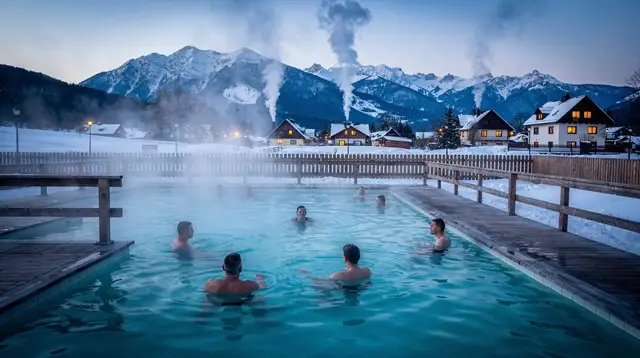
Most of the day trips sold out of Kraków still stop firmly on the Polish side — the shared minibus runs to the hot springs, like the Zakopane hot springs shared trip or the fuller full-day Zakopane and thermal baths tour, are genuinely good value and I’ve booked versions of them myself. But they’re also evidence of the pattern: the commercial itinerary rarely crosses the line, even when the mountains obviously do.
The obstacle is the plan, not the passport
Here’s my honest theory: nobody skips Slovakia because it’s hard to reach. They skip it because their itinerary was built around Zakopane as a destination in itself, and the Slovak side never made it onto the list of things to research. A rental car removes the question entirely — Poprad and Kežmarok sit close to both Tatranská Lomnica and Štrbské Pleso, and Orava castle makes a good detour on a longer loop — but even without a car, organised trips across the border exist, and a two-day version built for exactly this crossing is laid out in the Slovak side itinerary.
If you’d rather stay near the thermal water while someone else drives, the Zakopane thermal baths day trip is a fine Polish-side alternative — I just don’t think it should be the only shape a Tatras trip takes.
What I’d actually plan for
If I were building a first Zakopane trip now, I’d give the Slovak side one full day, not a rushed afternoon squeezed between two Polish stops. Ždiar and Bachledka in the morning, Tatranská Lomnica and the Lomnický štít cable car if the weather holds, Štrbské Pleso if it doesn’t and you want a calmer half-day instead. Here’s roughly how the two sides compare on the points that actually change a plan:
| Polish side | Slovak side | |
|---|---|---|
| Highest cable car point | Kasprowy Wierch, 1,987 m | Lomnický štít, 2,634 m |
| Flagship lake | Morskie Oko, 1,395 m, very crowded | Štrbské Pleso, 1,346 m, frozen ~155 days/year |
| Treetop walk | Murzasichle, near Poronin | Bachledka, at Ždiar, longer and step-free |
| Currency | Złoty (PLN) | Euro (EUR) |
| Border formality | None (Schengen) | None (Schengen) |
| Distance from Zakopane | — | 30–60 km |
None of this is an argument against the Polish side, which is why I still recommend a lot of it. It’s an argument against stopping at the ridgeline out of habit, when the range you came to see keeps going for another sixty kilometres and, on most days, gets quieter the further you go.
Frequently asked questions about crossing to the Slovak Tatras
Do I need my passport to cross into Slovakia from Zakopane?
You need a valid ID card or passport, but there is no border control. Poland and Slovakia are both in the Schengen area, so the crossing is an open road, not a checkpoint.
How far is the Slovak side of the Tatras from Zakopane?
The nearest Slovak towns, around Ždiar and the Bachledka treetop walk, are about 30 km from Zakopane. Tatranská Lomnica and Štrbské Pleso are closer to 60 km, still under an hour and a half by car.
Is Lomnický štít really higher than anything reachable by cable car in Poland?
Yes. The cable car from Tatranská Lomnica reaches 2,634 m on Lomnický štít, well above Kasprowy Wierch at 1,987 m, the highest point any cable car reaches on the Polish side.
Is Štrbské Pleso less crowded than Morskie Oko?
Both get busy in July and August, but Štrbské Pleso has road and rail access right to the shore, spreading visitors out, while Morskie Oko funnels everyone onto one 9 km paved track from a single reserved car park.
What currency do I need on the Slovak side?
Slovakia uses the euro, unlike Poland’s złoty. Carry some cash or a card that handles both currencies without heavy fees if you are combining both sides in one day.
Can I visit the Slovak Tatras as a day trip from Zakopane?
Yes, comfortably. Ždiar and Bachledka work as a half day, and Štrbské Pleso or Tatranská Lomnica as a full day, all without an overnight stay or any border formality.
Are the Slovak Tatras cheaper than the Polish side?
Often, yes, particularly outside the Slovak ski season. Polish prices spike hardest around Zakopane in the Christmas and February school-holiday weeks; Slovak resort towns generally hold steadier euro pricing.
Popular day trips
Verified deep-linked GetYourGuide tours. Book through these links and we earn a small commission at no cost to you.
GetYourGuide does not provide a product photo for this activity — the image shows the meeting point, photographed by us.