Zakopane and the Tatras: Wheelchair and Reduced Mobility Guide
Is Zakopane accessible for wheelchair users?
Only partially, and never by default. Zakopane town has some level pavement but also cobbles and slopes; the national park's trails are mountain paths with roots, stone and gradient, not built for wheels. The Kościeliska valley (paved, gentle) on the Polish side and the Bachledka treetop walk in Ždiar on the Slovak side are the two genuinely step-free options, and even those need checking for the day.
What “accessible” actually means here
Search for “Zakopane wheelchair accessible” and most of what comes back is reassurance: photogenic cable cars, gentle-sounding valley names, phrases like “suitable for all”. None of it is a lie exactly, but almost none of it is checked against the ground itself. Zakopane and the Tatra National Park sit in a real mountain range: the vast majority of marked trails are natural paths cut into rock, root and scree, built by foresters and shepherds long before accessibility was a design brief. A cable car can lift a wheelchair 1,000 vertical metres in twenty minutes and still leave you facing a summit of loose stone with no paved surface anywhere in sight.
This guide will not tell you the region is broadly accessible, because it is not. It will tell you, place by place, what has a genuine chance of working, what needs a support person or extra planning, and what to simply cross off the list. Anyone travelling with a wheelchair, a mobility scooter, a walking frame, or simply limited stamina on uneven ground should plan around specific, verified segments rather than trust a general impression of the destination.
Zakopane town: workable, not flat
The town itself is the most forgiving part of the trip, and still not uniformly easy. Krupówki, the pedestrian street at the centre of town, is paved and mostly level along its main run, which makes it the best base for a slower visit: cafés, the Tatra Museum, market stalls and a constant flow of foot traffic.
But side streets slope quickly toward the hills that frame the town, older buildings often have a step or two at the entrance, and Zakopane’s famous wooden villas were built in the 1890s with narrow doorways and internal stairs, not ramps. Newer hotels near the centre are more likely to have a lift and a level entrance; older guesthouses in traditional Zakopane-style buildings frequently are not, so confirm room and building access directly with any property before booking, rather than assuming from photos.
A private, paced visit of the town removes most of the guesswork, since a driver or guide who knows the terrain can route around the worst pavements and stop wherever the ground gets difficult. A private tour of Zakopane town built around your own pace is a more realistic way to see Krupówki, the old church and Pęksowy Brzyzek cemetery than joining a fixed group walk with no flexibility for slower ground.
The cable cars: the ride up is not the terrain at the top
Both of Zakopane’s mechanical lifts are genuinely built for mass tourism, and both can usually take a wheelchair as far as the cabin door with staff assistance. That is where the promise ends.
The Gubałówka funicular, from the top of Krupówki, is a short assisted ride, and the immediate viewing terrace at the summit has firm, largely level paving with panoramic benches — genuinely one of the easier viewpoints in this guide. Move past that terrace toward the ridge walk to Butorowy Wierch or the string of souvenir stalls further along, and the ground turns to packed earth, slopes and the occasional step.
The Kasprowy Wierch cable car, from Kuźnice, climbs to 1,987 m with a change of cabin at Myślenickie Turnie. The lower station has level access and the cabins can carry a wheelchair, but the summit itself is bare alpine rock and gravel, with the marked ridge trails toward Kondracka Kopa and Giewont running over uneven, sometimes steep ground with no paved surface at any point.
Treat a Kasprowy Wierch ticket as a view, not as an accessible walk once you are up there — and note that the base at Kuźnice is itself closed to private cars, reached on foot, by minibus, or from the Rondo Kuźnickie car park, each with its own short but uneven approach.
Inside the national park: check the surface, not the name
Every trail inside the Tatra National Park requires the standard entry ticket, wheelchair or not, and every trail is subject to the same rules — marked paths only, no exceptions for terrain difficulty. Within that, surfaces vary enormously.
The Kościeliska valley, entered at Kiry about 8 km west of town, is the strongest candidate on the Polish side: a wide forestry track, paved or firmly compacted for a long opening stretch, with almost no gradient.
It is the trail this site already recommends for prams and young children for the same reason it deserves attention here — see the Kościeliska valley family hike guide and the broader stroller-friendly trails guide for the exact sections that hold up best. It is not a certified accessible trail, surface quality can vary after rain or maintenance work, and the paving thins out the further you go toward the Ornak hut — so verify current conditions rather than assuming the whole 9 km is rollable.
Morskie Oko, the destination most visitors ask about first, does not hold up under scrutiny. The 9 km access road from the Palenica Białczańska car park is paved and gently graded, which sounds promising, but it climbs roughly 400 m over that distance with no built rest points, and the horse carriages that shorten the walk for other visitors are not equipped or licensed to carry a wheelchair and its occupant. Reaching the lake independently in a wheelchair is not realistic without a dedicated support team and equipment beyond what any standard visit involves; do not plan around it.
Giewont, the Five Lakes valley, and Rysy are conventional mountain hikes with climbing, chains or loose rock in their final stretches and belong nowhere near an accessibility plan. Rusinowa Polana and the lower section of the Chochołowska valley are gentler than most but still natural, unpaved ground — workable for some mobility aids on a dry day, not something to promise in advance.
The Slovak side: the one attraction actually built for this
The strongest recommendation in this entire guide sits across the border. The Bachledka treetop walk at Ždiar, Slovakia, about an hour’s drive from Zakopane through open Schengen border with no checks, is purpose-built: a 1,234 m ramped walkway through the forest canopy up to 24 m high, explicitly designed without steps. It is the only attraction named in this guide that was engineered for accessibility from the outset rather than adapted after the fact, and it is worth the drive on that basis alone.
Combine it with the nearby Štrbské Pleso lakeside promenade, which is largely flat and paved around its near shore, for a full accessible day on the Slovak side — a day trip covering the High Tatras treetop walk and Štrbské Pleso packages both stops with transport included, which removes the biggest practical obstacle: getting there.
Thermal baths: the most consistently accessible category
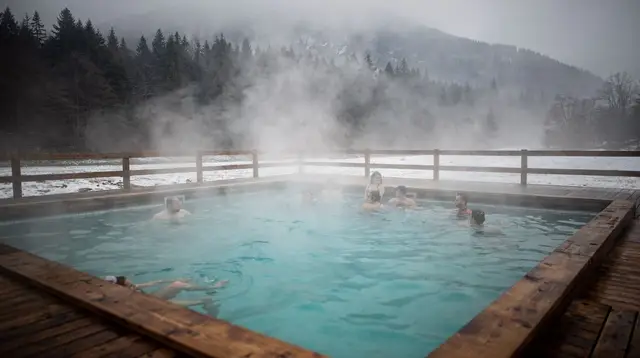
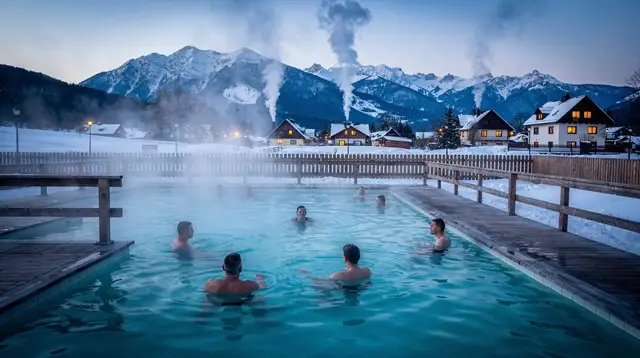
Of everything covered here, the thermal baths come closest to reliable accessibility, because commercial spa operators build for a broad range of mobility from the start. Termy Chochołowskie in Chochołów, the largest complex in Poland with around 30 pools, and Terma Bania in Białka Tatrzańska both maintain ramps, accessible changing facilities and, at some pools, hoists — though exactly which pools and which season varies, so confirm directly with the venue before a visit built around it.
A day trip to the Zakopane thermal baths from Kraków, or the combined thermal baths and cable car day trip, both include transport, which matters as much as the venue itself for anyone who cannot rely on the standard minibus network.
Getting around without a step at the door
This is where plans quietly fail. The shared minibuses that connect the town centre to Kuźnice, Kiry, Palenica Białczańska and the other trailheads are small private vans, filled and dispatched informally, with a step at the door and no ramp, lift or wheelchair space guaranteed on any given vehicle. They are the default transport for most visitors and unreliable for this one.
| Transport option | Wheelchair reality |
|---|---|
| Shared minibus to trailheads | Step at the door, no ramp, not dependable |
| Local taxi | Standard car, boot space for a folding chair, driver assistance varies |
| Private tour with driver | Vehicle and pace can be discussed in advance |
| Kasprowy / Gubałówka cabins | Staff-assisted boarding, cabin itself accessible |
| PKN Bus / regional coach to Kraków | Standard coach, limited built-in accessibility |
A private tour from Kraków with a chauffeur sidesteps the minibus problem entirely: the vehicle, the stops and the pace can all be agreed before the day starts, which is worth more here than almost any other single booking decision. If driving yourself, note that parking at Kuźnice is for permit holders only and the walk in from the nearest public car park is itself uneven ground.
What to do with this before you book anything
- Contact accommodation directly about lift, doorway width and step-free access — do not infer it from marketing photos of a wooden Zakopane-style building.
- Pick one or two targets rather than a long list: the Kościeliska valley opening stretch, Gubałówka’s summit terrace, Bachledka, and a thermal bath complex cover the realistic ground in this region.
- Treat every cable car or funicular as solving the ascent, never the terrain once you arrive.
- Book private transport for trailhead days; do not rely on the shared minibus network.
- Check TOPR contact details (985 or 112) before any outing beyond the paved sections — mountain rescue in Poland is free, but reaching a stranded visitor on rough terrain still takes far longer than it would on a road.
- Re-verify conditions close to your date: surfaces on natural trails change after storms or maintenance, and ramps or hoists at spa facilities can be out of service without notice.
None of this makes Zakopane and the Tatras an accessible destination in the way a flat coastal resort might be — and no honest guide would claim otherwise. It does mean that a handful of specific places, checked in advance rather than assumed, can genuinely work: a paved stretch of mountain valley, a canopy walkway engineered for exactly this purpose, a spa built with ramps from the start. Build the trip around those, and around transport you control, rather than around the destination’s general reputation.
Wheelchair and Mobility Access in Zakopane: Common Questions
Can a wheelchair user visit Zakopane at all?
Yes, but choose the target carefully. The town centre has stretches of level, paved ground around Krupówki and the newer hotels, though older pavements, cobbled sections and steps at some shops and guesthouses remain. Treat the town as workable with planning, not as flat by default.
Is the Kasprowy Wierch cable car wheelchair accessible?
The cable car cabin and the lower station at Kuźnice can usually take a wheelchair with assistance from PKL staff, but the terrain at the top, 1,987 m, is bare mountain rock and gravel with no paved paths. The ride up does not translate into an accessible summit walk.
Is the Gubałówka funicular accessible?
The funicular itself is a short, assisted ride from central Zakopane, and the immediate viewing terrace at the top has firm, fairly level ground. Once you leave that terrace for the ridge walk or the stalls further along, the surface turns to packed earth and slopes.
What is the most wheelchair-friendly trail in the Tatra National Park?
The Kościeliska valley, entered at Kiry, is the closest thing to a step-free trail on the Polish side: a wide, largely paved forestry track with very little gradient for its first several kilometres. It is not certified accessible and can have loose gravel patches, so verify current conditions before committing to it.
Is Morskie Oko reachable by wheelchair?
Not realistically. The 9 km road to the lake is paved but climbs about 400 m, has no barrier-free rest points built for wheelchairs, and the horse carriages that shorten the walk for other visitors are not designed to carry a wheelchair or its user. Treat Morskie Oko as inaccessible without a support team and specialised equipment.
What is the best accessible attraction near Zakopane?
Across the border, the Bachledka treetop walk in Ždiar, Slovakia, is purpose-built and explicitly step-free, with a ramped walkway through the forest canopy. It is about an hour’s drive from Zakopane and is the single attraction in this guide that was designed with wheelchair access in mind from the start.
Are the thermal baths near Zakopane accessible?
Several, including Termy Chochołowskie and Terma Bania, have ramps, accessible changing rooms and pool hoists at some pools, which puts them ahead of most hiking terrain. Facilities vary by pool and by year, so confirm directly with the venue before travelling.
Should a wheelchair user rely on the local minibuses?
No. The shared minibuses that serve Kuźnice, Kiry and the other trailheads are small private vans with a step at the door and no ramp or lift, run on a fill-and-go basis with no accessible vehicle guaranteed. A private car, taxi or a tour with a chauffeur is the reliable alternative.
Cable cars and thermal baths
Verified deep-linked GetYourGuide tours. Book through these links and we earn a small commission at no cost to you.
GetYourGuide does not provide a product photo for this activity — the image shows the meeting point, photographed by us.