Train, Bus, or Car to Zakopane: What the Zakopianka Really Costs You
I have made the trip from Krakow to Zakopane more times than I can count now, by all three methods, and I still don’t think there is a clean winner. What I do think, after enough Friday evenings stuck in a line of brake lights below Nowy Targ, is that most people ask the wrong question. They ask “which is fastest,” compare the numbers on a timetable, and pick accordingly. The number that actually matters is not printed anywhere: it is whether you are travelling on the Zakopianka at the wrong hour.
Why the road is the variable that decides everything
There is essentially one road between Krakow and Zakopane: the DK47, universally called the Zakopianka. Every car, every tour coach, every bus, and a fair share of trucks funnel onto it south of Rabka-Zdrój, and it narrows to a single lane each way through several towns. On an ordinary Tuesday morning, the drive takes about ninety minutes.
On a Friday evening in July, or a Sunday afternoon when half of southern Poland is driving home from the mountains, or the first snowy weekend of the season, that same drive can take three hours, sometimes more. I have sat in that queue with nothing moving for twenty minutes at a stretch, watching the fuel gauge do nothing useful. This is not a rare event. It happens on a predictable rhythm, every single week in season, and almost nobody warns you about it before you rent a car.
The train: comfortable, a little slower, never stuck
PKP Intercity runs direct trains from Krakow to Zakopane, and the journey takes anywhere from two to three and a half hours depending on the service — some run nearly direct, others stop more. It is the one option genuinely immune to the Zakopianka’s mood, because the tracks don’t share the road. I like the train for the legroom and the fact that I can work, read, or just watch the Tatras come into view without needing to pay attention to anything. The trade-off is frequency: there are far fewer departures than buses, so you plan around the timetable rather than turning up and going.
The bus: the workhorse, and usually the right default
Buses are where the real flexibility is. More than fifty departures leave Krakow for Zakopane every day, run by several operators, and the trip takes two to two and a half hours under normal conditions. If one bus is full or the timing is wrong, another leaves within the hour. For a first visit, or for anyone who doesn’t want to think too hard about logistics, this is what I recommend by default. It is also, unlike the car, indifferent to whether you can parallel park or navigate a foreign motorway — you sit down and the driver deals with the Zakopianka, not you.
The car: fastest in theory, worst-case slowest in practice
A rental car wins on paper. Ninety minutes outside peak hours beats both the train and the bus comfortably, and it gives you the freedom to detour to Wadowice or Ojców on the way, or to leave Zakopane on your own schedule rather than a coach company’s. But that freedom comes with the one liability nothing else has: the Zakopianka’s traffic is not an edge case, it’s the normal case on a Friday, a Sunday, a public holiday, or the first proper snowfall. I have friends who drove down on a Friday afternoon expecting ninety minutes and arrived closer to four hours later, exhausted, having eaten nothing since Krakow because there was nowhere sensible to stop in a standstill queue.
What a car actually buys you once you’re there
Here is the part that changes the calculation for most travellers: even if you drive down, the car mostly stops being useful the moment you arrive. Kuźnice, the base of the cable car to Kasprowy Wierch and the starting point for Giewont, is closed to private vehicles entirely — you park at Rondo Kuźnickie and walk, or take a minibus. The road to Morskie Oko’s car park at Palenica Białczańska requires an online reservation days in advance in summer, and no car goes beyond that car park regardless.
What actually gets you around once you’re in Zakopane is the dense network of private minibuses to the valleys and Kuźnice — busy, a little chaotic, genuinely everywhere — running constantly from the town centre to every trailhead and to the thermal baths in Szaflary, Chochołów, and Białka Tatrzańska. I’ve used them for years and never once needed a car to reach a trail.
So the real question isn’t “which is fastest to Zakopane.” It’s “do I need a car once I’m there,” and for the overwhelming majority of stays — whether that’s a weekend or a longer week — the honest answer is no. A car earns its keep if you’re combining Zakopane with a wider road trip through southern Poland, or if you specifically want to reach somewhere the minibuses don’t go conveniently, like a quieter Pieniny village. For a first visit built around the classic sights, it’s dead weight you pay to park and worry about.
What I actually do now
These days I take the bus unless I’m arriving from Krakow’s airport on an awkward schedule, in which case a direct transfer or the train fits the arrival time better. If I’m doing a rushed one-day trip from Krakow, I book an organized day tour that includes transport, which sidesteps the whole question — the coach driver has seen the Zakopianka every day for years and knows when to leave.
A day like the From Krakow: Morskie Oko and Zakopane day trip handles the road entirely, which matters more than people think when the alternative is losing two extra hours each way to traffic you didn’t plan for.
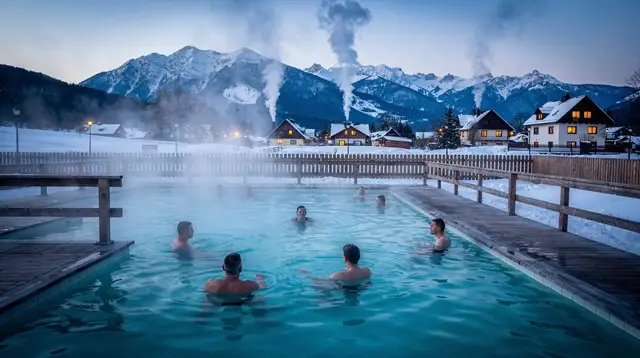
If the trip includes the thermal baths rather than the high peaks, the same logic applies. A Zakopane hot springs day tour from Krakow, or a full day Zakopane and thermal baths tour, removes the Zakopianka question from your day completely — you show up at the pickup point and someone else absorbs the traffic risk. It’s a small thing, but on the wrong Friday it’s the difference between an evening soak and three hours of staring at the car ahead of you.
Whatever you choose, keep a buffer. Never book the last bus or train back to Krakow if your plans could slip, and never plan a tight airport connection around a Sunday-afternoon drive down the Zakopianka. Build in the same slack the locals do, and the transport choice stops being stressful and just becomes a detail — which, once you’re actually here among the peaks, is exactly what it should be.
For the finer breakdown of prices and exact schedules, the dedicated Krakow to Zakopane transport guide is worth reading before you book, and if the złoty side of the trip is still unclear, the Zakopane budget guide covers what transport actually costs against everything else.
Questions about choosing between train, bus, and car
Is the train or the bus faster from Krakow to Zakopane?
The bus is usually a little faster in practice, at two to two and a half hours against the train’s two to three and a half hours, mostly because there are more direct services. Both are unaffected by road traffic, which the car is not.
Why does the drive from Krakow to Zakopane sometimes take twice as long?
The entire route funnels onto a single road, the Zakopianka, which narrows through several towns. On Friday evenings, Sunday afternoons, public holidays, and the first snowy weekends, traffic backs up for kilometres and a ninety-minute drive can stretch past three hours.
Do I need a rental car once I’m in Zakopane?
For most stays, no. Kuźnice is closed to private cars, Morskie Oko’s car park requires an advance online reservation and sits well short of the lake, and a dense network of minibuses reaches every trailhead and thermal bath from the town centre.
What’s the cheapest way to get from Krakow to Zakopane?
The bus is generally the cheapest option, helped by heavy competition between operators and frequent departures. The train costs a bit more depending on the class of service, and a rental car adds fuel, tolls, and parking on top of the rental fee itself.
Is there a direct transfer from Krakow Airport to Zakopane?
Yes, direct airport transfers and buses run from Krakow Airport (KRK) to Zakopane, typically taking around two to two and three-quarter hours. This avoids a transfer into central Krakow first.
When should I avoid driving the Zakopianka entirely?
Avoid Friday afternoons and evenings, Sunday afternoons, the days around Polish public holidays, and the first heavy snowfall of the season. These are the windows when the ninety-minute drive most reliably turns into three hours or more.
Can I book a day trip that avoids worrying about the Zakopianka?
Yes — an organized day tour from Krakow includes transport with an experienced driver who times the road accordingly, which removes the guesswork for a single-day visit to Zakopane, Morskie Oko, or the thermal baths.
Top-rated experiences
Verified deep-linked GetYourGuide tours. Book through these links and we earn a small commission at no cost to you.
GetYourGuide does not provide a product photo for this activity — the image shows the meeting point, photographed by us.