The Halny Wind That Closes the Cable Car
The morning I learned what “halny” means
I had a ticket for the first cabin up to Kasprowy Wierch, booked nine days earlier because that is how far ahead you have to plan in high season. I had a window of good light, a full day free, and a printed confirmation. What I did not have, standing at the base station in Kuźnice, was a moving cable car. A member of staff pointed at a small paper notice taped to the ticket window: wind speeds on the ridge were too high, the cars were suspended, and nobody could say when they would restart. Someone next to me, a local from Poronin waiting for a delivery, said one word before I even asked: “halny.”
That was my introduction to the wind that runs this valley’s plans, not the timetable.
What the halny actually is
The halny is a warm, dry föhn wind. Moist air is forced up the southern side of the Tatras from the Slovak side, drops its moisture as it climbs, then comes down the northern slopes toward Zakopane and Podhale as a warm, fast, turbulent gust. It is not a storm front you can see coming on a weather app the way you can see rain. It can arrive in winter or in the middle of August, on a day that started clear, and it can hit gusts strong enough to bring down trees, rip off roof tiles, and, for a visitor, ground the one cable car everyone came to ride.
Locals track it by more than the forecast. There is a lens-shaped cloud that sometimes caps the peaks before a halny arrives, a stillness in the town that people mention, and a folk tradition going back generations in the Podhale that the wind affects sleep and temper before it affects the trees — headaches, short fuses, restless nights, all blamed on “przed halnym,” the hours before it hits. I am not going to tell you that’s meteorology. But I will tell you that everyone in Zakopane treats the halny as a fact of daily life, not a myth for tourists, and that the one thing about it that is entirely measurable is wind speed on an exposed ridge at 1,987 m.
Why this matters more than any other weather here
Most of what closes attractions around Zakopane is predictable: the Kościeliska and Chochołowska valleys are open all year, Morskie Oko is a walk you can reschedule, and thermal baths do not care about wind at all. Kasprowy Wierch is different.
It is a cable car climbing nearly 1,000 vertical metres to an exposed alpine ridge, and PKL stops the cabins the moment gusts pass a safety threshold, at any season, with no obligation to warn ticket holders days in advance. It happened to me on a booking made more than a week out. It has happened to travellers with same-day tickets. There is no pattern you can book around, because the halny itself does not follow a seasonal calendar the way snow or thunderstorms do.
The practical consequence for a visitor is specific: a dated, timed ticket for Kasprowy Wierch, bought in advance because that’s the only way to get one in season, can simply not happen. Refunds and rebooking exist, but they do not give you back the day you built around that summit.
What actually happens to a ticket when it hits
If gusts close the cable car before you ride, PKL’s own line and the ticket office handle refunds or a rebooking for another slot — but “another slot” assumes there is space left in your remaining days, which in July and August there often is not. If the wind rises after you’re already on top, the descent can be delayed rather than the ascent blocked, which means a longer wait at altitude with no shelter beyond the summit station. Neither situation is dangerous with a bit of patience, and TOPR does not get involved in a cable car closure — but neither situation gets you the ride you paid for on the day you paid for it.
I now treat “halny risk” the same way I’d treat “this trail could be closed for snow”: a real possibility, not a remote one, on any Kasprowy day in any month.
How I’d build the day differently now
The lesson from that morning was not to skip Kasprowy Wierch. The lesson was to stop treating it as the single anchor of an entire day. Now, when I plan a Tatras day around the cable car, I build in an alternative that doesn’t depend on the ridge being calm: the Gubałówka funicular is far lower, far more sheltered, and rarely affected the same way, and it still delivers the panorama of the whole Tatra chain. A short comparison of the two, covered in this Kasprowy versus Gubałówka guide, is worth reading before you commit a whole morning to either.
Guided half-day trips give you a version of that flexibility built in. A tour like the Zakopane cable car and Tatra Mountains scenic tour or the Zakopane Tatra Mountains tour with hotel pickup is led by a guide who checks conditions before departure and can shift the plan on the day, which is a real advantage over a solo booking made a week ahead with no local eyes on the wind.
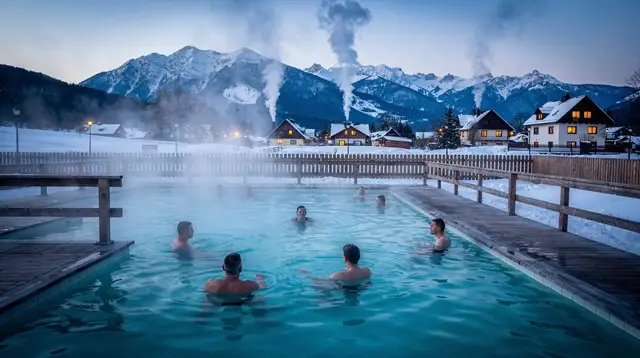
If you’d rather build a day that doesn’t collapse even if Kasprowy is closed outright, pair the cable car with something wind-proof. A combined trip such as the Zakopane thermal baths and cable car day still gives you a full day in Podhale even if the ridge stays shut — the baths don’t care about the weather at all.
Beyond the day itself, a few habits help. Check the forecast the evening before and the morning of, not just when you booked. Don’t schedule Kasprowy for your only full day in the mountains if you can help it — give yourself at least a two-day window, as laid out in this first-timer’s guide to how many days you need and in a two-day weekend itinerary that already has slack built in. And read the seasonal ticket-booking guide so you understand how rebooking actually works before you’re standing at a closed gate wondering.
None of this is about avoiding the mountain. It’s about not putting all of a short trip’s hope on one ridge and one wind you cannot see coming. For the wider seasonal picture — what closes when, and why — the month-by-month weather guide and the common mistakes guide are worth the ten minutes before you book anything at all. And if wind isn’t your worry but afternoon storms are, the summer thunderstorm guide covers that separate, more seasonal risk, while general trail safety sits in the TOPR mountain safety guide.
I did eventually ride Kasprowy Wierch — two days later, on a still, clear morning with none of the drama. The view was worth the wait. What I remember more, though, is standing at that base station with a useless ticket, and realising that the wind that shapes daily life in this valley had just shaped mine.
Questions about the halny wind and the Kasprowy cable car
What exactly is the halny wind?
It’s a warm, dry föhn wind that forms when air crosses the Tatras from the south, loses its moisture climbing the Slovak side, and descends the northern slopes toward Zakopane as a fast, gusty, warming wind. It can happen in any season.
Can the halny be predicted in advance?
Not reliably days out. Forecasters can flag rising risk a day or so ahead, and locals watch for signs like lens-shaped clouds over the peaks, but a booking made a week or more in advance carries real uncertainty regardless of what the forecast showed on the day you paid.
Does the halny only affect the Kasprowy Wierch cable car?
It’s the attraction most exposed to it, since the ride climbs to an open alpine ridge at nearly 2,000 m. Other high, exposed activities — ridge hikes toward Giewont, for instance — face the same wind risk, while valley walks, funiculars at lower elevation, and thermal baths are largely unaffected.
What happens to my ticket if the cable car closes for wind?
PKL offers a refund or rebooking for another available slot. The catch is availability: in peak season, a closure can leave no open slots in your remaining days, so a refund is often the realistic outcome rather than a same-trip reschedule.
Is the halny dangerous to be out in?
It’s disruptive rather than typically life-threatening for a visitor staying off exposed ridges — strong enough to down trees and close lifts, but not comparable to a lightning storm on a summit. Staying off high, open terrain when strong winds are forecast is the sensible precaution.
Is the folklore about the halny affecting mood and sleep real?
It’s a long-standing local belief in the Podhale region, not a scientific claim this guide makes. What is well documented and relevant to a visitor is the wind’s physical strength, which is what actually grounds the cable car.
How should I plan a Tatras day around this risk?
Avoid making Kasprowy Wierch the single anchor of your only full day, check the forecast the morning of your visit rather than only when you booked, and have a low-elevation backup such as the Gubałówka funicular or the thermal baths ready to shift to.
Does the halny affect Morskie Oko or the valley walks too?
Those routes sit lower and in more sheltered terrain, so they’re far less likely to close for wind. The bigger planning factor there is the reserved car park and daily visitor numbers, not the halny.
tours.Explainer
Verified deep-linked GetYourGuide tours. Book through these links and we earn a small commission at no cost to you.
GetYourGuide does not provide a product photo for this activity — the image shows the meeting point, photographed by us.