Snowmobile Tours Around Zakopane
Where do snowmobile tours around Zakopane actually take place?
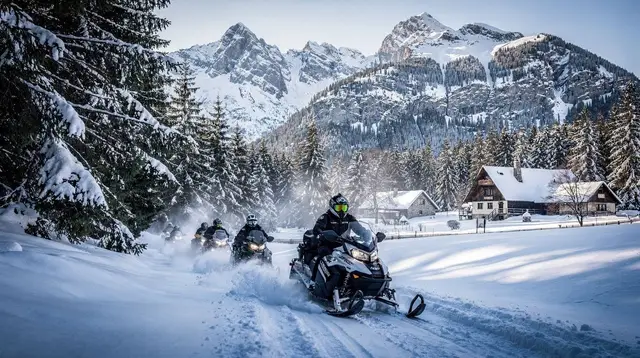
They run in the Podhale valleys around Zakopane, not inside the protected core of Tatra National Park, where only marked walking trails are allowed and motorised traffic is banned. Expect open farmland, forest tracks and village lanes rather than the high peaks.
The terrain a snowmobile tour actually crosses
Picture the map before picturing the ride. Zakopane sits at 830 to about 1,000 m above sea level, in a valley closed to the south by the Tatra ridge. It is a mountain town, not a mountain resort in the Alpine sense: there is no glacier here, no sea, and no single ski-in-ski-out slope running through the centre. What surrounds the town instead is a patchwork of farmland, forest, and small Podhale villages climbing gently toward the peaks — Kościelisko, Chochołów, Poronin and Murzasichle among them. That patchwork, not the high mountains, is where a snowmobile tour actually happens.
That distinction matters because the two landscapes are governed completely differently. Tatra National Park (TPN), 211.6 km² and formally established in 1954, restricts every visitor to marked walking trails, requires an entry ticket even for a valley walk, and bans dogs and drones outright. There is no exception in the rules for motorised traffic off the park’s own service tracks — a snowmobile has no more business on a TPN hiking trail than a car does.
So when an operator advertises a snowmobile route around Zakopane, that route runs through the Podhale — open fields, forest tracks, farm lanes, sometimes along the edge of a village — never up toward Kasprowy Wierch, Giewont, or the lakes inside the park boundary. If a walk through the protected core is what you actually want, that belongs to a different kind of day; the snowmobile belongs to the valleys around it.
A half-day out on snowmobiles is one of the more direct ways to feel that landscape move past you in winter, and it pairs naturally with the Kraków-based combination of buggy, quad and snowmobile options run around Zakopane, or with an outing built specifically around the snowmobile expedition with an optional bonfire stop that several Zakopane operators run through the season.
A winter that runs roughly December to March
Snow at valley level around Zakopane is a winter-season phenomenon, not a year-round guarantee. The town’s winter season runs roughly from December through March, and that window is when snowmobile operators actually run tours — outside it, valley snow cover is unreliable enough that it is not worth planning around.
The picture gets more complicated at altitude: residual snow can linger above about 1,500 m well into May and even June some years, long after Zakopane’s own streets have gone bare. That higher snow belongs to the high Tatras and to skiers on Kasprowy Wierch, not to a valley-based snowmobile route, which depends on what has actually fallen at 800–1,000 m, not on what is still sitting on a distant ridge.
This is also why nobody honest gives a fixed snowmobile itinerary months in advance: the terrain and the line an operator can safely run shift with the actual snowpack that particular week. Check the month-by-month weather guide before booking a winter trip, and treat any specific route or duration you read online — including this page — as provisional until the operator confirms it against current conditions.
What the cold on a moving vehicle really demands
Zakopane’s winter cold is a genuine Central European cold, not an alpine-resort cold softened by lift queues and heated gondolas. Riding a snowmobile adds wind chill on top of whatever the thermometer already reads, and that combination is the detail visitors from milder countries most often get wrong. A jacket that felt like plenty on Krupówki at midday can feel thin once you are moving at speed across open, unsheltered fields in the afternoon.
The basics that matter: a genuinely windproof and waterproof outer shell, insulated mid-layers underneath rather than a single thick coat, a hat or balaclava that covers the ears under the helmet, glove liners under whatever gloves are provided, and waterproof boots with room for a thick sock. Operators typically supply the helmet, and often a snowmobile suit over your own clothes — but “often” is not “always,” and it is worth confirming exactly what is included before you show up in trainers. Anyone travelling with children or riding pillion behind a guide should dress just as warmly as the driver; a passenger generates less body heat than someone actively steering.
If the cold-weather planning feels like a lot to think through, a snowmobile outing paired with a sleigh ride and a stop at the thermal pools solves part of the problem by building in a warm, water-based finish to a cold start — a format worth comparing against a traditional horse-drawn kulig sleigh ride if open-vehicle cold is a genuine concern for anyone in the group.
The wind that can rewrite the day: the halny
Poland’s Tatra region has one weather phenomenon that visitors rarely hear about until it happens to them: the halny, a warm föhn wind that blows down off the mountains from the south and can occur at any time of year, including deep winter. It is strong enough to close the Kasprowy Wierch cable car outright, and it is exactly the kind of unpredictable, locally specific weather that can force an operator to shorten, reroute, or postpone an outdoor activity — snowmobiling included.
There is no forecasting the halny weeks in advance from abroad; it is a day-of, sometimes hour-of, judgment call made by people who watch the mountains for a living. The practical takeaway is not to fear it, but to build a day around a tour rather than a tour around a single fixed hour, and to expect operators to reschedule rather than run a route they judge unsafe.
Time zone, currency, and who to call
A few operational facts are easy to get wrong from outside Poland and worth having straight before a winter trip. Zakopane runs on Central European Time — UTC+1 in winter, UTC+2 in summer — the same clock as Paris, Berlin, and Rome, so no time-zone adjustment is needed coming from most of Western Europe. Poland’s currency is the złoty (PLN); the country is not in the eurozone, and while cards are accepted almost everywhere in town, it is worth confirming payment method directly with a tour operator, particularly for a deposit paid at a meeting point rather than online.
For anything that goes wrong in the wider Tatra area — a fall, an injury, someone lost or stranded — the number to know is TOPR, the Tatra Volunteer Mountain Rescue service founded in 1909: 985, or +48 601 100 300, or the general European emergency number 112. Rescue in Poland, including by helicopter, is free of charge. That applies to hikers and skiers as much as to anyone on a guided snowmobile route, and it is worth having the number saved before you go, not looked up afterward. For a broader sense of how mountain safety works in this region, the TOPR and mountain-safety guide is the place to start.
Who a snowmobile tour suits
A snowmobile outing suits travellers who want to feel real winter terrain quickly, without committing to a full day of hiking gear and marked trails, and who are comfortable with cold, noise, and a guided pace rather than a solitary wander. It suits families loosely, provided younger children ride as passengers with an adult and are dressed for genuine cold rather than a quick errand outside.
It does not suit anyone hoping to see the high peaks up close — that experience belongs to the Kuźnice–Kasprowy Wierch cable car or a marked trail inside the park, not to a valley route — and it does not suit anyone with a strict, non-negotiable schedule, since weather and snow cover can shift what an operator is willing to run on a given day.
Anyone weighing a snowmobile day against the alternatives in the Podhale has a genuine choice to make. A quad bike adventure around Zakopane runs the same kind of Podhale terrain but without snow as a prerequisite, which makes it a useful fallback in a thin-snow week or outside the winter season altogether — the ATV seasonal conditions guide lays out when quads make more sense than snowmobiles.
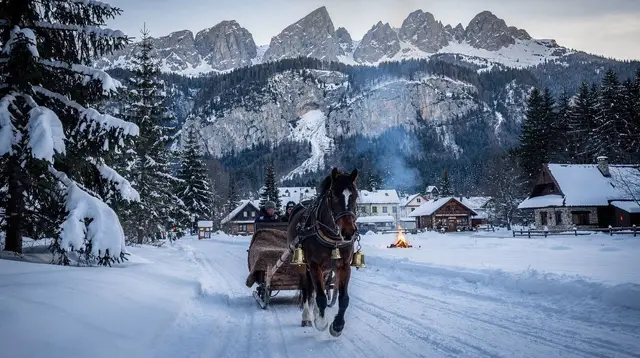
A horse-drawn kulig sleigh, by contrast, trades speed and noise for a slower, more traditional Podhale experience, worth reading up on in the sleigh ride versus horse carriage comparison if quiet matters more than pace. And for a first trip to the region generally, it is worth reading how to get from Kraków to Zakopane and driving conditions on the Zakopianka in winter before deciding whether to base a snowmobile day around a Kraków day trip or a longer stay in town.
What this page will not promise
This guide deliberately does not name a specific route, a fixed duration, or a set price for a snowmobile tour, because none of those are fixed facts about the region — they are commercial details that change by operator, by season, and by how much snow is actually on the ground that week.
What is fixed is the geography: tours run in the Podhale valleys, not inside the national park; the season is roughly December to March at valley level, with residual snow lingering much higher into late spring; the halny can disrupt plans at any time of year; payment runs in złoty, not euros; and TOPR (985 / +48 601 100 300 / 112) is the number to know if anything goes wrong in the wider mountain area. Confirm the specifics — route, length, price, what’s included — directly with whichever operator and tour you book, including the options linked on this page, since those details are exactly the part that shifts week to week.
Before locking in a winter date, it is also worth checking how snowmobiling fits around the rest of a Zakopane itinerary: whether Morskie Oko, Kasprowy Wierch, or a TPN entry ticket need advance booking for the same trip, and how the Podhale minibus network gets you to a snowmobile meeting point if you are travelling without a car. None of that changes what a snowmobile tour itself involves — cold valley terrain, real winter gear, and a route that stays outside the protected park — but it changes how comfortably the rest of the day fits around it.
Snowmobile Tours Around Zakopane: Frequently Asked Questions
Can a snowmobile tour enter Tatra National Park?
No. The park restricts movement to marked walking trails and bans motorised vehicles off public roads, along with dogs and drones. Snowmobile routes stay in the Podhale valleys outside the park boundary.
When is snowmobile season around Zakopane?
The snowy winter runs roughly December to March, which is when operators run these tours. Snow at valley level is not guaranteed at either end of that window, and conditions shift year to year, so a specific outing depends on what has actually fallen.
What should I wear for a snowmobile tour?
Real winter layers built for wind chill on a moving vehicle: a windproof and waterproof outer shell, insulated layers underneath, a hat that covers the ears under the helmet, glove liners, and waterproof boots. Operators generally supply the helmet and often a snowmobile suit, but check before you go.
Is a snowmobile tour dangerous?
It carries real risk — cold injury, collision, and terrain hazards among them — which is why briefings, helmets and marked routes matter. If something does go wrong in the wider Tatra area, TOPR mountain rescue (985 or +48 601 100 300, or 112) responds and rescue in Poland is free of charge.
Does a storm or warm wind cancel a snowmobile tour?
It can. The halny, a warm south wind, can blow at any time of year, and it is exactly the kind of weather that disrupts outdoor activity around Zakopane. Heavy fresh snowfall or icing can equally change or postpone a route.
Do I need experience to ride a snowmobile?
Tours built for visitors are generally guided, with a briefing beforehand, and most welcome first-timers. Passenger seats behind a guide or a two-up sled are common for anyone who would rather not drive.
Is Zakopane cold enough in winter to need this gear seriously?
Zakopane sits at 830 to about 1,000 m, and the surrounding valleys hold snow through a real Central European winter. Moving on an open vehicle adds wind chill on top of the air temperature, which is the detail visitors from milder climates most often underestimate.
Do snowmobile tours take euros?
No. Poland uses the złoty (PLN); it is not in the eurozone. Cards are widely accepted, but it is worth confirming payment method with the operator, especially for a deposit or a meeting-point transaction.
Winter adventures
Verified deep-linked GetYourGuide tours. Book through these links and we earn a small commission at no cost to you.
GetYourGuide does not provide a product photo for this activity — the image shows the meeting point, photographed by us.