Snowmobile Excursions in the Podhale Valleys
Should I book a day or evening snowmobile excursion in the Podhale valleys?
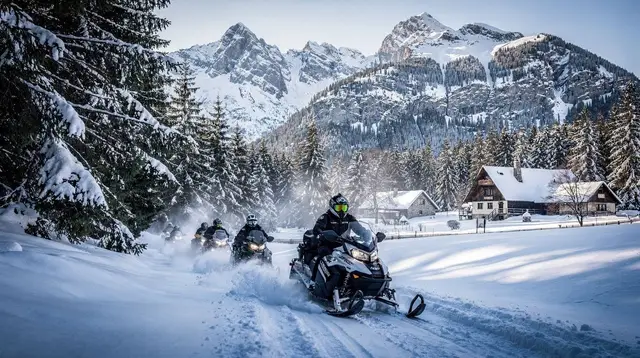
Both run on the flatter valley terrain around Bukowina Tatrzańska, outside the national park: daytime rides can show the high peaks such as Kasprowy Wierch and Giewont on a clear day, while evening rides go out under the night sky. The choice comes down to light, cold and whether you want to drive after dark, and any excursion can be suspended at short notice if the halny wind picks up.
Two Ways to Ride the Podhale Valleys
Anyone searching for a snowmobile excursion around Zakopane runs into the same fork almost immediately: book a daytime slot, or book one in the evening. The two are genuinely different outings, not just the same ride at a different hour, and the right pick depends on what you came for — a view of the mountains that close the horizon, or a quieter run through a dark, snow-covered valley with the engine noise and the headlight beam doing most of the work.
This guide sticks to what actually varies between the two formats: light, temperature, what you can expect to see, and the conditions that can interrupt either one. It does not repeat the marketing language of any specific tour, and it deliberately leaves out things like age limits, insurance terms and prices — those change by operator and by season, and the booking page is the only place they are current.
Where These Excursions Actually Run
Snowmobile excursions in this region operate in the Podhale, the belt of villages and valleys that lies below the high Tatras, not inside them. Bukowina Tatrzańska sits close to the centre of that belt: gentler, more open terrain than the steep-sided valleys of Tatra National Park, which is exactly why it suits engines with tracks rather than skis or boots. Motorised vehicles are not permitted on the marked trails inside the park, so a snowmobile route by definition stays outside its boundary, threading between fields, forest edges and farm tracks instead of climbing toward the ridgeline.
That geography also explains what you will and will not see. You are not riding up toward Kuźnice or the Kasprowy Wierch cable car base; you are riding across the lower, rolling ground that surrounds villages like Bukowina Tatrzańska, Białka Tatrzańska and Poronin. The high peaks appear as a backdrop on the horizon when the sky cooperates, not as terrain you pass through.
Day or Evening: What Changes
The daytime option
A daytime excursion runs in natural light, which is the main thing it has going for it. On a clear winter day, the route can open up views toward the ridgeline that includes Kasprowy Wierch (1,987 m) and Giewont (1,894 m) — the same skyline that dominates photographs of Zakopane itself, seen here from a distance rather than from the town’s main street. Daylight also makes it easier to read the trail surface: ice patches, ruts and drifted snow show up more clearly than they do under a headlight. The trade-off is that daytime slots sit inside a shorter winter day — sunset comes early, roughly mid-afternoon in December and January — so a daytime booking is usually a morning or early-afternoon one.
Riders who also want a broader look at the terrain sometimes pair a daytime snowmobile route with a guided alternative on wheels rather than tracks: a guided quad bike and buggy route through the same valley network, useful context for comparing what each vehicle type actually lets you see, since quads and buggies are not restricted to snow-covered months the way a snowmobile route effectively is.
The evening option
An evening excursion trades the mountain view for something else: a dark, quiet valley, the sound of the engine against otherwise still surroundings, and — on a clear night with little light pollution — a sky genuinely dark enough to show stars that a resort town like Zakopane’s own Krupówki street never will.
Cold deepens after sunset, so an evening ride generally means colder air than the same route at midday, even without accounting for wind chill from the machine’s own speed. Some evening formats build in a stop that daytime slots don’t, such as a ride that finishes with time in a heated thermal pool, which is a practical way to end a cold outing rather than heading straight back to a car.
Neither format is inherently the “real” or “better” version of a Podhale snowmobile excursion — they simply answer different questions about what you want from the hour or two on the machine.
Dressing for a Polish Winter on a Snowmobile
Podhale winters are genuinely cold, and moving at speed on an open vehicle adds wind chill on top of whatever the thermometer says. Ground snow is common from December through March most years, and temperatures at night can sit well below freezing even when daytime highs look manageable. Our month-by-month weather guide covers the wider seasonal pattern; for the snowmobile itself, the practical list is simple:
- A windproof, waterproof outer shell — jacket and trousers or salopettes, not a regular coat.
- A warm mid layer (fleece or synthetic insulation) and a moisture-wicking base layer, not cotton.
- A neck gaiter or balaclava, since the ride generates its own wind on top of the ambient cold.
- Insulated, waterproof gloves — thin gloves are not enough at speed in winter air.
- Thick socks and genuinely waterproof winter boots; wet feet end an evening fast.
- Goggles or wraparound eyewear if the operator does not supply them, to cut wind and glare.
Operators typically provide a helmet and sometimes an outer suit, but base layers, gloves and boots are usually the rider’s own responsibility — confirm what is included when you book, since this is exactly the kind of detail that varies by provider rather than being fixed across the region.
The Halny Wind and Other Reasons a Ride Gets Cancelled
The single most important weather fact to know before booking any outdoor activity around Zakopane is the halny: a warm, gusty föhn wind that drops down off the mountains and can arrive in any season, not just winter. It is strong enough to close the Kasprowy Wierch cable car and disrupt flights and road traffic, and the same gusts make an open-air snowmobile excursion a reasonable thing for an operator to postpone. Our explainer on the wind that closes the cable car covers how it behaves and why forecasts alone don’t always catch it in time.
Beyond the halny, the other realistic reasons a scheduled excursion changes on the day are the ordinary ones: heavy fresh snowfall that hasn’t been groomed yet, ice on exposed sections, very low visibility, or simply not enough snow cover if a warm spell has stripped the ground bare — which can happen even in the core December-to-March window. None of this means you should avoid booking; it means confirming with the operator on the morning of the excursion rather than assuming the forecast from a few days out still holds. If you’re driving yourself to the meeting point, our guide to driving to Zakopane and dealing with snow on the Zakopianka is worth reading the night before.
Safety and Emergency Contacts
Snowmobile excursions in the Podhale are guided and run on set routes, which keeps the risk profile well below that of unsupervised mountain travel — but cold-weather machinery on variable snow still carries real risk, and it is worth knowing who to call before you need to. Mountain and outdoor rescue in this part of Poland is coordinated by TOPR (Tatrzańskie Ochotnicze Pogotowie Ratunkowe), reachable on 985 or +48 601 100 300; the general European emergency number 112 also works and will route you to the right service.
Rescue operations in Poland, including by helicopter, are provided free of charge. Outside the immediate Tatra district, the equivalent volunteer rescue service is GOPR, using the same numbers. Our fuller Tatra mountain safety guide goes into more detail on how TOPR operates and when to call.
Combining a Snowmobile Excursion With Other Podhale Activities
Because these routes run outside the national park in villages that also host other winter attractions, a snowmobile excursion often sits well alongside a second activity on the same day rather than standing alone. The most common pairing is a thermal bath session afterward — Bukowina Tatrzańska has its own Terma Bukovina complex, and our broader comparison of the region’s thermal baths covers how it stacks up against Termy Chochołowskie and Terma Bania if you’d rather choose based on pool size or distance from your base.
Some tour formats build a fuller day around the ride itself, adding a treetop walk or a second adventure activity before finishing at the baths — for example a combined day that pairs a ride with a treetop skywalk and a soak in the thermal pools, which suits travellers who want to fill a single winter day rather than treat the snowmobile excursion as a standalone booking. If you’d rather stay on snow and treetops without the thermal stop, the same operators typically also sell a shorter format that pairs the ride with a nearby treetop walk instead.
Travellers building a full winter itinerary around Zakopane, rather than a single activity, may find it easier to plan against our three-day winter itinerary, which sequences an outdoor day like this one against the town’s other winter options, including night skiing on the beginner slopes for anyone who wants a second engine-free activity after dark.
What This Guide Deliberately Leaves Out
This page describes where snowmobile excursions run, how the day and evening formats differ, and what the season and weather actually do to a planned ride. It does not state a minimum age, does not claim insurance is included, and does not quote a price — those terms are set by individual operators, change between seasons, and are exactly the kind of detail worth reading directly on the booking page rather than trusting a guide that was last checked months earlier. Treat any age limit, insurance line or price you see elsewhere as provisional until the booking page in front of you confirms it.
Snowmobile Excursions in the Podhale Valleys: FAQ
Is a day or an evening snowmobile excursion better in the Podhale?
Neither is objectively better; they are different experiences. A day route can offer distant views of the Tatra skyline when the sky is clear, while an evening route trades the view for a quieter trail and a night-time atmosphere. Ask the operator which slot they run on the day you want to book, since not every route operates in both formats.
Which peaks can I actually see from a snowmobile route near Bukowina Tatrzańska?
The valleys around Bukowina Tatrzańska sit in the Podhale, well below the high Tatras, so any view is distant rather than close-up. On a clear day, the ridgeline that includes Kasprowy Wierch and Giewont can be visible on the horizon; on an overcast or snowing day it will not be.
What should I wear for a winter snowmobile excursion in Poland?
Layer under a windproof, waterproof outer shell: thermal base layer, an insulating mid layer, then a ski jacket and salopettes or snow trousers. Add a neck gaiter or balaclava, insulated waterproof gloves, thick socks and winter boots. December to March regularly brings snow to the ground in this part of Poland, and moving at speed on an open machine adds wind chill on top of the air temperature.
Can wind or weather cancel a snowmobile excursion?
Yes. The halny, a warm, gusty wind that blows down from the mountains, can arrive at any time of year and is strong enough to close ski lifts and cable cars in the Tatras; it can equally disrupt an outdoor excursion in the Podhale valleys. Heavy snowfall, ice or very low visibility are the other common reasons a scheduled ride is shortened, rerouted or postponed. Confirm on the morning of your booking rather than assuming conditions from the forecast alone.
What happens in an emergency during a snowmobile excursion?
In Poland, mountain and outdoor rescue is coordinated by TOPR, reachable on 985 or +48 601 100 300, or via the general emergency number 112. Rescue operations, including by helicopter, are provided free of charge in Poland. Outside the immediate Tatra area the equivalent service is GOPR, reachable on the same numbers.
Do snowmobile excursions in the Podhale go inside Tatra National Park?
No. Motorised vehicles, including snowmobiles, are not permitted on the marked trails of Tatra National Park, where movement is on foot, on skis on designated pistes, or by the official cable cars and funicular. Snowmobile excursions in this area run on separate tracks through the valley terrain of the Podhale, such as around Bukowina Tatrzańska, not inside the park boundary.
When is snowmobile season in the Podhale?
Snowmobile excursions depend on snow cover on the ground, which in this part of Poland is most reliable from December through March, matching the wider winter season described in our zakopane winter season guide. Snow cover outside that window varies year to year and is not something to assume without checking closer to your travel dates.
Is there a minimum age, and does the price include insurance?
This varies by operator and by whether you ride as a passenger or drive a machine yourself, and terms change between seasons, so we don’t state a figure here that could be wrong by the time you book. Check the age limit, driving licence requirements, insurance coverage and price directly on the booking page before confirming.
Winter adventures
Verified deep-linked GetYourGuide tours. Book through these links and we earn a small commission at no cost to you.
GetYourGuide does not provide a product photo for this activity — the image shows the meeting point, photographed by us.