Dunajec Rafting: Best Season to Avoid the Crowds
When is the best time to raft the Dunajec without crowds?
The Dunajec rafting season runs officially from 1 April to 31 October, with July and August the busiest weeks on the Sromowce–Szczawnica stretch. Early September to mid-October keeps the same 18 km route and gorge scenery with noticeably fewer rafts queuing at the pier, plus stable autumn weather and golden larches on the cliffs above.
Ask when to raft the Dunajec and most answers point straight at July and August, because that is when the river is warmest and the school-holiday calendars line up across Poland, Slovakia and Germany. That answer is correct and also incomplete. The gorge itself — the 18 km of limestone walls between Sromowce and Szczawnica — looks roughly the same whichever week you float through it. What changes from month to month is how many other rafts are on the water with you, how long the queue at the pier runs, and how the region around it behaves. This guide works from the calendar the rafting guild actually operates on, not from folklore about “the best season,” and it says plainly where the data runs out.
The Season Is Fixed: 1 April to 31 October
Wooden-raft trips on the Dunajec run on a fixed calendar, not a weather forecast. The piers at Sromowce Niżne and nearby Kąty open on 1 April and close on 31 October every year. Outside that window, the rafts are pulled from the water regardless of how mild or cold the autumn or spring happens to be. This matters for planning because it rules out an entire strategy that works for some outdoor activities in the Tatras — “go in the shoulder month when it’s quiet” only works here if the shoulder month is still inside the seven-month operating window.
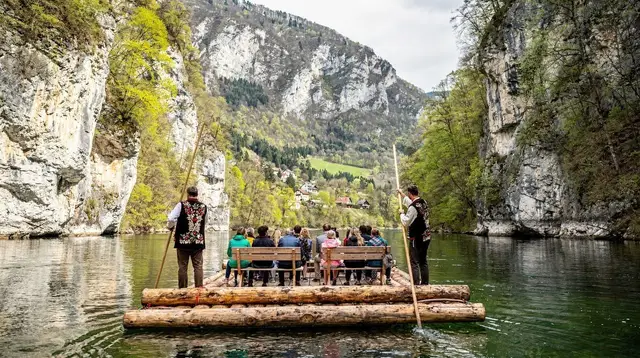
Within that window, the guild of raftsmen — a trade going back to 1832 — pilots traditional flat wooden rafts, each carrying around ten to twelve passengers and steered by two raftsmen with long poles, no engine, no rudder beyond their own skill reading the current. The full run from Sromowce Niżne or Kąty down to Szczawnica covers about 18 km and takes roughly two and a half hours, threading a limestone gorge whose walls rise as high as 300 m in places. For part of that distance the river itself is the border between Poland and Slovakia, which is part of what makes the gorge feel so enclosed: cliffs on both sides, a country on each bank, and no road running alongside to break the sense of being somewhere remote.
None of that changes across the seven-month season. What changes is everything around it.
July and August: The Season’s Crowded Core
If there is one fact worth committing to memory before booking a Dunajec trip, it is this: July and August are the peak, and not by a small margin. This is when Polish, Slovak and German school holidays overlap, when Zakopane and Kraków are both running near capacity, and when day-trip coaches from Kraków — a common way to combine Wieliczka or the thermal baths with an afternoon on the river — arrive at Sromowce in a steady stream through the late morning and early afternoon.
The practical effect at the pier is a queue: rafts loading and pushing off in sequence, a wait that can stretch depending on how many buses have arrived ahead of you, and a gorge that, once you’re on it, has other rafts visible ahead and behind rather than empty water. None of this makes the trip bad — the scenery does not care how many rafts share it, and two and a half hours through a 300 m-walled gorge is still two and a half hours through a 300 m-walled gorge. But it is a different experience from the same run in late September, and travellers who specifically want solitude on the water should know that July and August are the two months least likely to deliver it.
the classic wooden-raft descent from Szczawnica runs throughout the season, including these peak weeks — booking ahead does not change how many other rafts are on the river that day, but it does secure your place rather than leaving it to whoever reaches the pier first.
September to Mid-October: The Quiet Window
The same pattern that governs hiking, thermal-bath visits and Krupówki foot traffic across the wider Zakopane and Podhale region also governs the Dunajec: September through mid-October is generally the best-balanced stretch of the year, and the gorge is no exception. Polish schools are back in session, the summer coach traffic from Kraków thins out, and the raft season is still fully open — the pier does not start winding down until the very end of October.
Two things make this window specifically attractive on the river, beyond the general drop in crowds. First, early autumn tends to bring the most settled weather of the year to the Pieniny, the same stable high-pressure pattern that improves visibility on hikes like Trzy Korony above Szczawnica. Second, the larches that grow along the gorge’s limestone walls begin turning gold through late September and into October, adding colour to cliffs that in summer are simply green and grey. A quieter river and a more photogenic one tend to arrive in the same few weeks.
The honest trade-off: days are shorter by October, mornings are colder, and the season is visibly closing rather than opening — huts and stalls in the villages start reducing hours, and by very late October some operators are already scaling back ahead of the 31 October cutoff. Early September avoids both the July–August crowds and the end-of-season taper, which is why it comes up repeatedly as the strongest single recommendation for this river.
Rafting Season at a Glance
| Period | Crowd level on the river | What’s driving it |
|---|---|---|
| 1 April – May | Building, generally lighter | Season just opened; cooler water, fewer travellers in the region yet |
| June | Rising toward peak | Schools still in session for most of the month, weather warming |
| July – August | Peak, longest pier queues | Overlapping school holidays across Poland, Slovakia and Germany; Kraków day-trip coaches at their busiest |
| Early September – mid-October | Quietest relative to demand, most stable weather | Schools back, coach traffic down, larches turning; still fully within season |
| Late October | Thinning fast, season closing | Approaching the 31 October cutoff; shorter days, reduced hours regionally |
This table describes relative crowd pressure across the season, not fixed visitor counts, ticket prices or river-flow data for any given day — none of that is published in a way this guide can responsibly promise, and conditions on the day always depend on the operator and the weather at the time.
Afternoon Storms Are a Summer Risk, Not Folklore
Anyone planning a Dunajec trip for July or August should know that the same afternoon thunderstorm pattern that closes high trails around Giewont and the Kasprowy Wierch ridge in summer can also reach the Pieniny and the gorge itself. Storms in this part of southern Poland build through the morning and tend to break in the early-to-mid afternoon, which is exactly when a late-morning departure from Sromowce would otherwise be mid-river. Rafting operators pause or delay departures when lightning risk is close, the same way cable cars and mountain guides do elsewhere in the region.
This is not a reason to avoid summer rafting outright — plenty of July and August trips run without incident — but it is a reason to treat an afternoon slot in peak season as slightly less certain than a morning one, and to build a little flexibility into the day rather than scheduling a rafting trip back-to-back with a tight onward connection. The same logic that pushes hikers to be off exposed ridges by early afternoon in summer applies, in a gentler form, to a gorge with 300 m walls funnelling weather along the river.
The Route Itself: Sromowce to Szczawnica
Wherever the season sits, the geography of the trip does not change. Rafts put in at Sromowce Niżne, or the closely linked Kąty pier just nearby, and float downstream through the limestone gorge to Szczawnica, the spa town that sits at the gorge’s southern end and doubles as the gateway to the wider Pieniny. The 18 km run takes roughly two and a half hours under normal conditions, with the raftsmen using poles rather than paddles or an engine — a technique passed down through the guild since 1832, and one of the reasons the wooden rafts move at the unhurried pace they do rather than racing the current.
Szczawnica itself is worth building time around rather than treating as a mere disembarkation point. From the town, the walk into the Homole gorge at Jaworki is one of the easier hikes in the Pieniny, and the fortresses of Niedzica and Czorsztyn, facing each other across the reservoir lake, sit a short drive away.
Travellers who want the river trip framed as part of a fuller Pieniny day rather than a stand-alone activity typically build the raft descent into a loop that also touches the castles or the gorge hike — a combined day covering the Pieniny mountains, Niedzica castle and local highland food is one way that combination is packaged.
Travellers based in Zakopane rather than staying locally in Szczawnica also have the option of a return itinerary that folds in the drive itself — a rafting day organised directly from Zakopane handles the transfer to and from the gorge as part of the booking, which removes the need to arrange transport to Sromowce independently.
Booking Around the Crowd, Not Just the Calendar
Choosing September over August shifts the odds, but it does not eliminate the queue on any given day — a fine Saturday in early September can still draw more rafts than an overcast Tuesday in July. Two adjustments help regardless of which month you travel in. Arriving at the pier earlier in the day, ahead of coach groups making the drive out from Kraków, tends to mean a shorter wait even in peak season. And booking the crossing in advance, rather than turning up and joining whatever queue exists, at least guarantees a place on the water that day — it does not, and this guide will not claim otherwise, guarantee an empty gorge or a specific wait time, since neither is published or fixed in a way that can be promised ahead of the day.
For travellers who want the gorge experience without the traditional raft’s fixed pace and larger group size, kayaking the same stretch is the main alternative within the season’s operating window — a self-paddled kayak descent of the Dunajec with transfer included covers similar ground on the water under your own steam rather than a raftsman’s poles, which for some travellers is itself a way to feel less boxed in by however busy the pier happens to be that morning.
What September Buys Beyond a Quieter River
The case for early autumn on the Dunajec is really a case for early autumn across the whole Podhale and Pieniny region, and the river is simply one part of it. The same weeks that thin the queue at Sromowce also thin the crowds on Krupówki in Zakopane, shorten the wait for the Kasprowy Wierch cable car, and bring the same stable high-pressure weather that makes hiking conditions more predictable across the Tatras.
A Dunajec trip booked for the second week of September, rather than the last week of July, is rarely an isolated decision — it usually reflects a wider choice to see this part of Poland outside its single busiest stretch of the year, and the river rewards that choice as reliably as everything else around it does.
None of this replaces checking the specific week’s weather and operator schedule closer to the date — a season calendar shows the pattern, not the forecast for one particular Tuesday. But for travellers choosing between a July departure and a mid-September one with no other constraint pulling them toward summer, the gorge itself does not change; only the company you share it with does.
Dunajec Rafting Season and Crowds: FAQ
When does the Dunajec rafting season open and close?
The traditional wooden-raft season runs from 1 April to 31 October each year. Outside that window the piers close and no rafts run, whatever the weather happens to be doing.
What is the busiest month for Dunajec rafting?
July and August are the peak. School holidays across Poland and neighbouring countries push demand at the Sromowce and Kąty piers to its highest, and queues at the embarkation point are longest in these two months.
Is September a good time to raft the Dunajec?
September through mid-October generally brings the most stable weather of the year to the Pieniny, with fewer rafts on the water and the gorge walls turning gold as the larches change colour. The trade-off is shorter daylight and a season that is closing rather than opening.
Can afternoon storms disrupt a rafting trip in summer?
Yes. The same afternoon thunderstorm pattern that affects hiking across the wider Tatra and Pieniny region in July and August can also reach the Dunajec gorge, and rafting operators pause departures when lightning is close. It is a summer risk, not a myth specific to the mountains.
Where does the Dunajec raft trip start and finish?
Rafts put in at Sromowce Niżne or the nearby Kąty pier and float about 18 km through the limestone gorge to Szczawnica, a trip of roughly two and a half hours depending on the current and how often rafts pause.
Does the Dunajec gorge stay quiet outside July and August?
Traffic on the river drops outside the two peak months, but the season’s edges — April and late October — bring their own conditions, including cooler water and a shorter operating day, so quiet is not automatically comfortable.
Is there a way to avoid crowds without changing the season?
Arriving at the pier early in the day, before coach groups from Kraków reach Sromowce, thins the queue even in July and August, though it does not replace the calmer months for genuinely light traffic on the water.
Hikes and mountain days
Verified deep-linked GetYourGuide tours. Book through these links and we earn a small commission at no cost to you.
GetYourGuide does not provide a product photo for this activity — the image shows the meeting point, photographed by us.