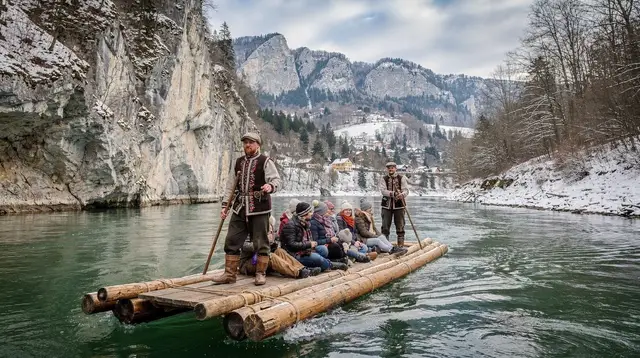
A flat wooden platform, two men with poles, and a limestone canyon
Ask what “rafting the Dunajec” actually means and the honest answer disappoints anyone picturing whitewater. The traditional Dunajec raft (flisacka tratwa) is a flat wooden platform, five narrower boats lashed side by side, poled and steered by two raftsmen standing at the front and back. There is no paddling to do and no rapids to brace for. You sit on a wooden bench in a row facing the raftsmen, a life vest buckled over your jacket, and the current does the work while the men read the water and push off the rocks with long wooden poles.
The trade is old. The boatmen’s guild that still runs the rafts today traces back to 1832, when Podhale and Pieniny villagers began ferrying goods and, soon after, curious visitors through the gorge. The costume some raftsmen still wear on the busiest days — embroidered waistcoat, felt hat — belongs to that same Górale tradition covered on the region’s highlander culture guide. This is not a theme-park recreation: it is one of the oldest continuously operating tourist activities in Poland, and the full mechanics of booking it are laid out in the complete Dunajec rafting guide.
The route: Sromowce Niżne or Kąty to Szczawnica
Rafts launch from one of two points on the Polish bank, Sromowce Niżne or Kąty, both a short drive from Niedzica and Czorsztyn lake, and glide roughly 18 km downstream to a landing stage on the edge of Szczawnica. The float takes about 2 hours 30 minutes, depending on water level — a fuller river in spring moves faster, a low late-summer river slower.
Along the way the rock walls close in and rise to as much as 300 m, sheer limestone on both sides, and for about 17 km of the run the river itself is the border between Poland and Slovakia: the Slovak bank is a few dozen metres away the whole time, no checkpoint, no formality, just a second country visible from your bench.
The raftsmen narrate as they go — rock formations with names like the Three Crowns massif or the Cauldron, the odd eagle overhead — but they are working the poles more than performing a script, and on a crowded July afternoon the running commentary competes with the queue of rafts ahead. A quieter version of the descent, with more room to actually look at the gorge, is described on the best season and crowd-avoidance guide.
How boarding and pricing actually work
Rafts do not run to a fixed timetable the way a bus does. Passengers buy a ticket at the launch point (or through a pre-booked tour), wait for enough people to fill a raft or a convoy of rafts, and set off in groups once the queue clears — on a busy August morning that can mean a real wait before boarding, not just a five-minute formality. Prices sit roughly in the 80–100 PLN range per adult for the raft alone on a walk-up basis, more once a return transfer and a guide are bundled in, and this guide’s site keeps the current walk-up and bundled figures on the Dunajec day-trip planning guide.
For a booked slot, a fixed pickup time, and someone else handling the return leg, the traditional wooden-raft descent through the gorge, guided and with transport included removes the queueing gamble entirely. A Szczawnica-based version that starts closer to the landing stage and suits travellers already staying in the Pieniny rather than Zakopane is the rafting adventure departing from Szczawnica itself.
What to wear, and what a wet raft actually feels like
A life vest is compulsory and handed out at the launch point; nobody boards without one, children included. Despite the “dry-ish” reputation compared with pontoons and kayaks, spray still finds the front rows, especially on a fuller spring river when the raftsmen push harder off the rocks, and rafts occasionally pass close to other convoys. Dress for a damp lower half more readily than a soaking one — light layers rather than full waterproofs cover most days.
The wooden benches have no backrest, and there is no shade structure over the raft: 2.5 hours in open sun on a July afternoon is longer than it sounds, so sunscreen, a hat, and water matter as much as a waterproof layer. Bags travel on board at your feet rather than in a hold, so a phone or camera is safer zipped into a pocket than held loose over the water for photos — a dropped phone does not come back. None of this is spelled out on a typical walk-up ticket stand, which sells the float as a scenic ride and lets first-timers discover the practicalities once they are already seated.
The season: 1 April to 31 October, and why the rest of the year is closed
The rafts operate from 1 April to 31 October. Outside that window the river is closed to rafting — not quieter, not by-arrangement-only, closed. Spring meltwater and winter ice make the gorge unsafe for a flat wooden platform poled by hand, and the operators simply do not run boats in November through March. A page or a listing that offers “Dunajec rafting” for a January visit is describing something that cannot happen; treat it the way this site treats any winter promise it cannot keep, in the same spirit as the weather-by-month guide.
Inside the season, July and August are the crowded peak: coach groups from Kraków, school-holiday families, and the queues at Sromowce Niżne and Kąty lengthen accordingly. Late May and June, and September, keep milder crowds with generally reliable water levels. April and October both run, but with cooler air, a raft ride in a gorge that stays shaded much of the day, and weather that can turn faster than in midsummer — pack for it the way the seasonal Zakopane guides recommend for the shoulder months generally.
Pontoons and kayaks run the same stretch, differently
The wooden raft is not the only way onto this water. Pontoon rafting and kayaking operate alongside the traditional rafts on the same section of river, paddled by the participants rather than poled by raftsmen, faster-moving, and considerably wetter — a different activity aimed at people who want to do something rather than sit and watch the cliffs go by.
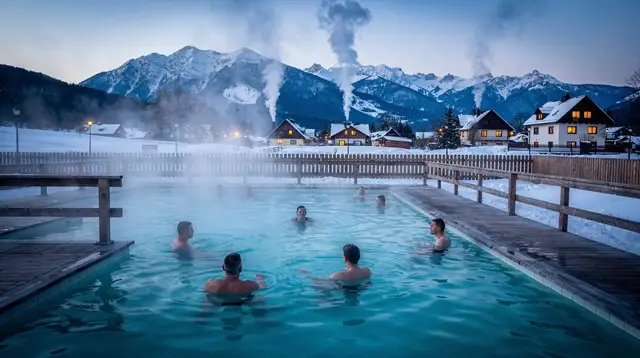
For a version that pairs the river with a nearby castle and a soak afterwards, the kayak descent combined with a castle visit and a thermal-baths stop covers ground the traditional raft does not. Families weighing which of the region’s warm pools suit a day that already includes cold river spray can check the thermal baths comparison guide before picking one.
A land-based add-on some operators now bundle with the river is an alpine coaster near the gorge — a gravity-fed toboggan track, nothing to do with the raft mechanically but often sold as a combined ticket, covered by the alpine coaster paired with the Dunajec rafting descent.
Who should think twice before booking
Boarding means stepping down a riverbank onto a floating wooden platform that shifts underfoot — there is no ramp, no fixed jetty, and no realistic way to get a wheelchair or a walker aboard. Anyone with limited mobility should treat this as one of the region’s least accessible activities, closer in that respect to the chained final stretch of Giewont than to the paved valley walks.
The commentary the raftsmen give as they point out rock formations is delivered in Polish; a guided or bundled tour usually adds a translated summary, but a walk-up ticket at Sromowce Niżne or Kąty comes with no English narration at all, so non-Polish speakers get the scenery and the poling but miss the folklore. For toddlers, or anyone who tires of sitting still within twenty minutes, 2.5 hours on a bench with no stop is a longer commitment than the postcard photos suggest — a short valley walk or a soak at the thermal baths rewards restlessness better than a raft does.
Getting to the start, and back from the end
This is where a Dunajec day trip quietly falls apart for travellers who assume it works like a loop. The raft launches at Sromowce Niżne or Kąty and lands at Szczawnica — two different places, roughly 18 km apart by river and not much less by road, with no shuttle built into a walk-up ticket. Arrive independently and you need to organise both a way to the launch point and a way back from Szczawnica to wherever you are staying, whether that is Zakopane or Kraków.
Most visitors solve this with a booked transfer or an organised tour that collects them, drives them to the launch, and picks them up at the Szczawnica landing stage — the same logic covered for the rest of the region on the bus, train and car comparison guide.
Travelling from Kraków rather than Zakopane, the raft is commonly sold as one stop on a longer day that also takes in Niedzica castle, as detailed on the Kraków day-trip guide. Budget travellers piecing the logistics together themselves should read the Zakopane budget and złoty guide before assuming a DIY version is automatically cheaper once transfers are counted in.
Combining the raft with Niedzica, Czorsztyn and Trzy Korony
Because the launch points sit right next to the Pieniny’s other big draws, almost nobody does the raft alone. Niedzica castle, built in the 1320s on a bluff above Lake Czorsztyn, and the ruined Czorsztyn castle facing it across the reservoir, are a short drive from Sromowce Niżne — full detail on the Niedzica and Czorsztyn guide. On the Szczawnica end, the walk up Trzy Korony (982 m) to its viewing platform, or the gentler Homole gorge near Jaworki, rounds out an afternoon after the raft lands — both covered on the Trzy Korony and Homole gorge hike guide.
A ready-built two-day version of this pairing, timed around the raft’s operating hours and an overnight in the Pieniny, is laid out in the Pieniny and Dunajec two-day itinerary, and travellers building a longer loop through both the Polish and Slovak mountains can slot the gorge into the seven-day Tatras and Pieniny itinerary.
What this trip is not
It is not whitewater rafting, and nobody paddles. It is not available outside 1 April to 31 October, and no amount of asking nicely at a Szczawnica kiosk in December changes that. It is not a loop trip: the start and the end are different towns, and the return leg needs planning before you set off, not after you land. And it is not a full day by itself — the raft is 2.5 hours on the water; the rest of a satisfying day comes from a castle, a gorge walk, or a thermal soak added around it, not from the float alone.
Dunajec gorge rafting: frequently asked questions
How long is the Dunajec gorge raft trip, and how long does it actually take?
The traditional route from Sromowce Niżne or Kąty to Szczawnica covers about 18 km through the gorge and takes roughly 2.5 hours on the water. Add transfer time at both ends and the outing fills a half day rather than a couple of hours.
Is the Dunajec raft trip open all year?
No. The wooden rafts run from 1 April to 31 October only. From November to March the river is closed to rafting entirely, whatever a generic listing for Zakopane or the Pieniny might suggest.
Do I steer the raft myself?
No. Each raft is a flat wooden platform poled by two professional raftsmen, members of a boatmen’s guild that dates to 1832. Passengers sit in facing rows and do not paddle or steer.
How many people share one raft?
A standard wooden raft carries 10 to 12 passengers plus the two raftsmen. Larger groups are split across several rafts that usually set off together.
Is the Dunajec raft trip suitable for young children?
It suits children who can sit reasonably still for 2.5 hours and wear a life vest without a fight. There are no rapids or sudden drops on the traditional route, but there is also no toilet stop until the rafts reach Szczawnica.
What is the difference between the wooden raft, the pontoon rafting, and the kayak options?
The traditional wooden raft is poled by raftsmen and passengers stay seated and dry-ish. Pontoon rafting and kayaking run on the same stretch of river but are paddled by the participants, move faster, and get everyone wetter; they suit visitors who want activity rather than a scenic float.
Does the river really mark the border with Slovakia?
Yes, for about 17 km of its course through the gorge the Dunajec is the border between Poland and Slovakia. Passengers stay on the Polish raft and the Polish bank the whole time; no passport check happens on the water.
How do I get from Zakopane to the raft starting point and back from Szczawnica?
There is no direct public transit link built for this loop. Most visitors book an organised transfer that collects them in Zakopane, drops them at Sromowce Niżne or Kąty, and picks them up in Szczawnica after the float; travelling independently means arranging a return bus or taxi from Szczawnica back to the start, or on to Zakopane.
What should I wear or bring on the raft?
A compulsory life vest is handed out at the launch point; wear it over a light layer that can get damp from occasional spray rather than full waterproofs. There is no shade for the full 2.5 hours, so sunscreen, a hat and water matter in summer. Keep phones and cameras zipped into a pocket rather than held over the water, and expect no backrest on the wooden benches.
What happens if it rains, or the raft trip is cancelled?
Light rain does not stop the rafts; the raftsmen keep poling and passengers get wetter than usual. The operators suspend departures only in genuinely dangerous conditions — flooding, storms, or a river running too high and fast after heavy rain — and on those days tickets are refunded or rebooked rather than run at reduced safety. Check conditions at the launch point on the morning of a marginal-weather booking rather than assuming a fixed schedule holds.